
Back to Blogs
AI Discoverability: How AI Systems Find and Surface Information
19 min readAug 2, 2026
AEO Foundations

Rosh JayawardenaData & AI Executive
AI discoverability is the layered process by which systems acquire information, interpret entities, retrieve relevant material, select sources, and present claims in generated answers; technical accessibility supports eligibility but never guarantees citation, recommendation, traffic, or influence.
AI discoverability is broader than appearing in a ranked result
AI discoverability sounds like it ought to be a score. It is really a chain of events.
In current industry usage, AI discoverability is the extent to which an AI system can find or acquire information, understand what it says and what entities it describes, retrieve it for a relevant query, and potentially reuse or reference it in an answer. This is a useful definition, but not a formal technical standard; most published definitions concern web content, businesses, brands, and products rather than every possible AI setting.
The object being discovered may be a page. But it may instead be a fact on that page, a passage spread across several pages, a product, an organization, a person, a place, or a relationship among these things. And discovery is not the same as endorsement. A system may know that a product exists without recommending it; it may retrieve a page without citing it; it may use a fact without sending the user to its source.
This is the first distinction to keep in mind: availability, retrieval, interpretation, selection, synthesis, and presentation are separate stages.
Conventional search visibility mainly asks whether a page can be indexed and where it appears in a ranked set of results. AI content discoverability asks some further questions. Can the system extract the relevant part? Does it connect that part to the right entity? Is the material suitable for grounding an answer? Will the system summarize it, cite it, mention it, or recommend what it describes? As Microsoft’s account of AI search selection explains, these systems may parse pages into smaller pieces and assemble an answer from pieces drawn from multiple sources.
That does not make SEO irrelevant. Search indexing and ranking can still supply the retrieval layer used by AI features, and the same technical faults that keep a page out of ordinary search can also narrow its chances elsewhere. AI discoverability is better understood as an extension of the visibility problem, not a clean replacement for it.
The labels around this work are unsettled. Answer engine optimization, or AEO, is often framed as making content suitable for direct answers. Generative engine optimization, or GEO, is often framed as improving its use in generative systems. Some practitioners treat these as distinct areas; others use AEO, GEO, AI SEO, and AI discoverability as names for the same work. The available evidence does not settle the dispute, so the terms should not be treated as standardized or automatically interchangeable.
The more useful question is not “What is my AI rank?” It is: At which stage can the information enter the system, and at which stage does it drop out?
The path from available information to an AI-generated answer
There is no universal AI-discovery pipeline. Still, a simplified path helps because it shows why a technically available page can remain invisible in the final answer.
First comes acquisition. A system may crawl the public web, ingest documents supplied to it, query an existing search index, use licensed or previously collected data, or draw on some combination of these. Some answers may rely on information learned during model training rather than a current retrieval step, so live crawling is not always involved.
Next comes processing and representation. An indexed retrieval system may tokenize text, split documents into chunks, add metadata, and create numerical representations called vectors, which encode semantic similarity. Microsoft’s Azure AI Search documentation describes text being stored in inverted indexes and vectors in vector indexes; it also describes enrichment steps that can chunk text and create more structure before querying. These are Azure-specific mechanics, not a blueprint for every AI assistant.
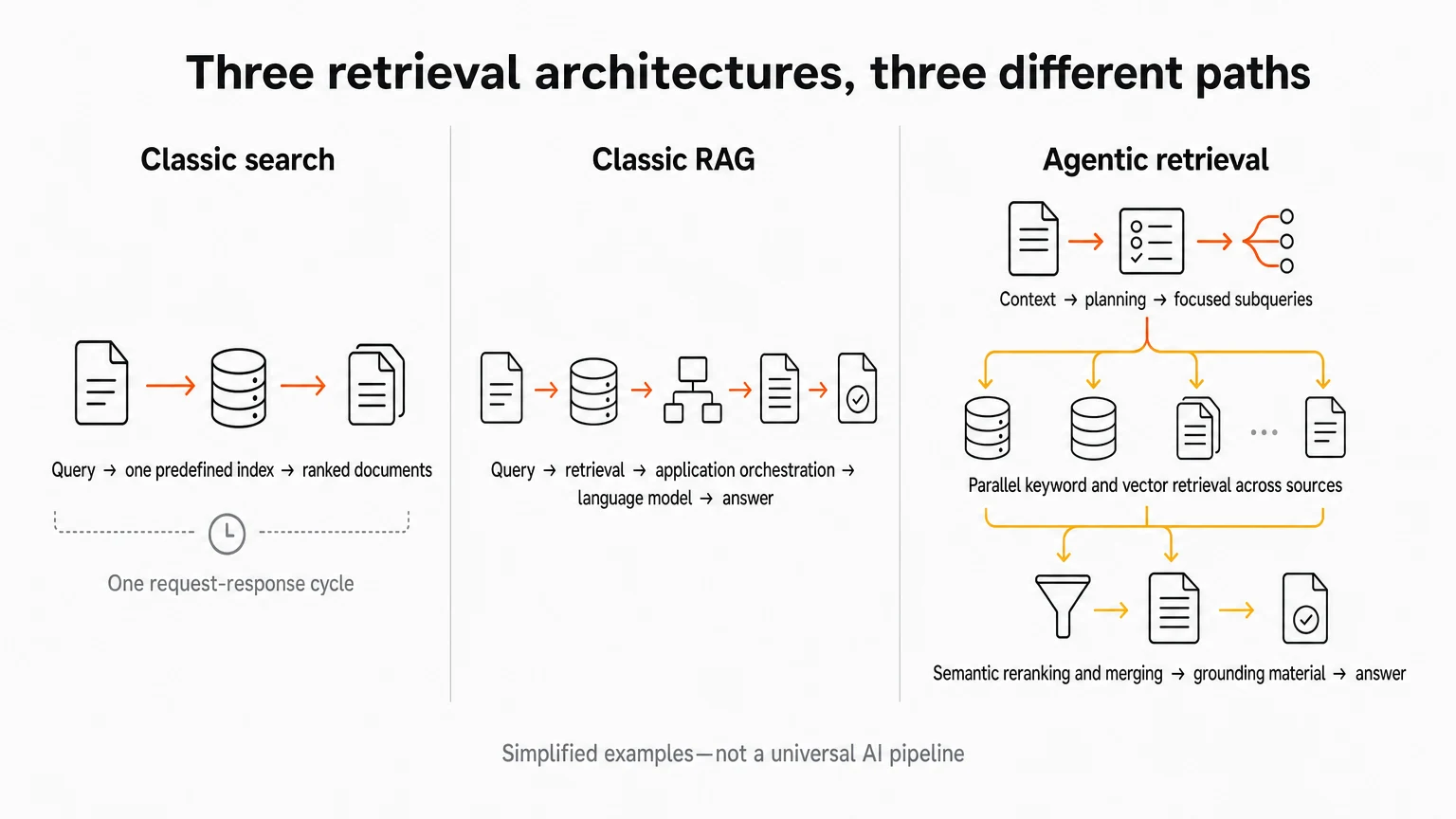
Then the system has to understand the query. A classic search request may target one predefined index and return ranked documents in one request-response cycle. A classic retrieval-augmented generation system—usually shortened to RAG—adds another layer: an application retrieves material and hands it to a language model, which formulates an answer from the result set.
An agentic retrieval system can do more planning. In Microsoft’s documented agentic workflow, a language model can use conversation history, break a complex question into focused subqueries, run searches across several knowledge sources in parallel, combine keyword and vector retrieval, and semantically rerank what comes back. Google likewise says its AI Mode can use query fan-out, breaking a question into subtopics and issuing many searches at once. These examples establish that such architectures exist; they do not show that every AI system plans or retrieves in the same way.
After retrieval comes selection. The system may have dozens of plausible passages but room for only a few in its grounding material. Relevance to the particular wording and intent of the query matters here, as may freshness, source quality, duplication, context, and system-specific rules. The selected chunks can then be merged into grounding data and passed to a model for synthesis. Some pipelines preserve source information and return citations or execution metadata. Others may mention an entity without linking to it, or answer without exposing any source at all.
So indexing is not the finish line.
A page can fail at each later stage. Its text may be hard to parse. Its subject may be ambiguous. A passage may be too broad or generic to match the query. The information may be stale, contradictory, or poorly supported. Better material may outrank it in retrieval. The system may retrieve it but choose another source for grounding. It may use the information but omit a citation from the interface.
Even “searchable” and “usable in an answer” can be different technical properties. In Azure AI Search, for example, a field can be searchable without being returned as grounding data; vector fields support similarity matching but are not themselves readable answer text. That is a product-specific detail, but it reveals a general point: something can help a system find a record without being the material the system ultimately presents.
This reframes how AI discoverability works. It is not one contest for one slot. It is a succession of filters, and passing one gives no guarantee about the next.
Technical accessibility creates eligibility, not visibility
Google Search offers a well-documented example of the early part of this chain. According to Google’s explanation of how Search works, the process includes URL discovery, crawling, rendering, indexing, canonicalization, and serving.
Google may discover a URL through a link from a known page or through a submitted sitemap. It may then crawl the page and render its JavaScript to see content that does not appear in the initial HTML. Pages blocked from crawling or hidden behind login can be inaccessible to this path. During indexing, Google analyzes text, key tags and attributes, images, and videos; when it finds duplicate or similar pages, it may cluster them and choose a canonical version.
But Google explicitly says it does not guarantee crawling, indexing, or serving, even when a page follows its guidelines. This is Google Search documentation, not a rulebook for every AI system. Its value is that it shows the difference between a prerequisite and an outcome: Google has to access and process a page before it can store that page in its ordinary web index, but successful access does not ensure indexing, and indexing does not ensure that the page will be served for a query.
Crawl controls also solve narrower problems than their names sometimes suggest. A robots.txt file can restrict crawler access, while page-level directives such as noindex can request exclusion from an index. A newer convention, llms.txt, is described in Prerender’s crawling guide as a way to help agents navigate documentation—not as a control for indexing. Evidence that AI systems consistently honor it is not established here.
Machine-readable organization may also help systems interpret what they acquire. Semantic HTML identifies the roles of parts of a page; a logical heading hierarchy exposes its structure; accessible text alternatives make some non-text content interpretable. Clean site architecture and internal links help both crawlers and users reach related material.
Structured data is a more explicit layer. Google’s structured-data documentation describes it as a standardized way to classify page content and provide clues about meaning. Google may use valid markup to understand content and produce enhanced search results, subject to required properties and quality rules. But structured data does not guarantee an enhanced result, ordinary indexing, AI retrieval, or citation. Nor does Google’s implementation establish what an unrelated AI provider does with the same markup.
Other providers describe different acquisition systems. You.com’s high-level account of AI search discusses ingesting material from web pages, databases, and enterprise documents, splitting it into semantic chunks, generating embeddings, storing it for similarity search, retrieving relevant documents, and then generating grounded answers with source attribution. This is a vendor-authored description of one architecture, not a universal model.
Practitioners often go further, claiming that particular readability scores, URL forms, third-party mentions, schema types, or formatting choices improve AI visibility. Some may be plausible. But the evidence supplied for these claims is guidance and observation rather than controlled proof of universal ranking factors.
Technical work therefore answers a limited but vital question: Can the relevant system get and parse the information at all? It does not answer the later question: Will that system choose to show it?
What makes information usable once a system finds it
Finding text is easy compared with using it well.
The practitioner evidence repeatedly associates usable AI content with clarity, directness, descriptive headings, self-contained passages, and answers that do not depend on a large amount of missing context. A passage that defines a term, states its scope, gives the relevant facts, and supports them is easier to extract than a vague paragraph that circles its point.
This is not proof of a universal ranking rule. It is a plausible consequence of passage-level retrieval and synthesis. If a system retrieves chunks rather than whole pages, each chunk has to carry enough meaning to survive separation from its neighbors. A clear answer near the start of a section may be easier to identify; that does not mean every page should be reduced to clipped prose or a pile of FAQs.
Depth matters differently. A short passage may answer one question cleanly, while a connected body of material supplies the definitions, exceptions, evidence, and related topics needed for harder questions. Practitioner sources associate topical coverage, expertise, original insight, and coherent internal linking with usefulness and trust. They do not establish that length or “topical authority” independently causes citations across platforms.
Reliability is another layer. Claims are more usable when their sources, definitions, dates, and limits are visible. Generic assertions leave a system little to check. Contradictory pages leave it with a resolution problem. Dataiku’s account of data quality in generative AI identifies accuracy, completeness, consistency, timeliness, and fitness for purpose as separate dimensions; inaccurate, incomplete, conflicting, or stale source material can flow into unreliable answers. This concerns answer quality more directly than discoverability, but the distinction matters little if the discovered information is wrong.
Freshness is also query-dependent. Current information is crucial for changing products, prices, offices, rules, and events. It may matter much less for a stable definition. “Fresh” is not inherently better; fit for the task is better.
Provenance and corroboration can help a system judge or contextualize claims, particularly claims about organizations and products. Independent, authoritative references may support what an owned page says. Yet third-party presence is not a magic lever. The evidence does not establish that a press release, review, forum post, or publication mention causes selection across AI systems.
AI content discoverability is not confined to page copy. Captions, transcripts, alt text, on-screen text, reviews, and discussions can all supply interpretable information in some products. Their use is platform-specific, however. You cannot assume that every system indexes the same formats or gives them the same weight.
There is also a deeper split between discovering content and discovering an entity. A page is one document. An organization, product, person, place, or service may be represented by many pages, records, reviews, profiles, names, and relationships. That is why fixing one article may improve passage retrieval while leaving the system’s understanding of the underlying entity confused.
The entity layer: being recognized is not being recommended
Suppose a system encounters a name. It still has to work out what the name refers to.
Named entity recognition identifies mentions of things such as people, organizations, products, and places in unstructured text. Entity linking maps a mention to a canonical identifier—a stable reference for the underlying thing. Disambiguation resolves names with several possible meanings. Entity resolution merges records, aliases, spelling variants, and duplicates that refer to the same real-world entity.
These steps turn scattered mentions into something closer to a map. In a knowledge graph, entities can be represented as nodes and their relationships as edges. A product belongs to an organization; a person holds a role; a service operates in a location. The relationships provide context that a bare name does not.
As an overview of entity recognition in AI search explains, linking can normalize variant names and connect mentions to shared identifiers. Senzing’s discussion of entity-resolved knowledge graphs makes the complementary data-management point: unresolved duplicates and missing links can leave a graph full of disconnected or misleading facts.
Consistent canonical names, clearly stated aliases, stable descriptions, structured identifiers, and coherent relationships may therefore make an entity easier to attribute correctly. Corroborating references can help distinguish self-description from independently supported facts. These are mainly practitioner-led mechanisms, though, and they do not guarantee knowledge-graph inclusion, retrieval, citation, or ranking.
Most important, recognition is not recommendation.
Entity recognition answers “What thing is this?” Retrieval asks “Is material about this thing relevant to the query?” Selection asks “Should this material ground the answer?” Recommendation asks something harder still: “Given this user’s needs and the available alternatives, should this thing be suggested?” Those decisions may depend on query context, source quality, freshness, fit, safety rules, and system-specific ranking logic.
A system can identify an organization perfectly and never mention it. It can mention a product but link to a third-party review. It can cite the organization as a source while recommending a competitor. Entity clarity creates the possibility of correct attribution; it does not create an entitlement to visibility.
Responsible practices should improve information quality before they chase platform signals
The safest AI discoverability best practices are mostly practices you would want even if AI-generated search disappeared tomorrow.
Make important pages accessible to the systems you intend to reach. Use clean, semantic HTML and a site structure that exposes related material. State the answer to a question plainly, then add evidence, limits, and detail. Define concepts consistently. Cite supporting sources. Keep changing facts current. Make first-hand or expert knowledge clear rather than burying it under generic copy.
Use structured data where it accurately describes visible content and where a provider documents a use for it. Keep entity names, aliases, product details, locations, and relationships consistent. Connect related pages through sensible internal links so the information forms a coherent whole rather than a set of isolated claims.
These practices have either documented enabling mechanisms or plausible information-quality benefits. They still do not guarantee selection.
Platform-specific tactics deserve more caution. Third-party articles, reviews, public discussions, press releases, Reddit threads, directories, and Wikipedia may become contextual inputs for some systems. Their presence can support corroboration, but the available evidence does not show that any one channel reliably produces AI visibility. Wikipedia has its own notability and editorial rules; Reddit varies by community and query; press-release claims remain claims even when widely copied.
Manipulative tactics are less defensible still. Hidden prompt injections, cloaking, and self-promotional listicles may damage information quality or conventional search performance, and the available industry analysis does not establish durable gains from them. A tactic that works only by confusing a system is the opposite of discoverability in the useful sense: it makes the information environment harder to trust.
One modest hypothesis is worth testing. An observational analysis of 100 AI citations found that 79% of cited snippets appeared in the top half of the page. That does not prove that moving an answer upward causes citations; page quality, topic, authority, and query selection could explain the association. But it suggests a clean experiment: move a direct answer into the opening section of suitable informational pages, leave other conditions as stable as possible, and compare citation frequency before and after. Treat the result as evidence for those pages and test conditions, not as a law.
The durable strategy is almost disappointingly plain: make the information easy to acquire, hard to misunderstand, and worth using.
Generative search changes the observable outcomes of discoverability
Generative search inserts an answer between the query and the source.
Google says AI Overviews and AI Mode may use query fan-out to issue related searches across subtopics and sources, then present a synthesized response with supporting links. Google also says the two features may use different models and techniques and therefore show different answers and links. These are Google-specific behaviors, and AI Overviews are not representative of all discoverability in generative AI.
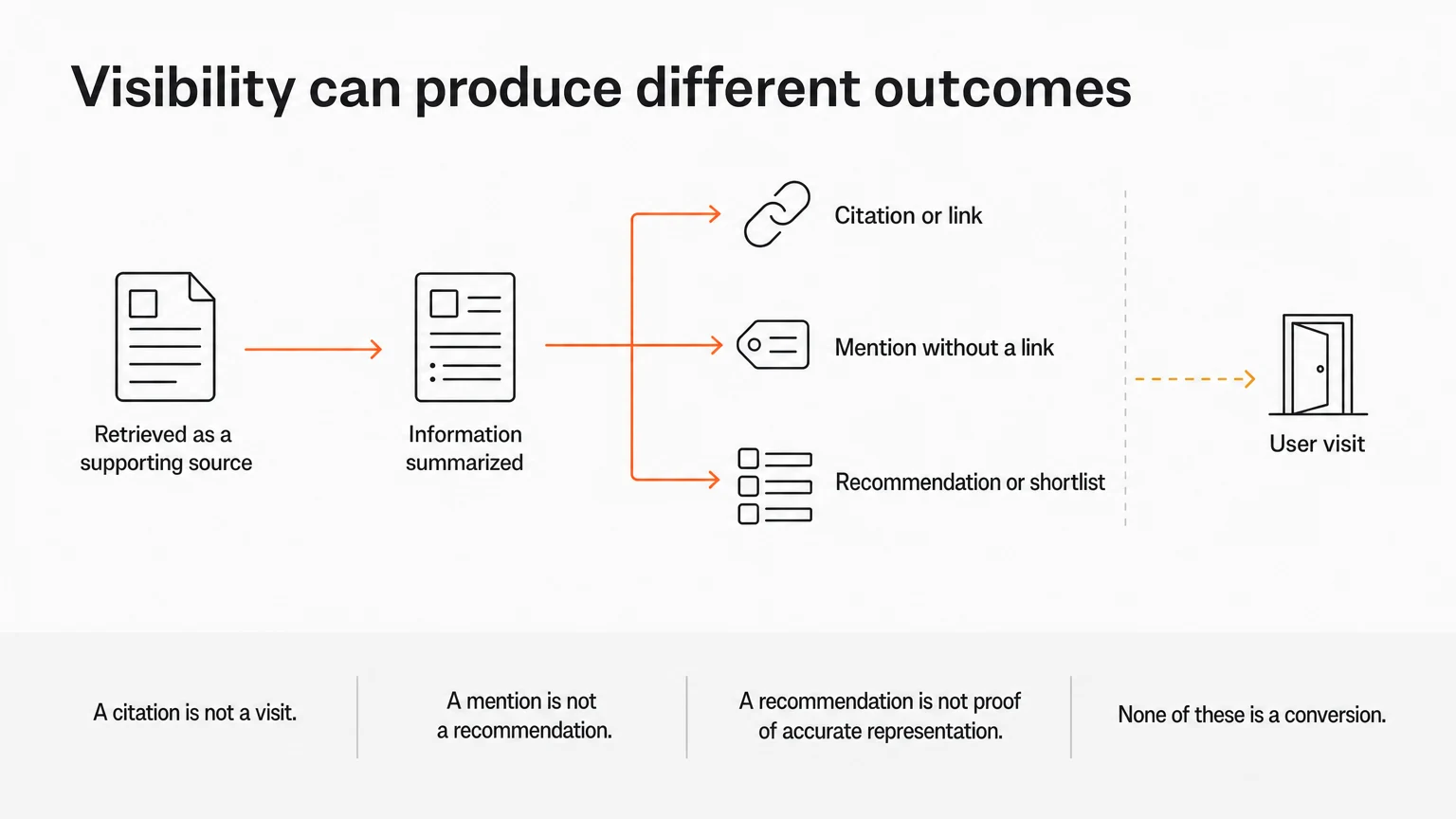
This interface produces several outcomes that ordinary rank tracking does not capture. A page may be retrieved as a supporting source. Its information may be summarized. It may receive an explicit citation or link. A brand may be mentioned without a link. A product may be recommended or shortlisted. Only after all this may a user visit the source.
These states are not interchangeable.
A citation is not a visit. A mention is not a recommendation. A recommendation is not proof of accurate representation. And none of them is a conversion.
The distinction becomes especially important when considering U.S. search behavior. In a Pew Research Center study based on tracked browsing from 900 U.S. adults in March 2025, users clicked a traditional result on 8% of visits with an AI summary, compared with 15% of visits without one. Links inside the summary received clicks on 1% of visits with a summary. These figures describe that sample and period, not all users or platforms.
An Ahrefs observational analysis of 300,000 keywords estimated that the top-ranking page had a 34.5% lower average click-through rate for informational keywords with an AI Overview than for similar keywords without one. This is a correlation, not a controlled demonstration that the overview caused every difference.
Google, meanwhile, says clicks from result pages containing AI summaries are of higher quality, meaning users tend to spend longer on the visited site. The supplied documentation does not give the underlying effect size or method. So the evidence supports lower observed click frequency in the cited U.S. studies, while leaving the value of the remaining visits unresolved.
Click volume and visit quality are different measurements.
Nor do the current studies establish a stable, long-term traffic effect. Interfaces change; source-selection systems change; the mix of queries that triggers summaries changes. Being visible inside an answer may create recognition or credibility without a click, but those later effects are hard to observe and should not be assumed.
Variation and measurement: discoverability is defined by the test conditions
Ask the same question in two systems and you may get different sources. Ask it twice in one system and you may still get different answers.
Results vary because architectures vary. Some systems use one index; others combine several sources. Some expand a query into subqueries. Some use conversation history or personal context. The wording and intent of the prompt can change retrieval. So can geography, device, freshness, account state, model updates, and time. Evidence for language-specific effects is thinner in the supplied research, so language should be recorded as a test condition rather than treated as a quantified universal factor.
The size of this variation is not merely theoretical. A Tow Center study published by Columbia Journalism Review ran 1,600 queries across eight generative search tools and evaluated whether each returned the correct article, publisher, and URL. The tools collectively answered more than 60% of the queries incorrectly, with large platform-level differences. The researchers also noted that each prompt was run only once and that identical prompts could produce different outputs later. This was a specific news-retrieval task, not a universal scorecard for AI systems, but it shows why platform and task cannot be stripped out of the result.
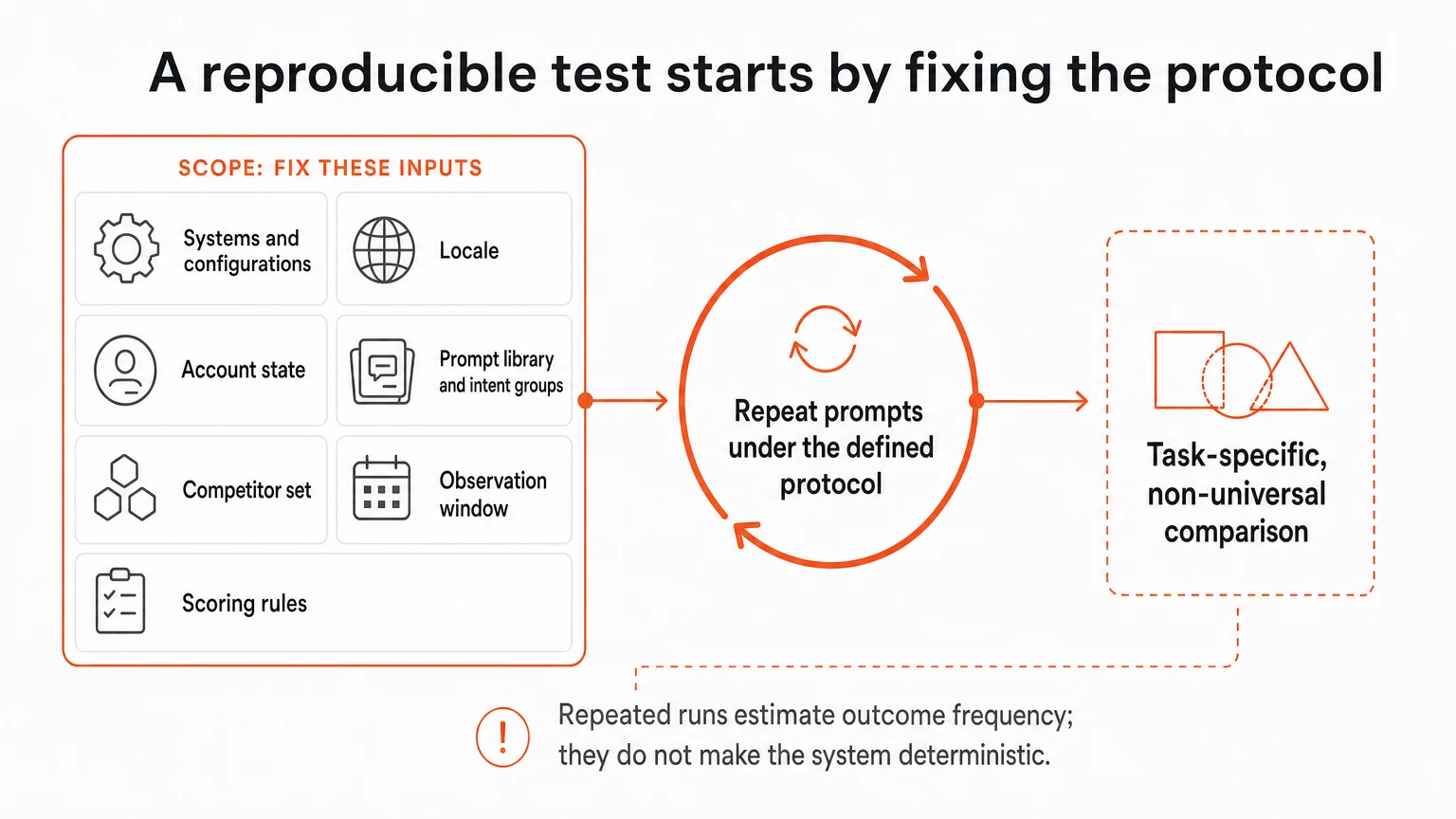
A defensible audit begins by fixing its scope. It should specify the AI systems and configurations, U.S. English or another defined locale, signed-in or signed-out state where relevant, prompt library, query-intent groups, competitor set, observation window, and scoring rules. Informational, commercial, transactional, and navigational prompts should be reported separately because they may trigger different interfaces and retrieval behavior.
Prompts should be repeated. Repeated runs do not make a probabilistic system deterministic; they estimate how often an outcome occurs under a chosen protocol. A fixed query set and explicit rubric can make a comparison reproducible enough for a task, while the result remains non-universal.
Measurement should also preserve the stages that the article has kept separate. A useful record can ask:
- Was the page or entity included or apparently retrieved?
- Was the entity mentioned?
- Was an owned page cited or linked?
- Was the entity recommended or shortlisted?
- Where did it appear in the answer?
- Was the description accurate and current?
- Was the framing positive, neutral, or negative under a defined rubric?
- What kinds of sources supported the answer?
- Was a referral visit or other observable action recorded?
These observations should not be blended blindly. “Share of answer,” “share of voice,” “visibility,” citation rate, and recommendation quality often use different formulas and denominators. Before comparing vendor scores, you need to know how prompts were selected, how competitors were defined, which platforms and locales were covered, how often the data was refreshed, and what counted as a mention or citation.
The denominator is the hidden problem. A visibility percentage measures frequency across the prompts you chose, not exposure across all real user questions. Real prompts are more varied than a neat benchmark set, and personalized sessions may produce answers that a clean-session test cannot reproduce. The test is a model of discoverability, not discoverability itself.
Attribution is weaker still. Many AI interactions create no click or referrer. A person may see a recommendation, return later through branded search, switch devices, call, or visit a location. Analytics may record the last step while missing the AI interaction entirely. Citation frequency can therefore show observed presence; it cannot by itself establish traffic, causation, revenue, or influence.
The right output of an AI-discoverability audit is not a universal number. It is a panel of separate measurements, tied to named platforms, prompts, locales, dates, and scoring rules, with the uncertainty left visible.
That may sound less satisfying than a rank. But it is more useful. Once discoverability is seen as a chain, the final question changes: not “Are we discoverable?” but which information was available, which system found it, for which query, what did the system do with it, and what—if anything—happened next?
Continue Reading
AEO Foundations9 min read
How to Get Cited by ChatGPT for Your Business
Learn how to get cited by ChatGPT with practical fixes for crawlability, page structure, schema, and off-site authority.
Rosh Jayawardena
AEO Foundations9 min read
llms.txt Explained: Should Your Website Have One?
llms.txt explained for real businesses: what it does, where it may help, and why most sites should fix bigger issues first.
Rosh Jayawardena
AEO Foundations10 min read
The AEO glossary: AEO, GEO, LLMO, AI SEO — what they mean and which one to care about
Four acronyms describe the same shift in AI search. Here's what each one means, who uses it, and the one we recommend standardising on.
Rosh Jayawardena
Deep dives, delivered weekly
AI patterns, workflow tips, and lessons from the field. No spam, just signal.