
Back to Blogs
The AEO glossary: AEO, GEO, LLMO, AI SEO — what they mean and which one to care about
10 min readMay 1, 2026
AEO Foundations

Rosh JayawardenaData & AI Executive
Four acronyms describe the same shift in AI search. Here's what each one means, who uses it, and the one we recommend standardising on.
AEO, GEO, LLMO, AI SEO: what they mean and which one to actually care about
A marketing manager I spoke to last month had read three articles in a week. One told her GEO was the future of search. One told her AEO was the future of search. The third mentioned LLMO and didn't bother explaining what it meant. By the next vendor call she had no idea whether she was being sold one thing or four — and which one her existing agency was already failing at.
That conversation is most of the reason this post exists. The work behind these acronyms is mostly the same job. The acronyms themselves are a category-naming fight that nobody has really won, and you don't have to pick the winner. But it helps to know what each term means before your next agency meeting, because the acronym a vendor leads with usually tells you where they came from — and sometimes whether they've actually changed how they work.
This is the AEO vs GEO vs LLMO glossary I wish I could have sent that marketing manager. Clean definitions. A vendor map I haven't seen anyone else publish. An honest read on how much overlap there really is. And, at the end, the one term we've decided is worth standardising on.
Why there are four acronyms for one job
The category is roughly two years old. In that window, a few different groups planted flags before anyone agreed on a name.
Academics got there first. The term GEO ("Generative Engine Optimization") was coined in a 2023 paper out of Princeton and the Allen Institute for AI — Aggarwal et al., the same group that introduced the GEO-BENCH benchmark. That academic provenance is part of why Wikipedia ended up canonicalising "GEO" rather than any of the alternatives.
Enterprise vendors took a different route. They reached for AEO ("Answer Engine Optimization") because it slotted neatly into existing marketing vocabulary. Marketing teams already had a sense of what an "answer engine" was — voice search and featured snippets had been training people on the phrase for years.
Boutique brand consultancies — often PR-adjacent — settled on LLMO ("Large Language Model Optimization"), because they were less interested in retrieval surfaces and more interested in how the model represents the brand internally.
And legacy SEO agencies, who needed something to put on the new line of the rate card, started selling AI SEO as a softer rebrand of what they already did.
None of those groups is wrong. None of them has won, either. The job isn't to crown a winner — it's to recognise which lineage each vendor comes from when they pitch you.
The five terms, defined
Here's each term in one paragraph, with where it came from, what it actually emphasises, and one example of how it shows up in a real conversation.
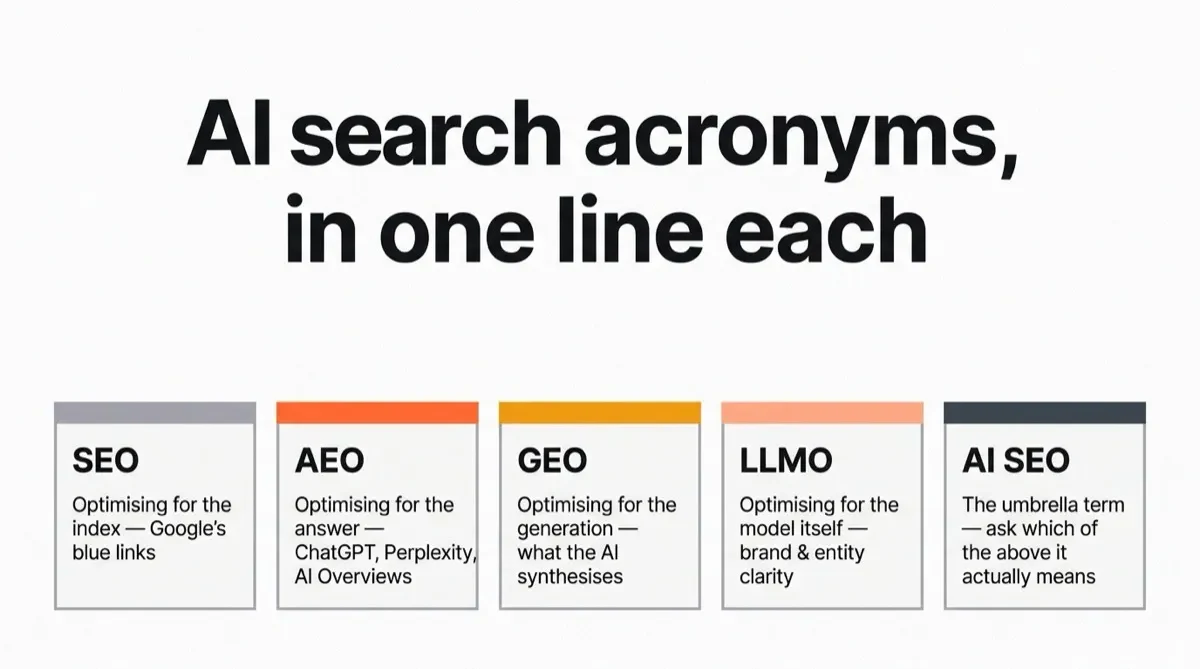
SEO — Search Engine Optimization. The original. Optimising content to rank in a list of blue links on a traditional search results page. Still mostly Google. Still the foundation everything else builds on. Example: "We're investing in SEO this quarter to grow organic traffic and rank for high-intent commercial queries."
AEO — Answer Engine Optimization. Optimising content so AI answer engines — ChatGPT, Perplexity, Claude, Google AI Overviews — cite, summarise, or recommend your business when a user asks a question. Heritage: voice-search and featured-snippet optimisation, repurposed for the answer-engine era. Emphasis: structured answers, entity clarity, citation-worthiness. Example: "If your AEO is right, ChatGPT will mention you when someone asks for a property manager in Wellington."
GEO — Generative Engine Optimization. The academic term, from Aggarwal et al.'s 2023 paper. Optimising content for generative AI systems that synthesise answers across multiple sources. Emphasis: getting included in a generated response, not necessarily linked or clicked. Example: "Our GEO experiments showed authoritative quotes lifted citation rate by about 40 percent."
LLMO — Large Language Model Optimization. Optimising for how LLMs themselves represent your brand — including in conversational chat, where there is no live retrieval at all. Emphasis: entity clarity, brand consistency across the web, and presence in training data. Example: "LLMO is why we made sure every page on the site describes the company the same way."
AI SEO. The umbrella label. Sometimes it means "AEO + GEO + LLMO under one roof." Sometimes it means "we use AI tools to do SEO faster." Ambiguous on purpose. When an agency pitches AI SEO, it's worth asking which of those two things they actually do. The answer matters. Example: "Fair question to ask when an agency leads with 'AI SEO' — which of the three things underneath it have they actually changed?"
Terms you can probably ignore. AIO, GSO, Search GEO, AEOPS — same shift, more acronyms, no extra meaning that I've been able to find. If a vendor leads with one of these, they're reaching for differentiation that doesn't really exist.
Who uses which term, and why it matters
This is the section I haven't seen anyone else write. The terminology isn't random — every term has constituencies, and once you can read those constituencies, vendor calls get a fair bit easier.
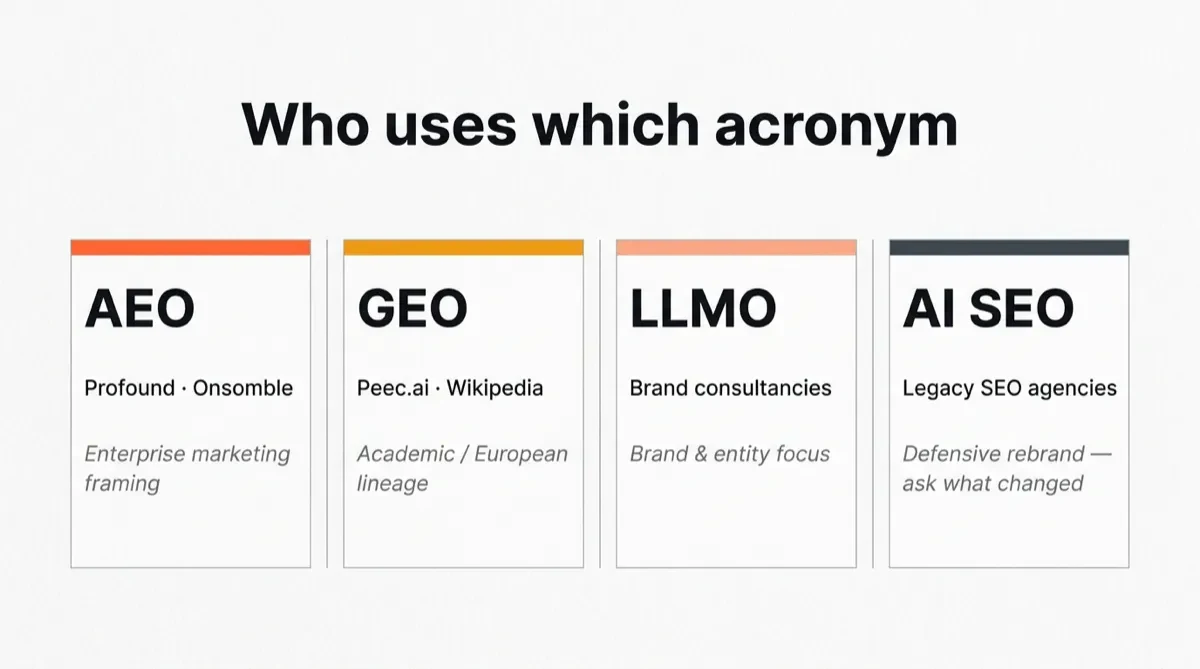
| Term | Who leads with it | Why | What it tells you |
|---|---|---|---|
| GEO | Peec.ai, Wikipedia, Princeton paper, many European agencies | Anchored to the original academic paper; the term Wikipedia canonicalised | The vendor sits closer to the research / European practitioner camp |
| AEO | Profound, Onsomble, several US enterprise vendors | Frames the work as an extension of SEO; an easier sell to traditional marketing teams | The vendor is selling into enterprise marketing, not engineering |
| LLMO | Boutique brand consultancies, PR shops, some reputation-management firms | Emphasises brand representation in the model itself, not retrieval | The vendor cares about narrative and entity, not crawl-layer technicals |
| AI SEO | Legacy SEO agencies, generalist digital agencies | Defensive rebrand; lets them keep selling SEO with new language | Worth asking what they have actually changed about the work |
Read the room. The acronym a vendor leads with doesn't tell you whether they're better or worse than the next vendor. It tells you what shelf they came off, and what blind spots are worth probing in the next conversation. A GEO-led pitch from an academically grounded shop tends to feel quite different from an AI-SEO pitch by an agency that just renamed last quarter's deck.
How much overlap is there, really?
The honest answer is about 80 to 90 percent.
That number is uncomfortable for vendors, because every acronym wants to feel like a discrete discipline that needs its own budget line. But the technical work — clean HTML, internal linking, structured data, entity consistency, robots.txt opened to AI crawlers, citation-worthy content, llms.txt, schema markup — is essentially the same regardless of which acronym ends up on the invoice.
The differences are mostly about which surface you're optimising for. SEO is for the index. AEO is for the answer. GEO is for the generation. LLMO is for the model. In practice you do most of the same things, and they reinforce each other.
What doesn't overlap with traditional SEO is the assumption you'll get the click. Across AEO, GEO and LLMO, the most common outcome of a piece of work that's gone well is that you get cited without being clicked. The user asks ChatGPT, the answer mentions you, and the conversation continues. That's the real shift. Same shift no matter which name a vendor puts on it.
I should admit something here. Early on, we treated AEO and GEO as separate workstreams. Different to-do lists. Different sprints. We were quietly convinced the differences were bigger than they turned out to be. After a few months of doing both, we noticed the same five or six fixes kept appearing in both backlogs. The honest thing to do was merge them — and call the merged thing one name.
Which one should you actually use?
Where we've landed: AEO.
Not because it's technically more correct than GEO. Both are defensible. The Princeton paper has the academic credit, and Wikipedia is going to keep canonicalising "GEO" for years. If someone wants to call you parochial for preferring "AEO," they're not wrong on the history — they're just not solving the same problem you are.
The reasons we've standardised on AEO are practical, not technical:
- It connects to existing marketing vocabulary. People tend to understand "answer engine" faster than "generative engine." When you take the term into a board meeting, half the work is already done.
- It's the term enterprise buyers in 2026 seem to be settling on. The major US-listed vendors lead with AEO. The category looks to be consolidating around it.
- It scales across audiences. You can use the same word with a board, a marketing agency and a developer without code-switching. GEO and LLMO don't always survive the trip into a non-technical room.
We use AEO at Onsomble for those reasons. If your agency uses GEO instead, that's fair enough — they probably mean the same thing. The question worth asking is the only one that actually matters: "What does that change about the work?" If they can't answer it crisply, the acronym is doing branding, not strategy.
One rule worth holding to, regardless of which term you pick: pick one and stay consistent. Switching between AEO, GEO and LLMO across pages of your own site is a reliable way to confuse the entity-recognition models you're trying to optimise for. Pick a flag and plant it.
What this means for the actual work
The acronym you choose doesn't change the to-do list. It's the same to-do list you'd write down if you ignored every acronym entirely:
- Clean, structured content with proper headings and entity clarity
- Consistent brand and entity descriptions across every page and every off-site profile
- AI-friendly crawl access — robots.txt that opens the door to GPTBot, ClaudeBot, PerplexityBot and friends
- Authoritative citations and source-worthy assertions
- Schema markup that gives machines an unambiguous read on who and what you are
- Active monitoring of what the AI systems actually say about your business right now
We've covered the practical foundation in our guide to answer engine optimization, which is the "how do you do it" companion to this "what does it mean" piece. If you want to check whether a newer brand is invisible right now, our AI search visibility for a new brand article walks through the early visibility work. And one of the more concrete fixes — the crawler-access work around robots.txt and llms.txt — is the same job whether you call it AEO, GEO or LLMO.
If you'd like to see what ChatGPT, Claude and Perplexity actually say about your business right now, run a scan. The answer's the same regardless of acronym.
One thing to take into your next meeting
Don't let acronyms make you feel behind. There are four names for roughly one job, and most articles on the topic hedge because hedging is safer than picking. The work doesn't really care which name you use. It cares whether you do it.
The acronym is a flag. The work is the work.
Continue Reading
AEO Foundations19 min read
AI Discoverability: How AI Systems Find and Surface Information
AI discoverability is the layered process by which systems acquire information, interpret entities, retrieve relevant material, select sources, and present claims in generated answers; technical accessibility supports eligibility but never guarantees citation, recommendation, traffic, or influence.
Rosh Jayawardena
AEO Foundations9 min read
How to Get Cited by ChatGPT for Your Business
Learn how to get cited by ChatGPT with practical fixes for crawlability, page structure, schema, and off-site authority.
Rosh Jayawardena
AEO Foundations9 min read
llms.txt Explained: Should Your Website Have One?
llms.txt explained for real businesses: what it does, where it may help, and why most sites should fix bigger issues first.
Rosh Jayawardena
Deep dives, delivered weekly
AI patterns, workflow tips, and lessons from the field. No spam, just signal.