
Back to Blogs
ChatGPT Shopping Optimization for Ecommerce
9 min readApr 29, 2026
AEO Foundations

Rosh JayawardenaData & AI Executive
ChatGPT shopping optimization starts with feeds, PDPs, reviews, and Google Shopping visibility. Use this playbook to improve product discovery.
ChatGPT Shopping Optimization for Ecommerce: A Practical Playbook for Product Visibility
A lot of ecommerce teams are treating ChatGPT Shopping like a mysterious new acquisition channel. I do not think that is quite right.
In practice, chatgpt shopping optimization looks more like an extension of work good commerce teams should have been doing already. The difference is that weak product data, vague PDP copy, and patchy review signals are now easier to punish.
That matters because shoppers are no longer only searching in Google. They are asking ChatGPT for product ideas, comparisons, and buying advice, then clicking through from whatever looks most credible. If your catalogue is badly represented, you can disappear before the shopper even reaches your site.
We touched on the broader visibility shift in our piece on AI search visibility and why some brands keep showing up in AI search. This article is the ecommerce version of that problem. More operational, a bit less theoretical.
How does ChatGPT decide which ecommerce products to recommend?
ChatGPT appears to recommend ecommerce products by combining product retrieval, structured product data, and wider web signals such as reviews, editorial mentions, and contextual relevance.
That is the most sensible reading of the evidence available so far. It is also worth keeping a bit of humility here, because none of us outside OpenAI gets the full recipe.
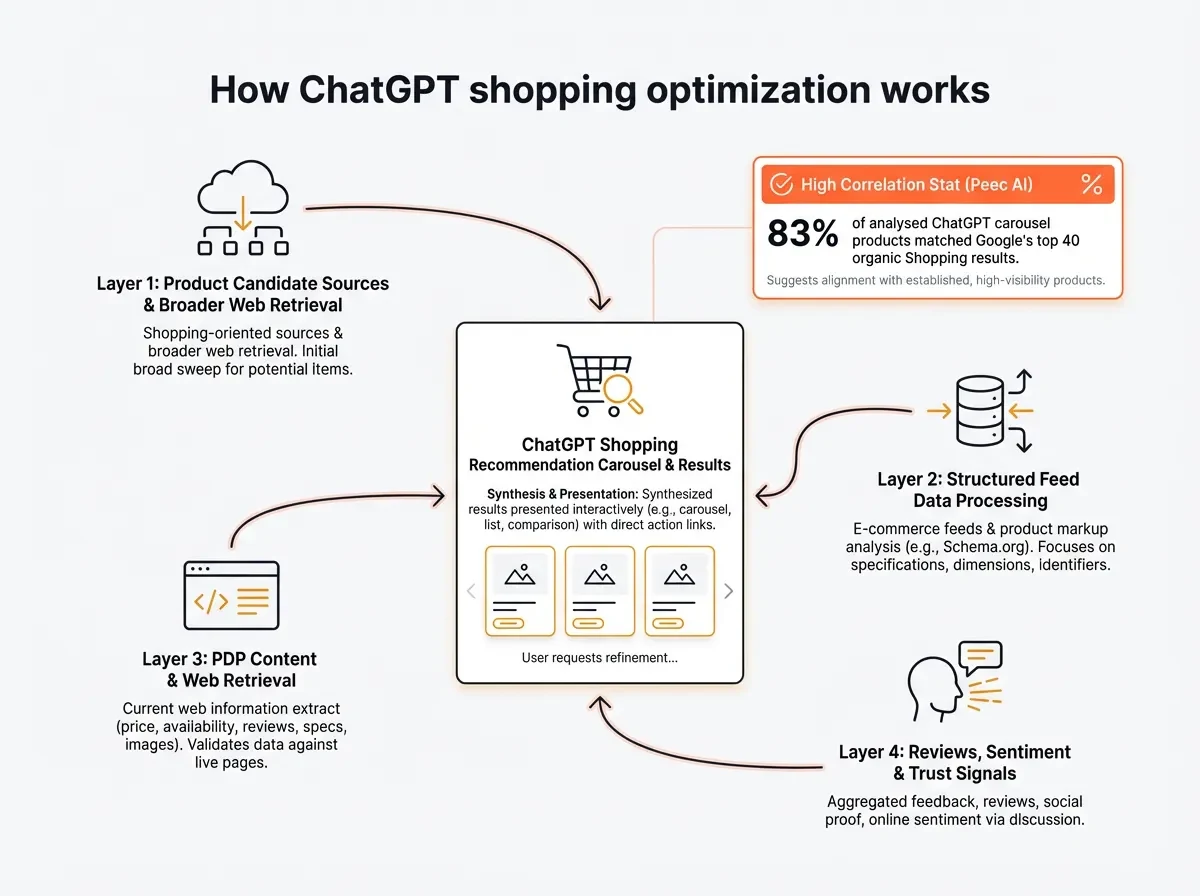
The clearest external data point comes from Peec AI. In its 2026 analysis, it reported that 83% of analysed ChatGPT carousel products were strong matches to products found in Google's top 40 organic Shopping results. The same write-up said the dataset covered more than 43,000 carousel products.
That does not prove Google Shopping is the only source. It does suggest it is a fairly important one.
OpenAI's own shopping materials point in a similar direction. Its merchant documentation says richer, current product feed data helps merchants improve placement, catalogue coverage, and product accuracy in ChatGPT. Its shopping research launch also says the system looks across the internet for up-to-date price, availability, reviews, specs, and images.
So the practical interpretation is fairly straightforward:
- ChatGPT needs product candidates
- it benefits from structured product data
- it appears to use wider web context to decide what looks trustworthy and relevant
I got this wrong at first. I assumed this would mostly be a schema problem. It is not only that. Schema helps, but it looks more like the surface output of a broader representation problem. If the feed is wrong, the page is weak, and the reviews are patchy, no amount of tidy markup is going to save it.
What this means for ecommerce teams
If you want to know how to rank products in ChatGPT, stop looking for one ranking factor. You are dealing with a layered system.
A reasonable working model is this: retrieval gets you into consideration, data quality keeps you eligible, and reputation helps you get selected.
Why does Google Shopping performance affect ChatGPT Shopping visibility?
Google Shopping performance appears to affect ChatGPT Shopping visibility because Google Shopping looks like a major upstream source of product inclusion and ranking context.
Again, the best evidence here is from Peec AI's published research. It reported that around 60% of ChatGPT carousel matches came from the top 10 Google Shopping organic results, and nearly 84% came from the top 20.
That is pretty useful, because it turns a vague AI-search conversation into a clearer operating target. If your priority products are not competitive in organic Google Shopping, your odds of appearing in ChatGPT look materially worse.
This also explains why some teams feel confused by ChatGPT product recommendations. They assume the answer engine is inventing a separate product graph from scratch. It may not be. It may be leaning on an existing commerce ecosystem that already has strong product, merchant, and relevance data.
For ecommerce AI search optimization, that changes the job. You are not only trying to optimise for a chatbot. You are trying to become one of the products most likely to be pulled through from a machine-readable shopping environment.
Branded visibility still matters
This gets more interesting with branded queries.
If someone asks for your product by name, you would expect your own site to be the obvious outcome. Fair enough. But if resellers, marketplaces, or other merchants outrank you in Google Shopping, those merchants can also become more visible in ChatGPT's product layer.
That has commercial consequences. Price presentation, title structure, stock accuracy, and retailer trust can all shape who gets the click.
What should ecommerce teams fix first to improve ChatGPT product rankings?
Ecommerce teams should fix feed completeness, Merchant Center eligibility, product title clarity, PDP specificity, and review strength first, because those are the inputs most likely to affect both visibility and product credibility.
This is the part most articles rush through. I would not.
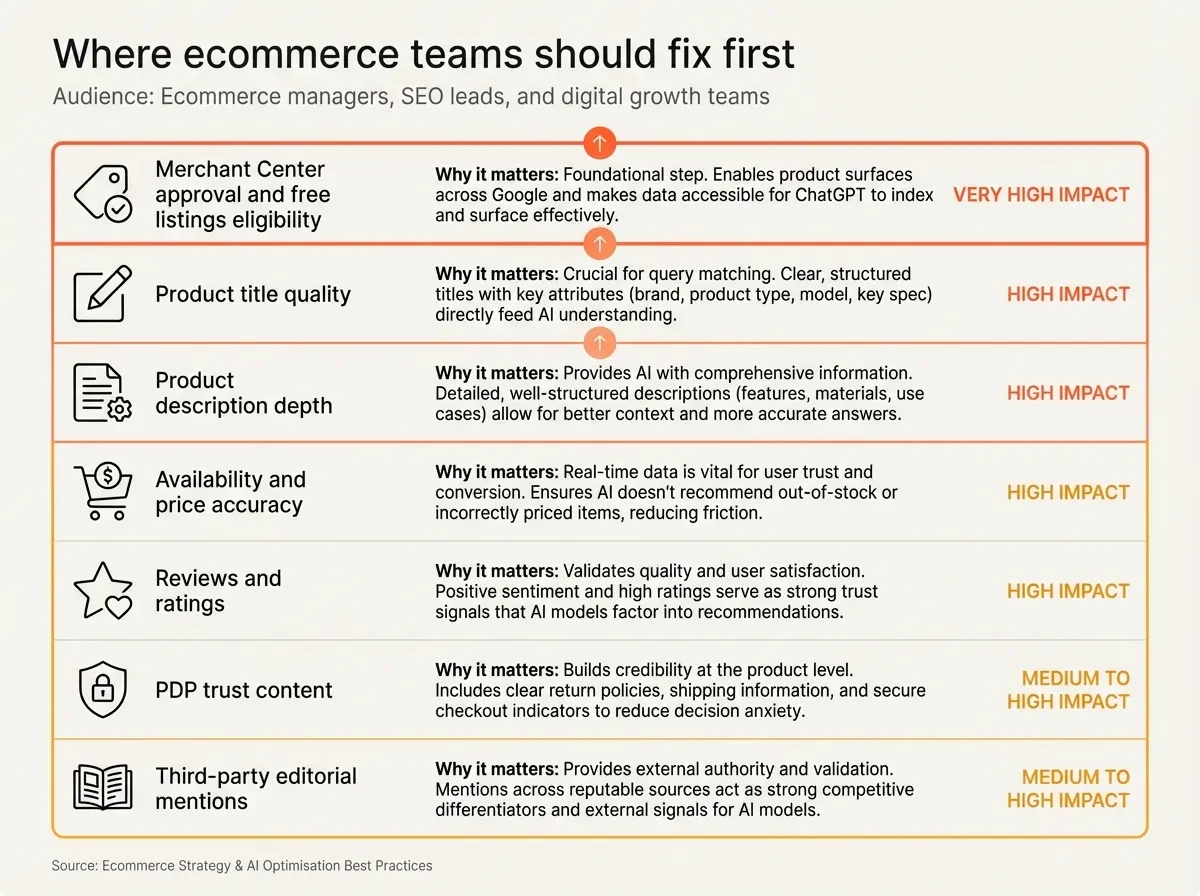
If you are serious about chatgpt shopping optimization, start with the product-level basics before chasing experiments. A lot of teams treat feed work as admin. I have seen that mindset in plenty of SEO and ecommerce setups, and it usually ends the same way. The feed gets maintained just enough to stay alive, then everyone acts surprised when newer AI surfaces prefer somebody else.
Here is a sensible priority order.
| Priority area | Why it matters | Effort | Likely impact |
|---|---|---|---|
| Merchant Center approval and free listings eligibility | If products are not eligible, they are far less likely to appear in organic Shopping and downstream AI surfaces | Low to medium | Very high |
| Product title quality | Titles help match queries, attributes, and shopper intent | Medium | High |
| Product description depth | Better descriptions help with use-case fit, features, and differentiators | Medium | High |
| Availability and price accuracy | OpenAI explicitly references current price and availability in shopping research | Medium | High |
| Reviews and ratings | Review volume and sentiment help reinforce trust and buyer fit | Medium to high | High |
| PDP trust content | Return policies, shipping details, FAQs, and warranty information reduce ambiguity | Medium | Medium to high |
| Third-party editorial mentions | Reinforces product legitimacy outside your own domain | High | Medium to high |
Fix 1: clean up the feed before rewriting everything else
Start inside Google Merchant Center. Check approval status, free listings eligibility, variant structure, GTIN coverage, category mapping, and attribute completeness.
OpenAI's merchant documentation reinforces this direction. It says richer feeds help with catalogue coverage, accurate product details, and placement. That is not subtle.
If I were running this as an ops sprint, I would begin with a shortlist of high-margin or high-volume SKUs. Get those sorted first. Do not try to fix the whole catalogue in one heroic push.
Fix 2: rewrite titles and descriptions for how buyers actually ask
A vague product title is a problem twice over. It hurts Shopping visibility and it gives answer engines less context to work with.
Good titles usually include the brand, product type, core distinguishing feature, and variant when relevant. Good descriptions explain what the product is for, not just what it is.
That matters because ChatGPT shopping research is designed for multi-constraint questions. OpenAI says users ask things like “find the quietest cordless stick vacuum for a small apartment.” If your feed and PDPs cannot express those constraints clearly, you are less likely to be a neat match.
Fix 3: strengthen visible trust signals on the PDP
This is where a lot of product feed optimization for ChatGPT work starts to overlap with conversion work.
Add FAQs. Clarify returns. Make shipping expectations visible. Show warranty details. Surface rating volume and review themes honestly. If multiple reviews mention that the product is lightweight, easy to assemble, or good for wide feet, say so in plain language where appropriate.
You are helping both the shopper and the machine understand the same thing.
The operating model for chatgpt shopping optimization
The best operating model for chatgpt shopping optimization is a shared workflow between merchandising, SEO, product marketing, and review or PR efforts.
This is where the topic gets a bit awkward, because a lot of teams are still organised in silos built for an older web.
Feed management sits with one team. PDP copy sits with another. Reviews sit under CX. Editorial mentions sit under PR. SEO sits off to the side trying to translate all of it. Then the business wonders why AI surfaces look inconsistent.
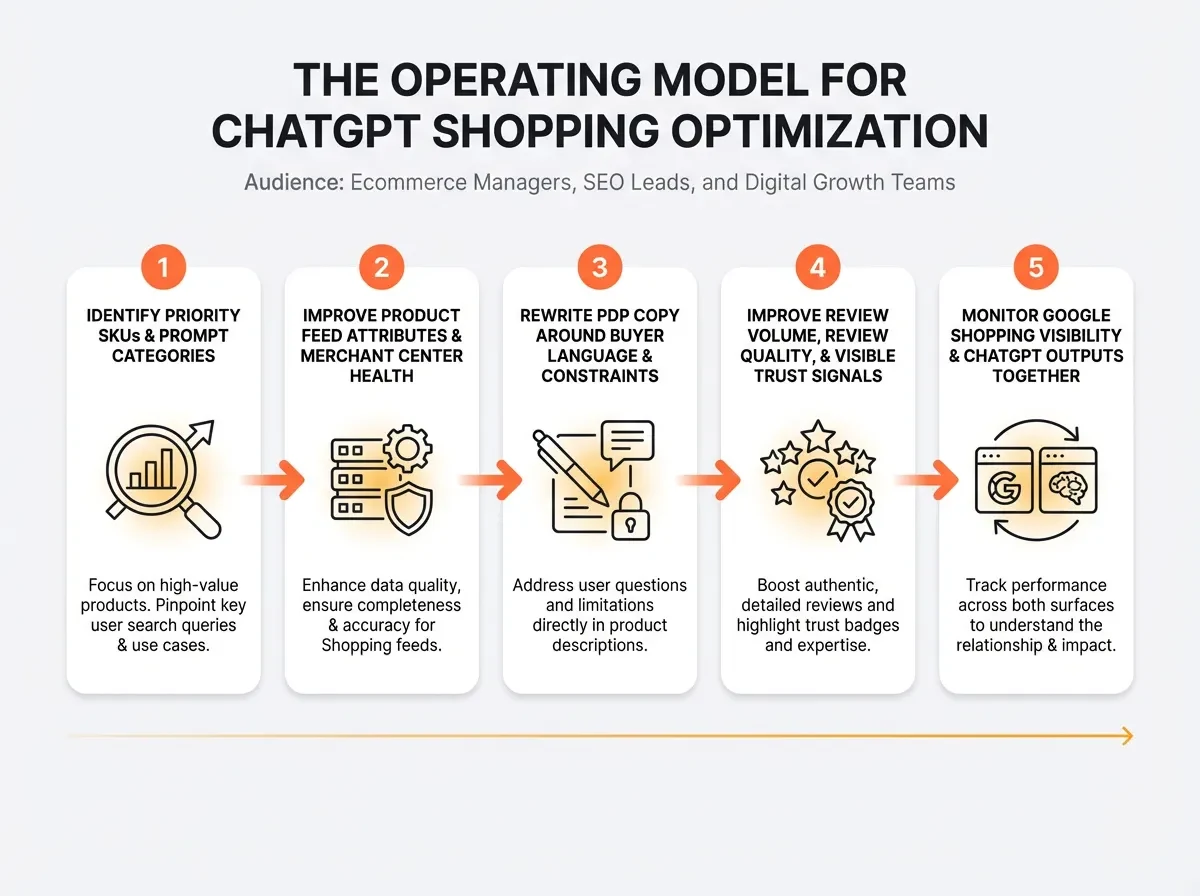
What seems to work better is a tighter loop:
- identify priority SKUs and prompt categories
- improve product feed attributes and Merchant Center health
- rewrite PDP copy around buyer language and constraints
- improve review volume, review quality, and visible trust signals
- monitor Google Shopping visibility and ChatGPT outputs together
That is not glamorous work. It is pretty effective though.
If you want a broader view of how these representation signals compound, our article on markdown vs HTML for AI crawlers gets into how AI systems still depend on machine-readable structure and retrieval-friendly pages. Different context, same underlying lesson.
How to measure ChatGPT Shopping visibility without guessing
You should measure ChatGPT Shopping visibility with a mix of prompt tracking, Google Shopping checks, referral analysis, and SKU-level before-and-after testing.
Do not wait for perfect tooling. You can get useful signals with a fairly simple process.
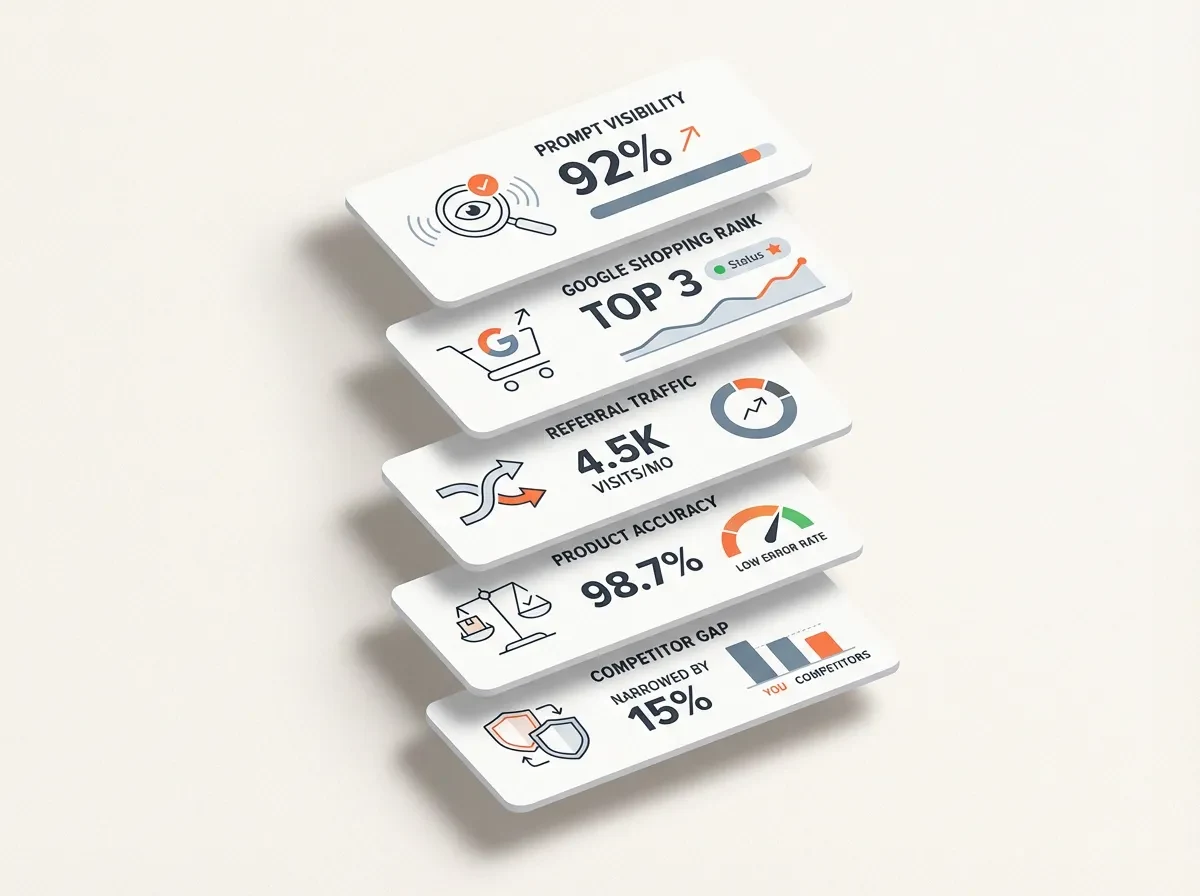
Start with four measurement layers:
| Metric | What to look for |
|---|---|
| Prompt visibility | Does your product appear for priority commercial prompts? |
| Google Shopping rank | Is the product in the top 10, top 20, or absent? |
| Referral traffic | Are sessions tagged with utm_source=chatgpt.com appearing in GA4? |
| Product accuracy | Are titles, prices, and descriptions shown correctly when you do appear? |
Then add a fifth layer once the basics are in place: competitor gap analysis. Which products show up instead of yours, and what do they have that you do not?
This is also where you avoid a common mistake. Teams often measure AI visibility only at brand level. I do not reckon that is enough for ecommerce. Product surfaces are won and lost SKU by SKU.
Frequently Asked Questions
How does ChatGPT decide which products to show?
ChatGPT appears to combine candidate products from shopping-oriented sources with product data and broader web context such as reviews, specs, availability, and relevance to the shopper's prompt. OpenAI says shopping research uses current web information like price, availability, reviews, specs, and images, while Peec AI's research suggests Google Shopping is a major product source.
Does Google Shopping affect ChatGPT rankings?
It appears to, quite materially. Peec AI reported that 83% of analysed carousel products matched Google's top 40 organic Shopping results, with roughly 60% coming from the top 10 and nearly 84% from the top 20.
Which product data fields matter most?
The most important fields are usually the ones that reduce ambiguity: title, description, price, availability, brand, image, variant data, GTIN or MPN where relevant, review count, and average rating. OpenAI's merchant guidance also points to richer, current product feed data as a factor in better representation and placement.
Do reviews and editorial mentions matter?
Yes, because product recommendation systems do not work only from your own catalogue. OpenAI says shopping research looks across the internet for reviews and other current information, and competitor research suggests broader sentiment and editorial context likely help determine which eligible products look most trustworthy.
Conclusion
ChatGPT Shopping is not a magic new shelf you unlock with one technical tweak. It looks much more like a visibility layer built on product data quality, merchant infrastructure, product-page clarity, and outside validation.
So I would start with your top products, not your whole catalogue. Audit Merchant Center eligibility, improve titles and descriptions, tighten PDP trust signals, and compare your Google Shopping visibility against the prompts that matter most. That is the work most likely to move both discoverability and revenue.
Continue Reading
AEO Foundations19 min read
AI Discoverability: How AI Systems Find and Surface Information
AI discoverability is the layered process by which systems acquire information, interpret entities, retrieve relevant material, select sources, and present claims in generated answers; technical accessibility supports eligibility but never guarantees citation, recommendation, traffic, or influence.
Rosh Jayawardena
AEO Foundations9 min read
How to Get Cited by ChatGPT for Your Business
Learn how to get cited by ChatGPT with practical fixes for crawlability, page structure, schema, and off-site authority.
Rosh Jayawardena
AEO Foundations9 min read
llms.txt Explained: Should Your Website Have One?
llms.txt explained for real businesses: what it does, where it may help, and why most sites should fix bigger issues first.
Rosh Jayawardena
Deep dives, delivered weekly
AI patterns, workflow tips, and lessons from the field. No spam, just signal.