
Back to Blogs
AI Search Visibility: Why Brands Keep Showing Up
9 min readMay 4, 2026
Deep Dive

Rosh JayawardenaData & AI Executive
AI search visibility is not just rankings. Learn why some brands get cited in AI answers and how to improve your visibility.
AI Search Visibility: Why Some Brands Keep Showing Up in AI Search
A lot of teams still assume AI search visibility is just SEO with a new label. I do not think that holds up anymore.
If a potential customer asks ChatGPT, Gemini, Perplexity, or Google AI Overviews for a recommendation, the brand that appears is not always the brand that ranked first in Google. Quite often, it is the brand that is easiest to understand, easiest to verify, and safest to cite.
That changes the job a bit. You are no longer only trying to rank a page. You are trying to make your business retrievable as a credible answer.
We explored a related technical angle in our piece on markdown vs HTML for AI crawlers, and this is the strategic version of the same problem. Machines need clean structure. They also need reasons to trust what they find.
What is AI search visibility?
AI search visibility is the likelihood that your brand, page, or viewpoint appears inside AI-generated answers on platforms such as ChatGPT, Google AI Overviews, Google AI Mode, Perplexity, Gemini, and Copilot.
If you need the broader foundation first, start with our practical guide to answer engine optimization.
That is different from traditional rankings. In classic search, you were trying to win a place in a list of blue links. In AI search experiences, the system often synthesises an answer from multiple sources, then cites a smaller set of pages, publishers, forums, or entities.
Google has been fairly explicit about this shift. Its AI search updates describe AI-powered snapshots, follow-up questions, and what it calls query fan-out, where Search breaks a question into subtopics and runs multiple searches behind the scenes. That is a different retrieval model. It favours pages that answer clear sub-questions, use structured language, and fit neatly into a synthesis.
This is why AI search visibility is partly a content problem, partly a brand problem, and partly a technical clarity problem. If your business is hard to interpret, AI systems will usually move on.
Why the definition matters
A lot of people treat this as a traffic issue. It is broader than that.
If your brand is absent from AI answers during comparison, shortlisting, or vendor research, you can lose influence before a buyer ever clicks a website. That is not ideal. Also not especially rare now.
Why are some brands cited in AI search even when they do not rank first in Google?
Some brands are cited in AI search because answer engines do not simply reward the highest-ranking page, they reward the most usable evidence available for the specific question being asked.
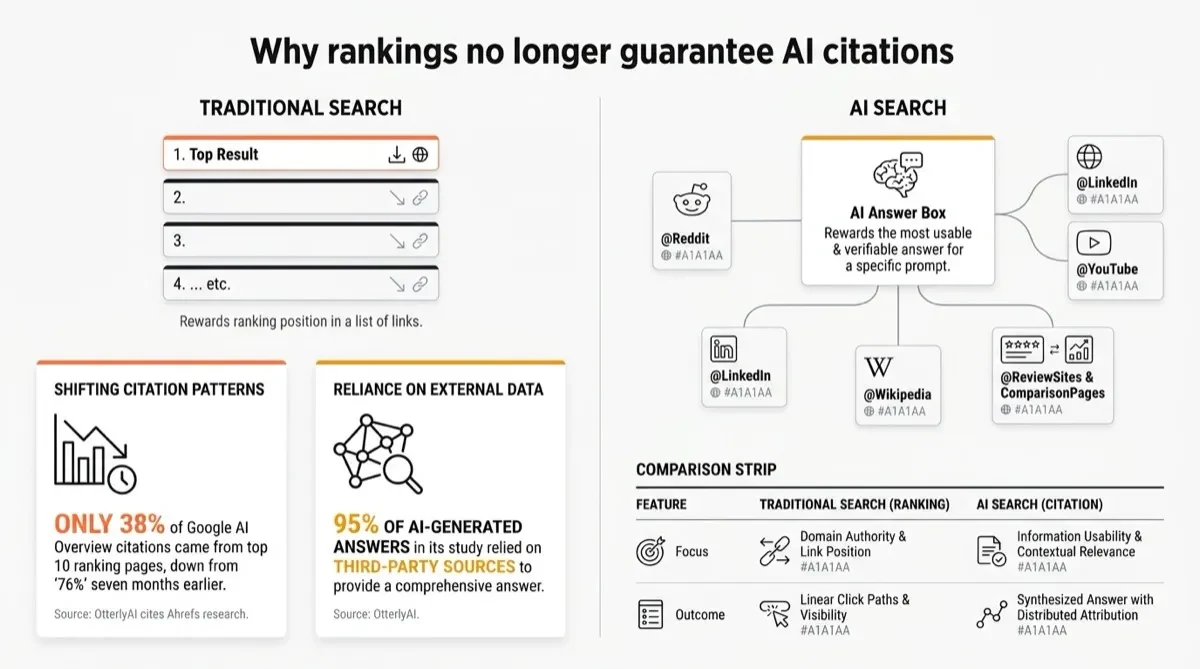
That evidence can come from a company website, but it can also come from Reddit, LinkedIn, YouTube, Wikipedia, trade media, review sites, product directories, and comparison pages. According to OtterlyAI, 95% of AI-generated answers in its study relied on third-party sources rather than brand-owned content. The same article cites Ahrefs research claiming only 38% of Google AI Overview citations came from pages ranking in Google’s top 10, down from 76% seven months earlier.
That gap is the point. Ranking still matters, but ranking alone is not enough.
In practice, AI systems seem to favour content with a few traits:
- clear answers to narrow questions
- named entities, such as Google, OpenAI, Reddit, Wikipedia, or ISO/IEC 27001
- evidence that stands on its own in a short passage
- external corroboration from other trusted sources
- stable brand descriptions across multiple platforms
I got this wrong myself at first. I assumed strong rankings and decent on-page SEO would carry the rest. They helped, obviously, but not as much as expected. The pages that got traction were the ones that answered one thing clearly, then had supporting signals elsewhere.
Retrieval beats sheer authority
This is where a lot of brands get stuck. They think, “We are well known, so the models should pick us up.” Fair enough, but that is not how it works consistently.
If a smaller competitor has a cleaner comparison page, clearer FAQ blocks, better LinkedIn commentary from subject matter experts, and a few good mentions in niche publications, they can become easier to cite than a bigger brand with a muddled website.
What makes a brand more visible in AI search experiences like ChatGPT and Google AI Overviews?
A brand becomes more visible in AI search experiences when it is easy for systems to identify what the business does, extract a useful answer, and verify that answer against other trusted sources.
That sounds simple. It is not always easy. Still, the pattern is fairly consistent.
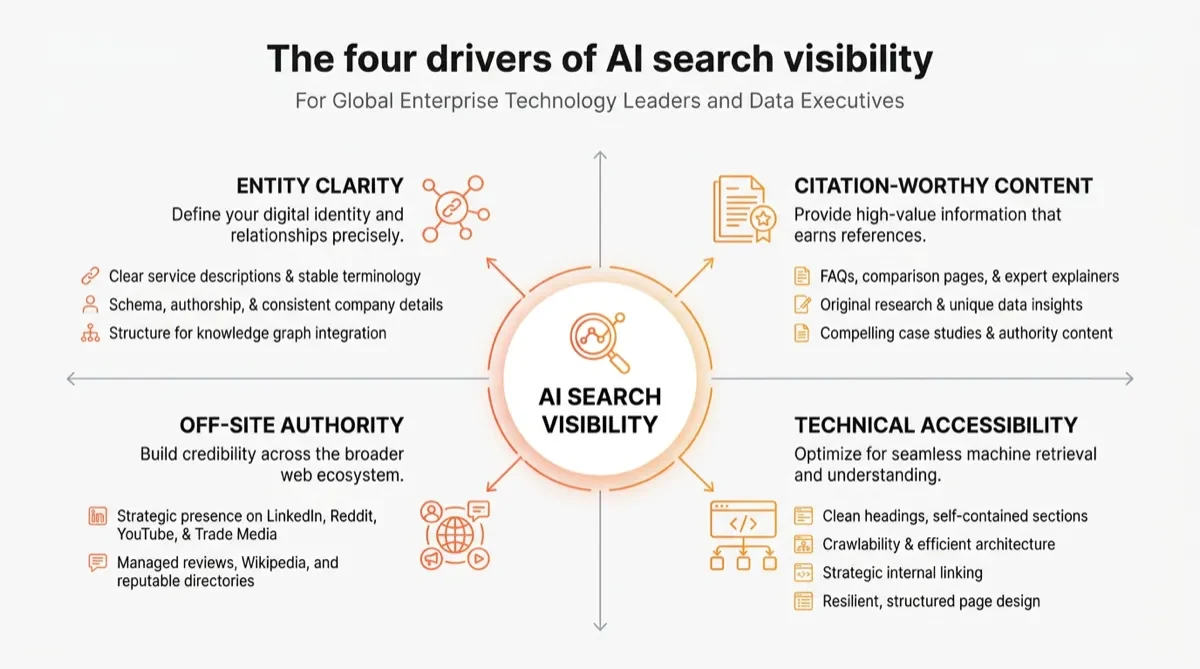
1. Entity clarity
AI systems need to understand the basic facts of your business. What you do. Who you serve. What problems you solve. What category you belong to. What makes you different.
That means your key pages need plain language, stable terminology, and consistent naming. If your homepage says one thing, your LinkedIn page says another, and your service pages drift into abstract copy, you make retrieval harder than it needs to be.
Entity clarity usually improves when you have:
- a precise service description
- named use cases and industries
- structured FAQs
- schema markup such as Article and FAQPage
- authorship and company details that match across the web
Wikidata, Wikipedia, LinkedIn, Google Business Profile, review platforms, and trade directories can all reinforce this picture. You do not need every one of them. You do need consistency.
2. Citation-worthy content
Most content is summarised. Much less is cited.
For the practical version of creating pages that are easier to cite, see our guide to getting cited by ChatGPT for your business.
The difference is usually information gain. If you publish a generic opinion piece that says what everyone else says, ChatGPT or Perplexity can paraphrase the idea without needing you. If you publish original data, a useful comparison, a specific framework, or a sharply written answer to a real buyer question, you become harder to replace.
That is why pages that tend to do reasonably well in AI search experiences include:
| Content type | Why it gets cited |
|---|---|
| Comparison pages | They match decision-stage prompts and often answer dealbreaker questions directly |
| FAQ pages | They provide short, self-contained answers that retrieval systems can lift cleanly |
| Original research | They add information AI cannot reconstruct easily from consensus content |
| Case studies with numbers | They give verifiable evidence and specific outcomes |
| Expert explainers | They combine clarity, authorship, and practical context |
The OtterlyAI roundup also notes that nearly a third of AI citations come from listicles and comparison pages. I would not treat that as gospel, but it lines up with what buyer prompts tend to look like.
3. Off-site authority
This is the bit many teams underweight.
If AI systems lean heavily on third-party sources, then your reputation away from your own domain matters quite a lot. Reddit matters. LinkedIn matters. YouTube matters. Trade press matters. Reviews matter. Wikipedia matters when you have the notability to sustain it properly.
OtterlyAI cites a Semrush study of 230,000 prompts that found Reddit was the most cited source, with LinkedIn second. Again, vendor-cited data deserves a little caution, but the pattern makes sense. These are places where people explain, debate, review, and compare things in natural language.
A good way to think about it is this: your website states your case, and the wider web checks whether anyone else agrees.
4. Technical accessibility
This part is less glamorous, but still pretty important.
Google’s AI search documentation makes it clear that AI Overviews and AI Mode still rely on links to web content, with AI Mode using query fan-out to dig into subtopics. If your content is difficult to crawl, buried behind odd rendering, poorly structured, or stripped of clear headings, you reduce the chance of being selected.
Not every technical SEO improvement lifts AI search visibility. Some do. Clean headings, self-contained sections, schema, internal linking, and sensible page architecture all help machines understand where an answer begins and ends.
We touched on some of that in our article on markdown vs HTML for AI crawlers, especially around how machines parse structure when pages are trying too hard to be clever.
How can businesses improve AI search visibility without starting over?
Businesses can improve AI search visibility without starting over by upgrading the pages and signals they already have, then filling the evidence gaps that AI systems currently solve with somebody else’s content.
You probably do not need a grand AI content transformation programme. You need a sharper editorial and entity model.
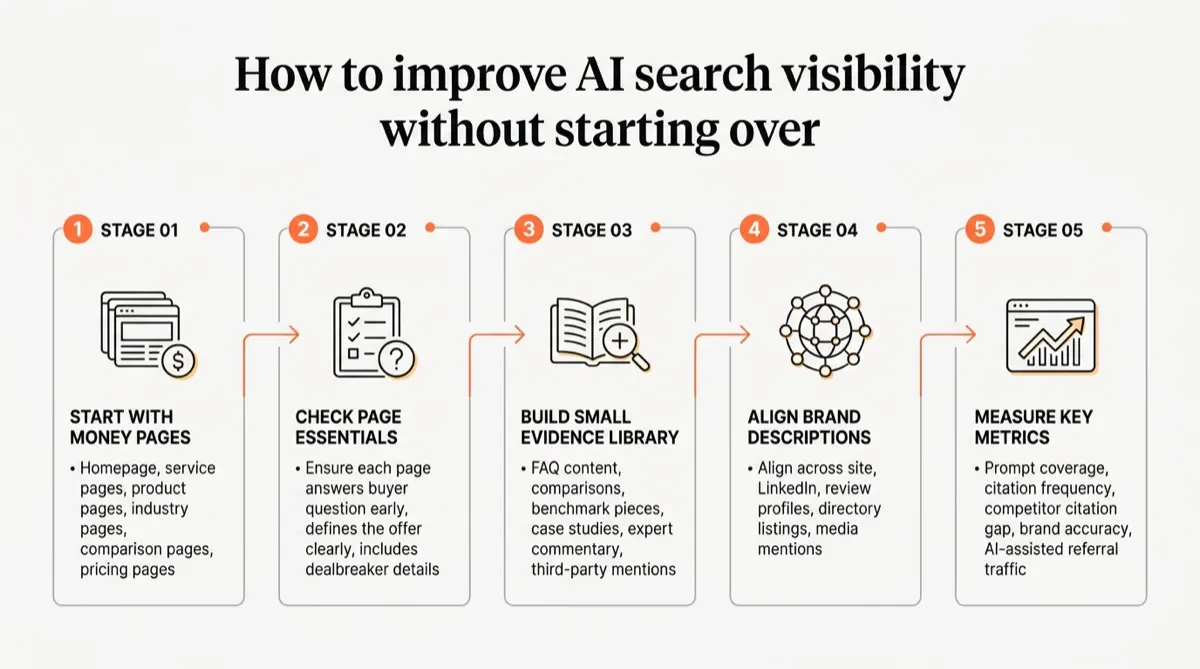
Start with your existing money pages
Look first at the pages tied to enquiries, demos, bookings, or sales conversations:
- homepage
- core service pages
- key product pages
- industry pages
- comparison pages
- pricing or qualification pages
Then ask a blunt set of questions:
- Does each page answer a real buyer question in the first few lines?
- Is it obvious who the offer is for?
- Are dealbreaker details present, such as integrations, compliance, pricing bands, implementation model, or industry fit?
- Would a paragraph from this page make sense if copied into an AI answer with no extra context?
If the answer is no, that is where to start.
Build a small evidence library
The fastest way to improve AI search citations is usually not “more blog posts.” It is better evidence.
That might include:
- a comparison page against common alternatives
- an FAQ section covering high-intent objections
- a short benchmark or mini research piece
- a case study with real numbers
- named expert commentary from your team on LinkedIn or YouTube
- third-party mentions in relevant industry publications
Google says AI Overviews has already driven more than a 10% increase in usage for the query types where it appears in markets like the U.S. and India. So this is not a fringe behaviour issue anymore. The answer surfaces are getting used.
Keep your descriptions consistent everywhere
This sounds boring. It is also where a fair bit of value sits.
Your brand description, service categories, proof points, and subject matter positioning should be aligned across your site, LinkedIn, review profiles, directory listings, and media mentions. If every source describes you differently, you make synthesis harder. If ten sources describe you in roughly the same way, you become easier to trust.
How should you measure AI search visibility?
You should measure AI search visibility by tracking where your brand appears in AI answers, which prompts trigger those mentions, which sources are cited instead of you, and whether those appearances influence pipeline activity.
Rankings are still useful. They just are not the whole story now.
A simple measurement stack looks like this:
| Metric | What it tells you |
|---|---|
| Prompt coverage | Which commercial and informational prompts mention your brand |
| Citation frequency | How often your pages or brand are referenced |
| Competitor citation gap | Where competitors appear and you do not |
| Brand mention accuracy | Whether AI systems describe your offer correctly |
| AI-assisted referral traffic | Whether AI surfaces are sending visitors who do something useful |
OtterlyAI is one tool in this category. There will be others. The tooling will move around a bit. The logic probably will not.
If you only track clicks and rankings, you will miss the earlier stages where buyers form a shortlist through AI search experiences.
Frequently Asked Questions
What makes a brand more visible in AI search experiences like ChatGPT and Google AI Overviews?
Brands become more visible when their pages are easy to parse, their positioning is consistent, and their claims are supported by trusted third-party sources. Systems like ChatGPT and Google AI Overviews tend to favour clear answers, named entities, schema, and corroborating signals from places like LinkedIn, Reddit, YouTube, and trade media.
Why are some brands cited in AI search even when they do not rank first in Google?
AI systems often cite the most relevant and verifiable passage for a question, not just the highest-ranking URL. OtterlyAI says 95% of AI-generated answers in its research relied on third-party sources, and its article cites Ahrefs research showing declining overlap between top-10 rankings and Google AI Overview citations.
How can businesses improve AI search visibility without rebuilding their whole content strategy?
Most businesses can improve AI search visibility by tightening existing service pages, adding FAQ and comparison content, publishing more original evidence, and aligning off-site brand descriptions. In practice, that is usually enough to make a site more retrievable and more trustworthy without starting from scratch.
Conclusion
AI search visibility is turning into a representation problem as much as a ranking problem. The brands that keep showing up are usually not doing one magical thing. They are easier to understand, easier to cite, and easier to verify.
So I would start there. Audit the prompts that matter, check how your brand is described across the web, fix the pages closest to revenue, and publish evidence that gives an AI system a reason to pick you. That will not sort everything overnight, but it is a pretty sensible place to begin.
Continue Reading
Deep Dive15 min read
What Is robots.txt? How It Works and Where Its Limits Begin
Robots.txt is an origin-scoped plain-text protocol that guides compliant crawlers but cannot secure resources or reliably control indexing. Its effect depends on retrieval status, user-agent groups, path matching, crawler-specific rules, and cache behaviour.
Rosh Jayawardena
Deep Dive11 min read
What Is Artificial Intelligence Search? A Business Owner's Guide
Artificial intelligence search is the new place customers ask for recommendations. Here's a plain-English guide to what it is, where it happens, and what it means for being found by your customers.
Rosh Jayawardena
Deep Dive9 min read
Answer Engine Optimization: Practical Guide
Answer engine optimization explained simply, with practical steps to improve AI search visibility and earn more citations in answers.
Rosh Jayawardena
Deep dives, delivered weekly
AI patterns, workflow tips, and lessons from the field. No spam, just signal.