Back to Blogs
What Is Artificial Intelligence Search? A Business Owner's Guide
11 min readMay 19, 2026
Deep Dive

Rosh JayawardenaData & AI Executive
Artificial intelligence search is the new place customers ask for recommendations. Here's a plain-English guide to what it is, where it happens, and what it means for being found by your customers.
A customer in your city opens ChatGPT and types a question they used to type into Google: "Who's the best emergency plumber near me?".
The AI thinks for a second. It names three. Confident, specific, helpful. The customer reads it, picks one, and books the call.
Your business is not in that answer.
No analytics caught it. No traffic dropped. There was nothing for the customer to click. The AI gave them the recommendation directly. The decision just happened, somewhere in the conversation, and you were not part of it.
ChatGPT alone has around 883 million monthly users (ExposureNinja, 2026). Google's own AI Overviews now appear above regular search results for around 45% of queries (Position Digital, 2026). Most business owners have no idea what AI says about them. The answer never reached their analytics.
TL;DR
- Artificial intelligence search (usually shortened to "AI search") is what happens when people ask AI assistants (ChatGPT, Claude, Perplexity, Gemini, Google AI Overviews) and get a synthesised answer instead of a list of links.
- For business owners, the question shifts from do I rank? to do I show up in the answer?, and your traditional SEO scoreboard does not measure this.
- A ten-minute manual check (in the action section below) is the cheapest way to find out what AI is currently saying about you.
What Is AI Search, Really?
AI search is when an assistant gives you the answer instead of handing you the links.
That is the whole shift in one sentence. Google's job for twenty years has been to fetch the most relevant pages for your query and let you read them. AI search compresses that. You ask a question. A model reads the relevant sources for you. It writes back a single, synthesised answer, often without showing you the sources at all, or with two or three citations tucked at the bottom.
Think of it as the difference between asking a librarian "do you have books on tax obligations for sole traders?" and asking an accountant "what do I actually owe?". The librarian hands you a stack of books. The accountant understands the legislation and tells you.
What we mean here is consumer AI search (not the enterprise versions like Coveo or Glean that companies bolt onto internal search): the assistants that everyday customers, including your customers, are using to find products, services, and businesses. ChatGPT. Claude. Perplexity. Gemini. Google AI Overviews. When someone asks one of these tools a question about your industry, your category, or your competitors, that is the new shop window.
The Five Places AI Search Is Happening Right Now
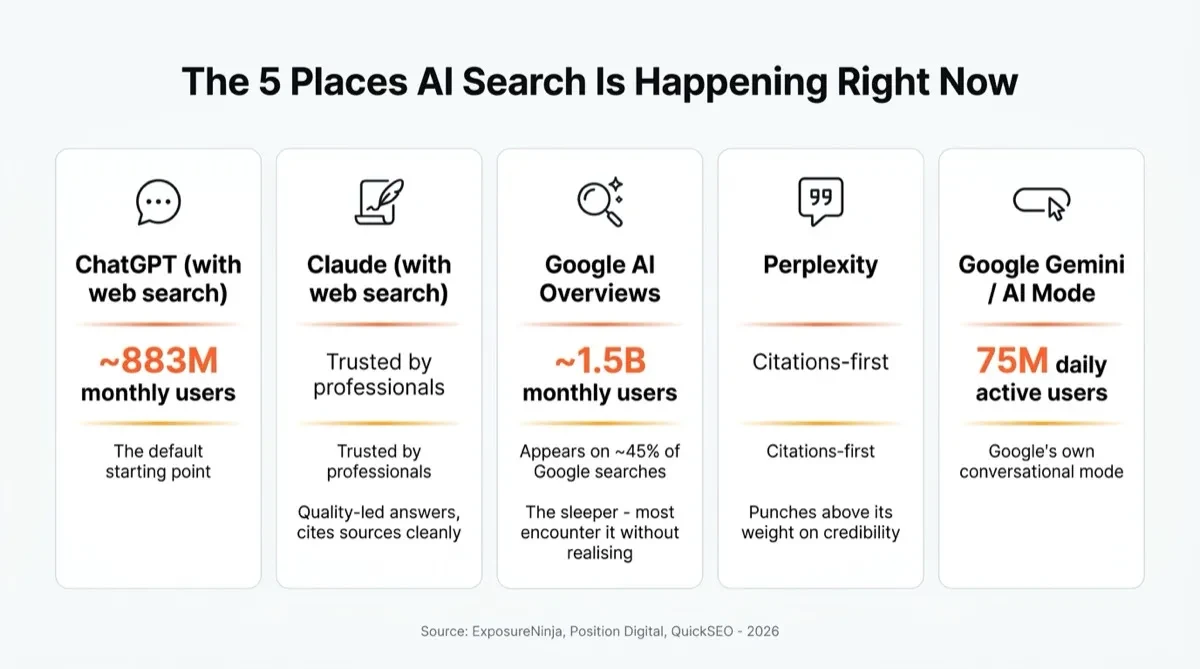
AI search is a category, not a product. Five platforms dominate the space right now.
| Platform | Approx. usage | How it answers | Why it matters for business |
|---|---|---|---|
| ChatGPT (with web search) | ~883M monthly users | Conversational; increasingly grounded in real-time web | The default starting point for most people who use AI search |
| Claude (with web search) | Smaller, growing in professional and technical work | Cites sources cleanly; careful, balanced answers | Trusted by an emerging high-value audience |
| Google AI Overviews | ~1.5B monthly users; appears on ~45% of Google searches | Top-of-page synthesised answer above the blue links | The "AI search" most owners encounter without realising it |
| Perplexity | Smaller user base, high credibility | Citations-first; positions as a research assistant | Punches above its weight for considered-purchase queries |
| Google Gemini / AI Mode | 75M daily active, 100M+ monthly | Conversational mode inside Google itself | Google's own ChatGPT, living inside the search box |
ChatGPT is the default. When non-technical people say "I asked AI", they mean ChatGPT. With nearly 900 million monthly users, it is now bigger than most national populations.
Google AI Overviews is the sleeper. Most owners do not think of this as "AI search". You search Google for "best [your service] in [city]" and the page now opens with an AI-generated answer above the regular results, complete with named recommendations. At around 1.5 billion monthly users on close to half of all Google searches (QuickSEO, 2026), it is by far the largest AI search surface in the world.
Claude and Perplexity punch above their weight. Smaller user numbers, but the people on them tend to be researchers, professionals, and high-consideration buyers. Exactly the customer who reads more than one source before deciding. If you sell to that audience, ignoring them is expensive. (We dug into who is winning early on these platforms in our piece on AI search visibility: brands winning in AI search.)
Gemini is Google's hedge. If AI Overviews is "AI in search", Gemini and AI Mode are "search in AI". A conversational mode that lives inside the Google account everyone already has.
How Artificial Intelligence Search Actually Works
Strip out the jargon (embeddings, retrieval-augmented generation, vector databases) and there are really three moves under the hood.
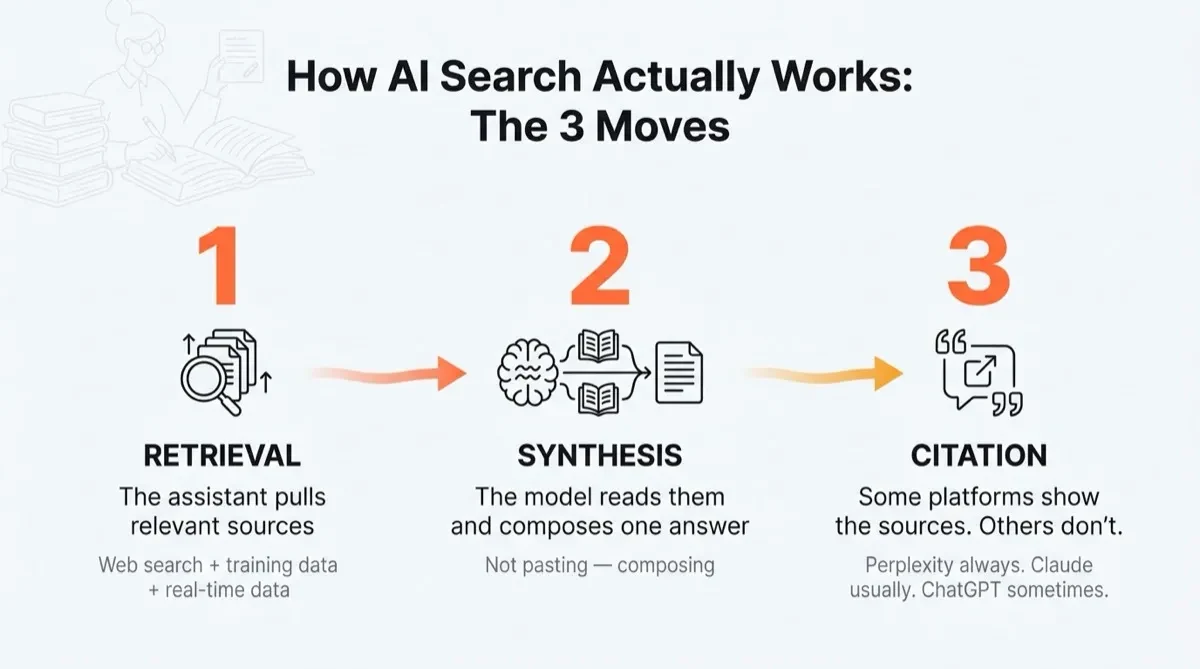
1. Retrieval. The assistant pulls a set of potentially relevant sources. Where those sources come from depends on the platform. ChatGPT and Perplexity do real-time web search for current questions. Claude does the same when web search is on. Google AI Overviews pulls from Google's existing index. Sometimes the "source" is just the model's training data: what it learned during training, frozen in time.
2. Synthesis. The model reads those sources and produces an answer. Not pasting quotes. Composing a response, picking what feels most relevant and stitching it together into something readable.
3. Citation. Some platforms show you where the answer came from (Perplexity does this aggressively; Claude usually; ChatGPT sometimes). Others bury the citations or leave them out entirely.
The librarian analogy still helps. Traditional Google search hands you the ten books and tells you to read. Artificial intelligence search reads the ten books for you and gives you one summary. Helpful, fast. But you are now trusting the AI's judgement about which books to read, which sentences mattered, and how to combine them.
This is also why two AI assistants asking the same question can give different answers. They retrieve different sources, weight them differently, and synthesise in different voices. The answer you see is one possible answer, not the answer.
AI search gets things wrong. Models hallucinate. They make claims with confidence that turn out not to be true. They cite sources that do not exist. They miss obvious context. That has not stopped people from using them, and it has not stopped Google from putting AI Overviews above the blue links on nearly half of all searches. The technology is improving, but the gap between feels confident and is correct is the thing worth watching.
How AI Search Differs From Google Search
Google search and AI search both answer questions. Beyond that they diverge, and the differences matter for any business that depends on being found.
| Dimension | Google Search | AI Search |
|---|---|---|
| Result format | Ten blue links | One synthesised answer |
| How it matches | Keyword overlap | Semantic intent |
| "Winners" per query | Page 1 of ten results | One to three names mentioned |
| User behaviour | Click, compare, decide | Trust the recommendation |
| Success signal | Rank position | Citation-worthiness |
Ten links versus one answer. Google has always had an above the fold problem. Most clicks go to the top few results. AI search makes that problem absolute. The answer is one block. You are either in it or you are not.
Keywords versus intent. Traditional SEO is partly about matching the exact words a customer types. AI search reads the intent. "Best brokers for a small firm" and "insurance company for under-ten staff" land in roughly the same answer.
One winner versus ten. A page that ranks #4 on Google still gets some clicks. A business that comes in fourth in an AI answer often does not appear at all. Most AI responses name two or three options, then stop.
Click-and-compare versus trust. When a customer sees ten links, part of the decision is theirs. When they read an AI answer, the decision feels already made. The recommendation lands as advice from someone who knows.
Rank versus citation. SEO measures position. AI search measures whether a business has built up enough trustworthy, structured, citable material online for the model to pick it as a source. That is a different game.
Google's own AI Overviews also cost websites traffic. They have been shown to reduce clicks by up to 58% in measured studies (Position Digital, 2026). Even when your business is cited in an AI answer, customers may not click. They may not need to.
What AI Search Means For Your Business
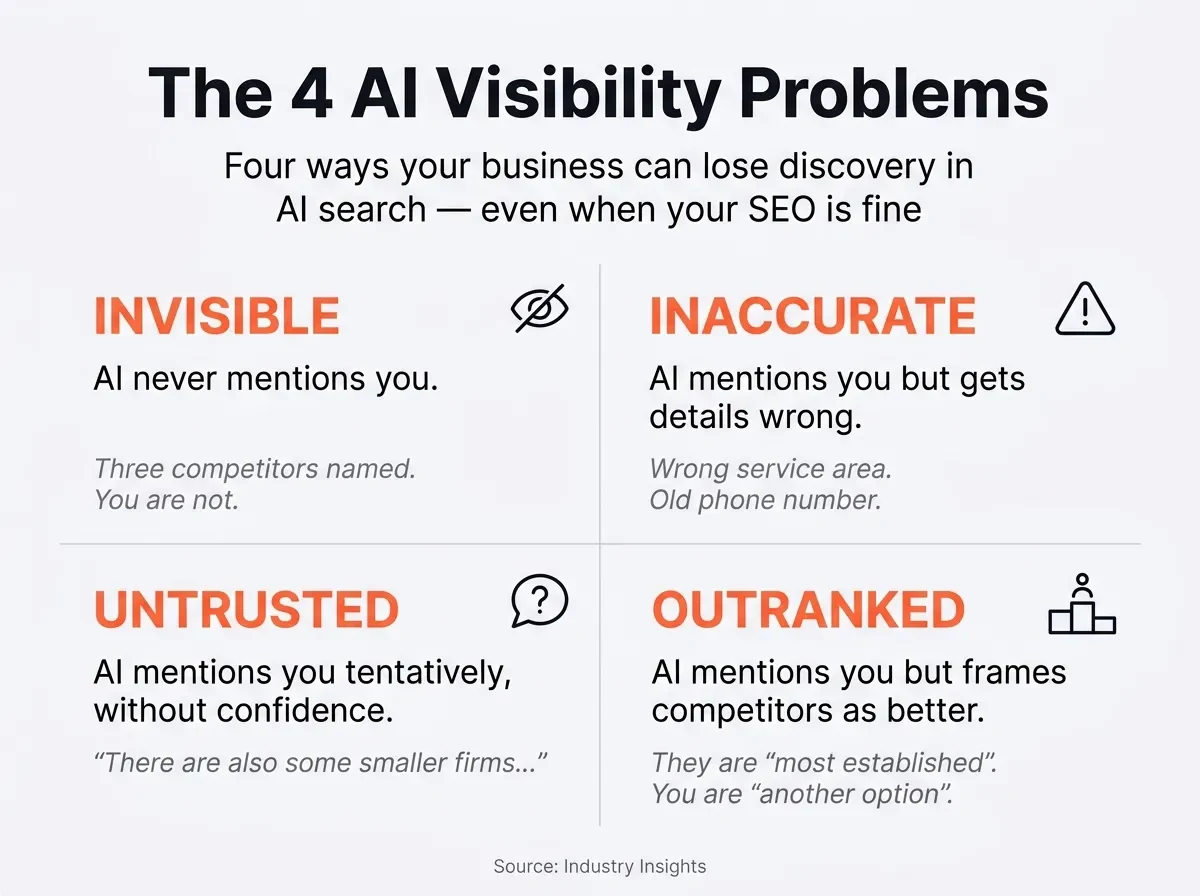
AI search creates four new ways your business can lose discovery, even when your traditional SEO is fine. We call them the four AI visibility problems:
- Invisible. AI never mentions you. A customer asks the obvious question for your category, and the answer comes back with three competitors and a thoughtful summary. You are not in it.
- Inaccurate. AI mentions you, but says something wrong, vague, or outdated. The wrong service area. An old phone number. A service line you stopped offering eighteen months ago.
- Untrusted. AI mentions you, but tentatively. The kind of "there are also some smaller firms in the area such as…" hedge that customers skip over. The model could not find enough public proof to back up a confident recommendation.
- Outranked. AI mentions you, and your competitors, but the framing makes you sound like the second-best option. They are "the most established". You are "another option".
Picture a customer asking an AI assistant about accountants for a small business. The answer reads:
"For small businesses in your area, the most established firms are Accountant A, Accountant B, and Accountant C, who all specialise in small business work. Accountant D is another local option."
If you are Accountant A, your visibility work is paying off. If you are Accountant D, every customer who reads that answer had their decision tilted before they ever heard from you. The same pattern shows up across trades, professional services, and retail.
Your traditional SEO ranking does not tell you any of this. You can rank on page one of Google and still be missing from the AI answer sitting directly above the Google results. Two games. Two scoreboards. The Google one is the one you have been measuring. The AI one is the one most owners have never looked at.
This is still early. AI mentions do not yet translate one-for-one into revenue for most local businesses. But the trajectory is one direction only, and the cost to check what AI is saying about you is zero. For most owners the question is not should I care?. It is have I actually looked yet?.
What You Can Do About It (Today)
Anyone can run a ten-minute AI visibility check today.
Step 1. Pick the questions a real customer would ask.
"Best [your service] in [your city]".
"Who should I use for [the specific job you do]?".
"Is [competitor] any good?".
Five questions are enough.
Step 2. Ask them in ChatGPT and Claude. Fresh chat. Include your location and category. Note what comes back. Who gets mentioned, who gets recommended, who gets ignored. Save the answers. Resist the urge to push back on the AI mid-test. You want a clean reading, not a coached one.
Step 3. Look at the gap. Compare what you would want the answer to say with what it actually said. If you were mentioned, were you described accurately, recommended confidently, or just listed as an afterthought? If you were not mentioned at all, which competitors were?
That gap is your AI visibility baseline.
The discipline that improves it has a name: Answer Engine Optimisation, or AEO. It is to AI search what SEO has been to Google for twenty years, except earlier, less crowded, and still figuring itself out. Our practical guide to AEO walks through the process step by step.
You can do this manually for five prompts and a couple of platforms. We built Onsomble for owners who want it across all the major AI assistants, weekly, without the spreadsheet. However, the spreadsheet is a perfectly valid place to start.
Frequently Asked Questions
What is artificial intelligence search?
When AI assistants (ChatGPT, Claude, Perplexity, Gemini, Google AI Overviews) answer a question directly instead of returning a list of links.
How does AI search work?
Three moves: retrieval (the assistant pulls relevant sources), synthesis (the model combines them), and citation (some platforms show where the answer came from).
Is AI search replacing Google?
Not entirely, but Google AI Overviews already appear on around 45% of searches, so the experience customers see has shifted regardless.
Which AI search engine is best?
There is no single winner. ChatGPT has the largest audience, Claude and Perplexity lead on citations, AI Overviews has the widest reach. Be visible across all of them.
How does AI search affect SEO?
SEO still matters as a feed for AI search, but ranking alone is no longer the success signal. AI assistants choose who to cite based on clarity, accuracy, trust signals, and structure. That is the territory of AEO (Answer Engine Optimisation).
How can I appear in AI search results?
Start with the ten-minute audit above to see where you currently stand. From there the work falls into four buckets:
- Fix accuracy on your own site. Service area, hours, services offered, contact details, anything an AI might cite. Outdated information on your own pages is the single most fixable problem.
- Strengthen third-party proof. Reviews, directory listings, mentions in local press and industry publications. AI assistants weight independent sources heavily because they are the easiest signals of trust.
- Structure your content so AI can parse it. Clear headings, plain-language answers to common customer questions, schema markup where it makes sense. We covered the standards side in our piece on llms.txt explained: should your website have one?.
- Re-check regularly. AI answers shift as models update and as competitors publish new material. A check that was clean six months ago can quietly slide.
This is the discipline known as AEO (Answer Engine Optimisation). The principles are still being written, but the four buckets above are what most owners can act on this quarter.
The Bottom Line
Google is not going to disappear overnight, and the panicked "blue links are dead" takes get more wrong than right. But somewhere on the spectrum between Google in 2008 and AI assistant in 2030, a real shift has already happened. Customers are asking AI assistants for advice. AI assistants are giving it. Most business owners have never sat down to read what AI assistants are saying about their own businesses.
The lowest-cost first move is the ten-minute manual check I've outlined above. Five questions, two platforms, one honest look at the answer.
Or if you would rather skip the spreadsheet, run an Onsomble scan and we will tell you what ChatGPT, Claude, Perplexity, Gemini, and AI Overviews are saying about your business across all of them.
AI search is the new way customers ask for a recommendation. Make sure your name comes up.
Continue Reading
Deep Dive15 min read
What Is robots.txt? How It Works and Where Its Limits Begin
Robots.txt is an origin-scoped plain-text protocol that guides compliant crawlers but cannot secure resources or reliably control indexing. Its effect depends on retrieval status, user-agent groups, path matching, crawler-specific rules, and cache behaviour.
Rosh Jayawardena
Deep Dive9 min read
AI Search Visibility: Why Brands Keep Showing Up
AI search visibility is not just rankings. Learn why some brands get cited in AI answers and how to improve your visibility.
Rosh Jayawardena
Deep Dive9 min read
Answer Engine Optimization: Practical Guide
Answer engine optimization explained simply, with practical steps to improve AI search visibility and earn more citations in answers.
Rosh Jayawardena
Deep dives, delivered weekly
AI patterns, workflow tips, and lessons from the field. No spam, just signal.