
Back to Blogs
Answer Engine Optimization: Practical Guide
9 min readMay 1, 2026
Deep Dive

Rosh JayawardenaData & AI Executive
Answer engine optimization explained simply, with practical steps to improve AI search visibility and earn more citations in answers.
What Is Answer Engine Optimization? A Practical Guide for the Future of Search
If you have been hearing more about answer engine optimization lately, there is a reason for it. Search is shifting, and not always in a dramatic Hollywood way, but in a fairly obvious product-design way. People ask ChatGPT, Perplexity, Gemini, and Google AI Overviews a question, and increasingly they get the answer before they ever visit a page.
That is where answer engine optimization comes in. It is the practice of making your content easier for answer engines to find, trust, extract, and cite, so your brand still shows up when the interface is doing the summarising.
For the more tactical version of that work, our guide to getting cited by ChatGPT for your business walks through what to fix first.
I think a lot of people, myself included at first, assumed AEO was just featured snippet SEO with a fresh coat of paint. It is not quite that tidy. Some of the mechanics overlap, but the content format, trust signals, and success metrics have changed enough that it is worth treating as its own discipline.
If you have already been thinking about AI search visibility for brands winning in AI search, this is the simpler foundational version. Same shift, clearer starting point.
What is answer engine optimization?
Answer engine optimization is the process of structuring content so AI systems can use it as part of a direct answer. In practice, that means writing material that is easy for ChatGPT, Google AI Overviews, Gemini, Claude, and Perplexity to parse, verify, and quote.
Traditional SEO is mostly concerned with ranking a page. AEO is more concerned with whether the useful part of that page can be extracted and surfaced in an answer. That is a different job.
A good AEO page usually does a few things well:
- It answers the question early, not 600 words in.
- It uses headings that match natural-language queries.
- It names sources, tools, and companies clearly.
- It gives machines clean structure through schema, lists, and short paragraphs.
That sounds almost too simple. Fair enough. But when you look at what Google is already rewarding for this query, the pattern is pretty consistent. The AI Overview for “answer engine optimization” leads with a tight definition, names platforms like ChatGPT and Perplexity, and points people to sources that are easy to summarise.
How is answer engine optimization different from SEO?
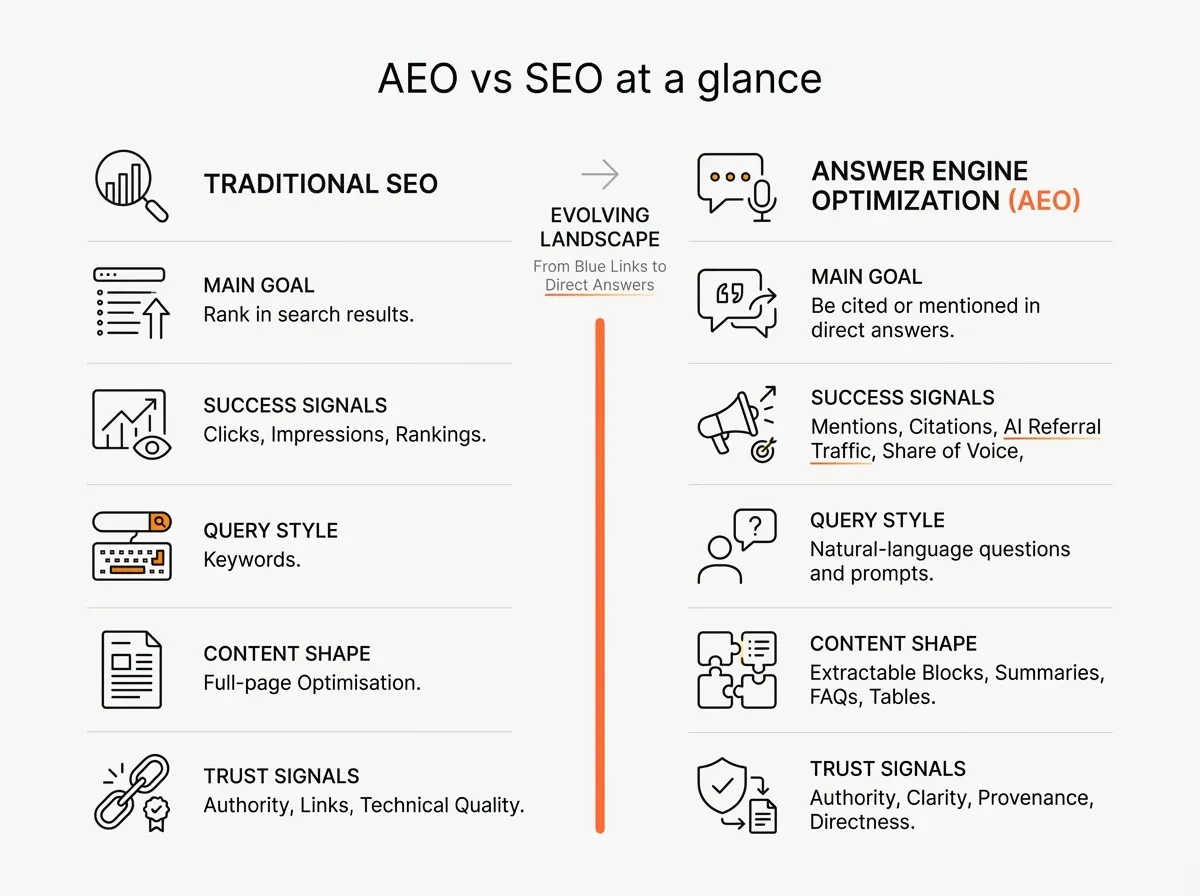
Answer engine optimization differs from SEO because the success condition is different. SEO aims to rank a page and earn the click. AEO aims to become part of the answer, whether or not the user clicks through.
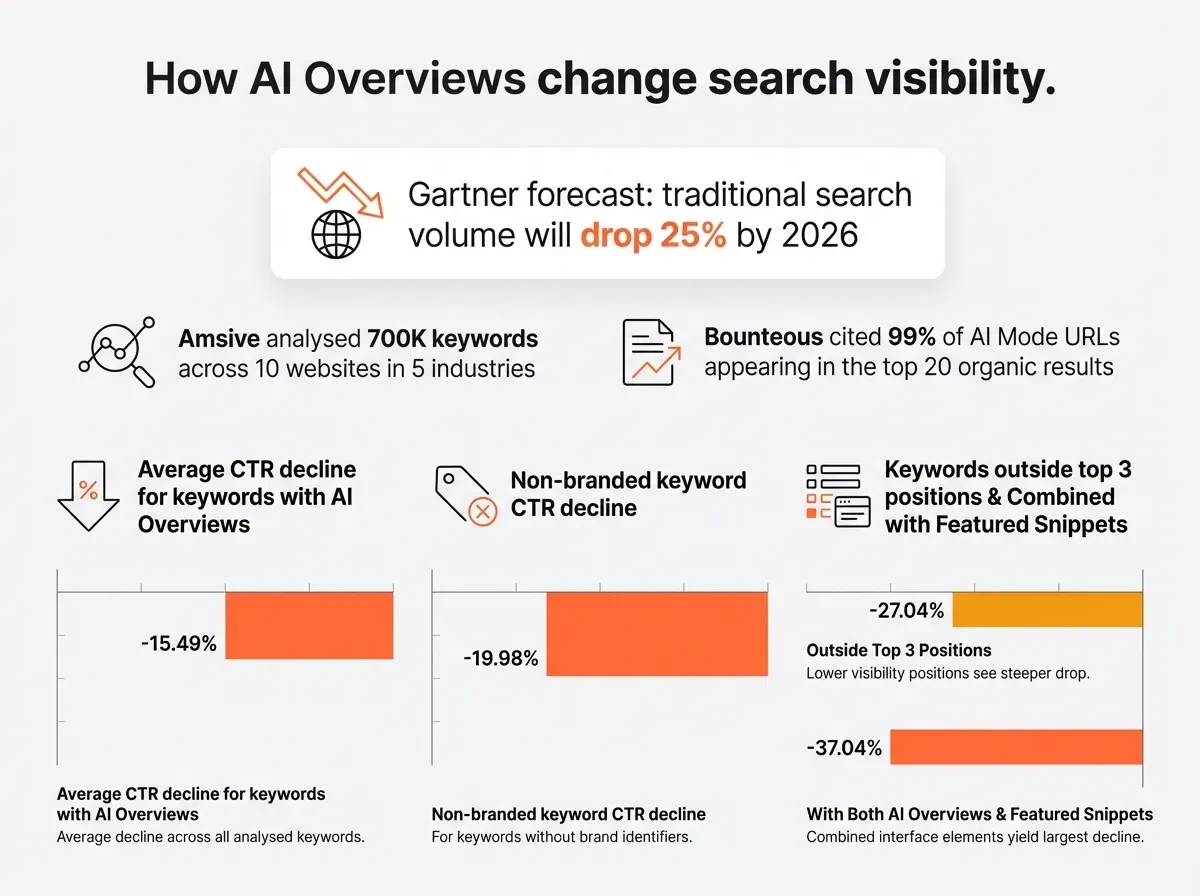
The two still overlap. Quite a lot, actually. Bounteous cites research showing that 99% of URLs in Google AI Mode also appear in the top 20 organic results. So strong SEO still matters. It just does not guarantee that your content will be the part Google or ChatGPT decides to quote.
Here is the cleaner way to think about AEO vs SEO:
| Area | Traditional SEO | AEO |
|---|---|---|
| Main goal | Rank in search results | Be cited or mentioned in direct answers |
| Success signal | Clicks, impressions, rankings | Mentions, citations, AI referral traffic, share of voice |
| Query style | Keywords | Natural-language questions and prompts |
| Content shape | Full-page optimisation | Extractable blocks, summaries, FAQs, tables |
| Trust signal | Authority, links, technical quality | Authority, clarity, provenance, directness |
HubSpot frames it pretty neatly. SEO is aimed at searchers scanning results pages. AEO is aimed at answer engines first, and readers indirectly.
That matters because the page that ranks first is not always the page that gets cited. If the writing is vague, padded, or hard to chunk into a usable answer, an AI system may look elsewhere.
Why does answer engine optimization matter if my website already ranks in Google?
Answer engine optimization matters even if your site ranks well because more search value is now being captured before the click. If your content is not built for extraction, you can rank well and still miss the answer surface where attention is actually going.
Gartner predicts traditional search engine volume will drop 25% by 2026 as AI chatbots and virtual agents absorb more queries. That forecast has been quoted a lot, partly because it lines up with what the interfaces are already doing.
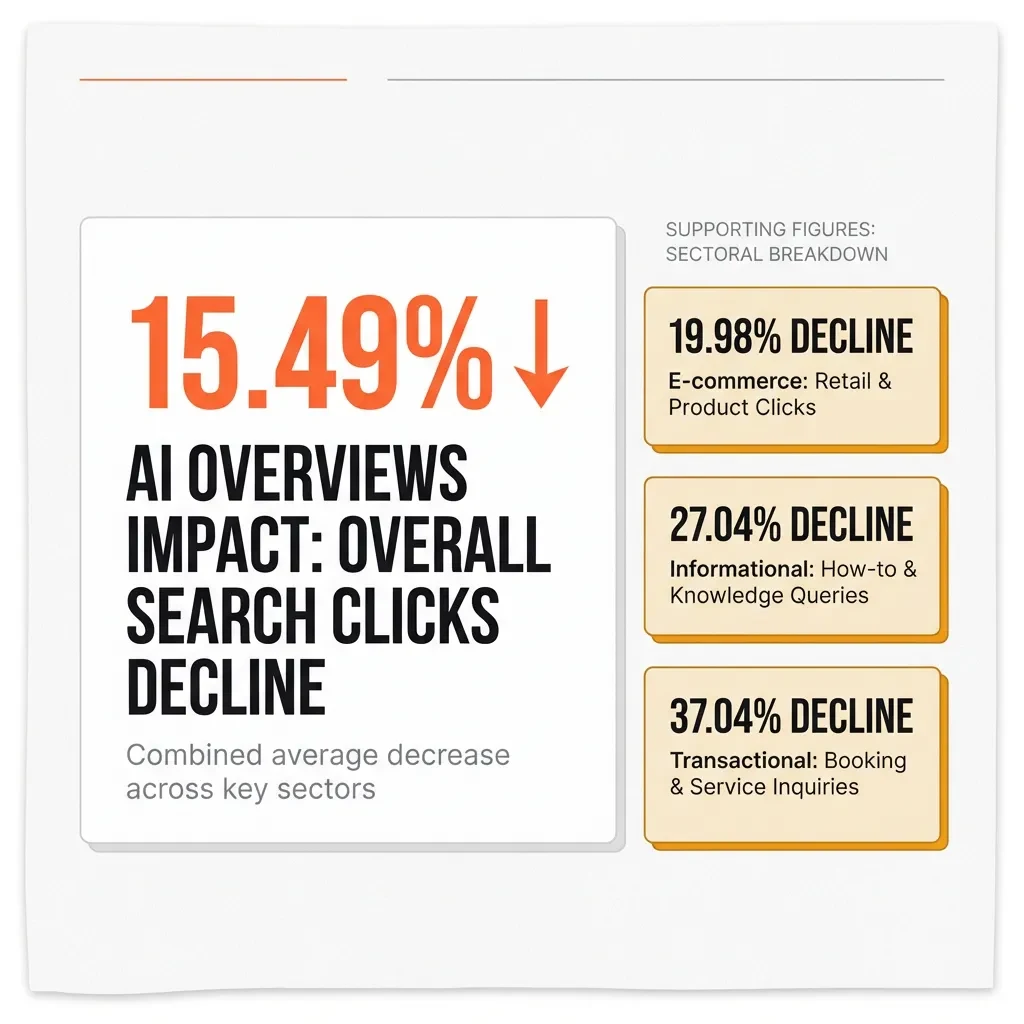
Amsive’s 2025 study is more useful day to day because it is closer to page-level impact. The firm analysed 700,000 keywords across 10 websites in five industries and found that keywords triggering AI Overviews saw an average CTR decline of 15.49%. Non-branded keywords dropped 19.98%, and keywords outside the top three positions dropped 27.04%.
That does not mean traffic disappears overnight. It means visibility is being redistributed.
Bounteous adds another useful layer here. It cites ChatGPT reaching 5.14 billion visits in April 2025, up 182% year over year, and points to a Best Western case where AI Overview visibility grew 349.5% after content was aligned to generative search behaviour. I would not use a single agency case study as gospel, but it is enough to show the direction of travel.
The practical point is this: if a buyer gets your category, your competitors, and the shortlist from an answer engine, it is a bit late to discover you were technically ranking seventh.
What should a business do first to improve visibility in answer engines?
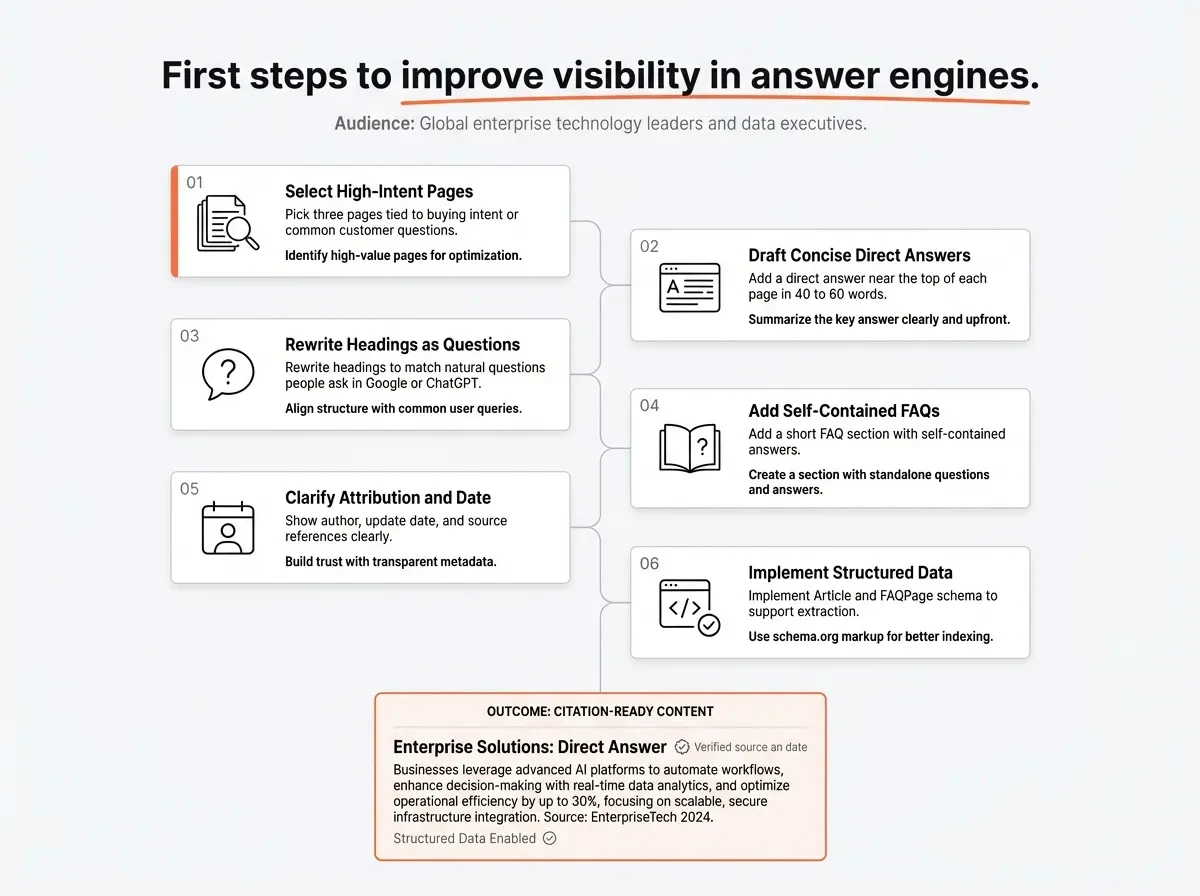
The first thing a business should do is not rebuild the whole website. Start by improving a small set of high-intent pages so they answer real questions directly, show their sources clearly, and make extraction easy for answer engines.
That usually looks like this:
- Pick three pages tied to buying intent or common customer questions.
- Add a direct answer near the top of each page in 40 to 60 words.
- Rewrite headings to match natural questions people ask in Google or ChatGPT.
- Add a short FAQ section with self-contained answers.
- Show author, update date, and source references clearly.
- Implement relevant schema, usually Article and FAQPage to start.
This is where most teams get a bit carried away. They hear “AI search” and immediately want a huge site overhaul, a new dashboard, and probably a workshop. I have done that sort of thing before. It feels productive. It often is not.
What worked better for me was smaller and more boring. Rewrite the money pages first. Tighten the answers. Add trust signals. Then watch what happens.
A practical answer-ready page often includes:
- A short summary paragraph that answers the main question immediately.
- Named entities such as Google AI Overviews, ChatGPT, Perplexity, or Gartner.
- Bullet points that can stand on their own.
- A clean table where comparisons matter.
- Structured data that helps machines identify the content type.
If you are keen to go further, pair that with stronger brand entity work. Make sure your site, LinkedIn presence, product messaging, and media mentions describe the same thing in the same language. Answer engines are not very forgiving when your digital identity is messy.
What does good answer engine optimization content look like?
Good answer engine optimization examples usually look a bit plainer than the average SEO page. That is not a flaw. It is part of why they work.
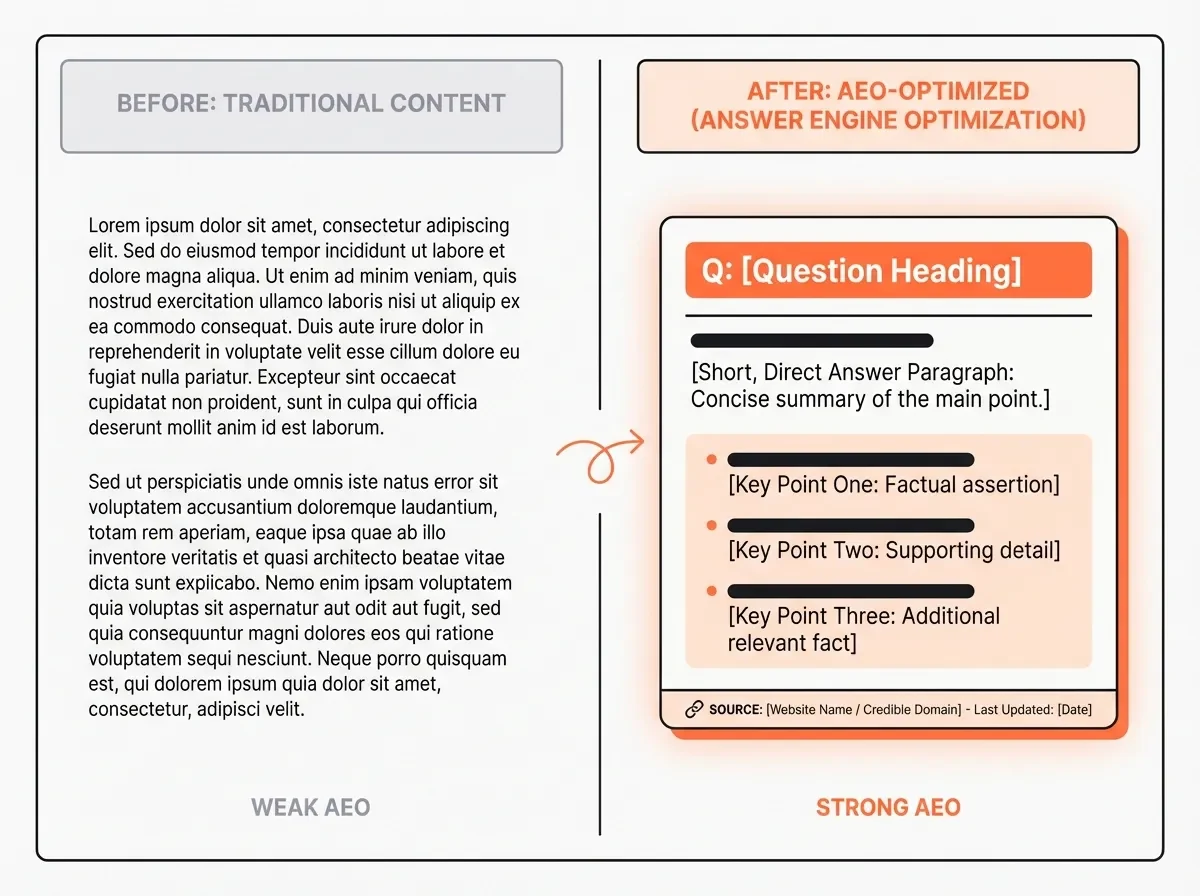
Here is a simplified before-and-after:
Weak SEO-only version
“Businesses today face an evolving landscape in search, where AI technology continues to transform the way consumers interact with content and discover relevant brands across channels.”
That sentence sounds polished enough. It also says almost nothing.
Stronger answer-ready version
What is answer engine optimization? Answer engine optimization is the practice of formatting content so tools like ChatGPT, Perplexity, and Google AI Overviews can cite it in direct answers. It works best when pages use clear question headings, short answer blocks, and visible trust signals.
That version is easier to quote, easier to verify, and easier to match to a prompt.
A lot of AEO advice ends up sounding like a call for “better content,” which is true but not very useful. The more practical test is this: could a model lift two sentences from your page and answer the user correctly without needing to tidy them up first?
If not, the page probably is not sorted yet.
Does AEO replace SEO?
No, AEO does not replace SEO. It sits on top of it.
You still need crawlable pages, sensible information architecture, useful internal linking, and content that deserves to rank. Without that, you are asking for AI citations without doing the foundational work that often gets you into the candidate set in the first place.
But SEO on its own is less complete than it used to be. Ranking matters, then extraction matters, then trust matters, then brand consistency matters. It is a longer chain.
That is why I would treat AEO as an extension of search strategy, not a rebellion against it. If your team already understands technical SEO and structured content, you are not starting from scratch. You are adapting the format and the measurement model.
This becomes more obvious when you compare it with topics like markdown vs HTML for AI crawlers. The technical base still matters. The answer layer changes what you do with it.
Frequently Asked Questions
What is answer engine optimization, and how is it different from traditional SEO?
Answer engine optimization is the practice of formatting content so AI systems like ChatGPT, Gemini, Perplexity, and Google AI Overviews can extract and cite it in direct answers. Traditional SEO is still focused on ranking pages and earning clicks, while AEO is more concerned with mentions, citations, and answer visibility.
Why does answer engine optimization matter if my website already ranks in Google?
It matters because AI interfaces increasingly answer the question before the click happens. Amsive found that keywords triggering AI Overviews saw an average CTR decline of 15.49%, so rankings still help, but they are no longer the whole story.
What should a business actually do first to improve visibility in answer engines?
Start with three high-intent pages and rewrite them in answer-first format. Add direct summaries, natural-language headings, clear source attribution, and FAQ schema so systems like Google AI Overviews and Perplexity can parse the content more easily.
Can small businesses benefit from AEO, or is it mainly for large brands?
Small businesses can benefit from AEO if they publish clear, trustworthy answers in the categories they want to be known for. Large brands often have more authority to begin with, but smaller firms can still win specific question spaces by being more direct, more useful, and less vague.
Conclusion
Answer engine optimization is not just another shiny acronym. It is a practical response to the way search products now behave.
If your content is clear, evidence-based, and easy to extract, you have a better chance of showing up in the answers people read first. If it is buried, fluffy, or written like a brochure, you probably will not.
A sensible first step is to audit three important pages this month. Rewrite them in answer-first format, add visible trust signals, and track whether your brand starts appearing more often across AI search surfaces. That is usually enough to learn something useful before you spend real money on the bigger programme.
Continue Reading
Deep Dive15 min read
What Is robots.txt? How It Works and Where Its Limits Begin
Robots.txt is an origin-scoped plain-text protocol that guides compliant crawlers but cannot secure resources or reliably control indexing. Its effect depends on retrieval status, user-agent groups, path matching, crawler-specific rules, and cache behaviour.
Rosh Jayawardena
Deep Dive11 min read
What Is Artificial Intelligence Search? A Business Owner's Guide
Artificial intelligence search is the new place customers ask for recommendations. Here's a plain-English guide to what it is, where it happens, and what it means for being found by your customers.
Rosh Jayawardena
Deep Dive9 min read
AI Search Visibility: Why Brands Keep Showing Up
AI search visibility is not just rankings. Learn why some brands get cited in AI answers and how to improve your visibility.
Rosh Jayawardena
Deep dives, delivered weekly
AI patterns, workflow tips, and lessons from the field. No spam, just signal.