Back to Blogs
How to Get Cited by ChatGPT for Your Business
9 min readMay 1, 2026
AEO Foundations

Rosh JayawardenaData & AI Executive
Learn how to get cited by ChatGPT with practical fixes for crawlability, page structure, schema, and off-site authority.
How to Get Cited by ChatGPT for Your Business
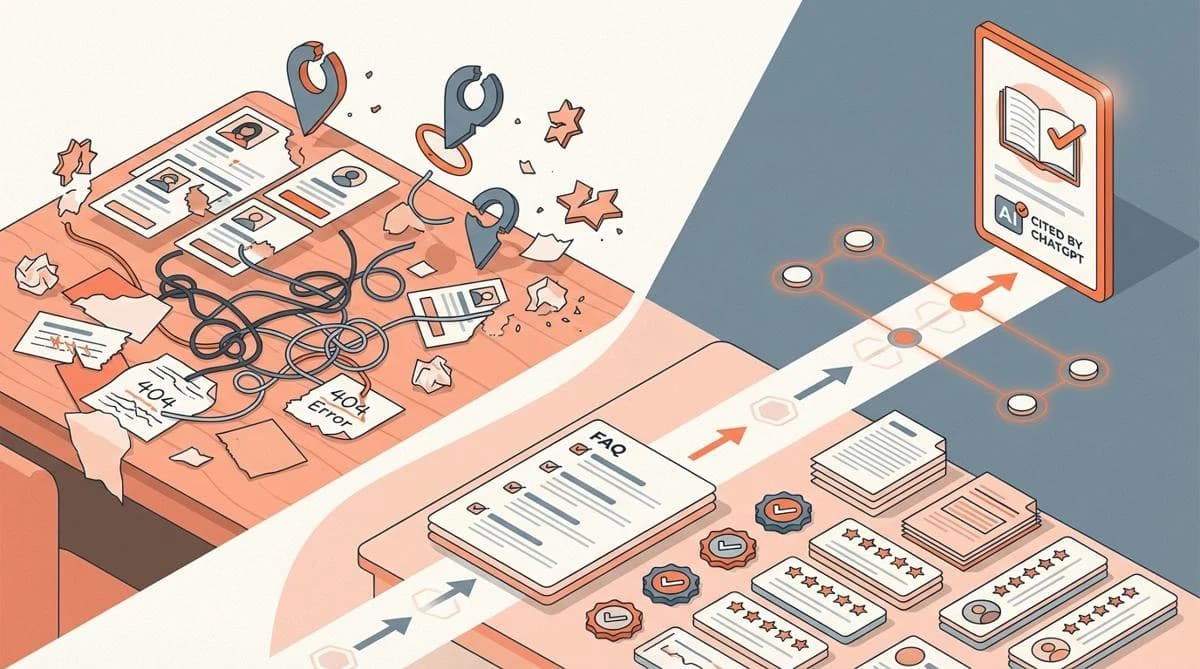
If you are trying to work out how to get cited by ChatGPT, the short answer is fairly practical. You need pages that are easy to retrieve, easy to quote, and easy to trust.
That sounds obvious, but a lot of the advice in this space has drifted toward tricks. Add this file. Use that schema plugin. Rename everything as a framework. Some of that helps a bit. Most of it is secondary.
What I have found is that ChatGPT citations look more like the result of solid content operations than a clever technical hack. The businesses that show up tend to be clear on what they do, consistent across the web, and specific enough to quote.
If you have already read our breakdown of what answer engine optimization is, this is the practical next step. This piece is about what to fix first.
How does ChatGPT decide which businesses and websites to cite in its answers?
ChatGPT tends to cite sources that fit the question closely, are structured in a way it can extract cleanly, and look trustworthy across the wider web.
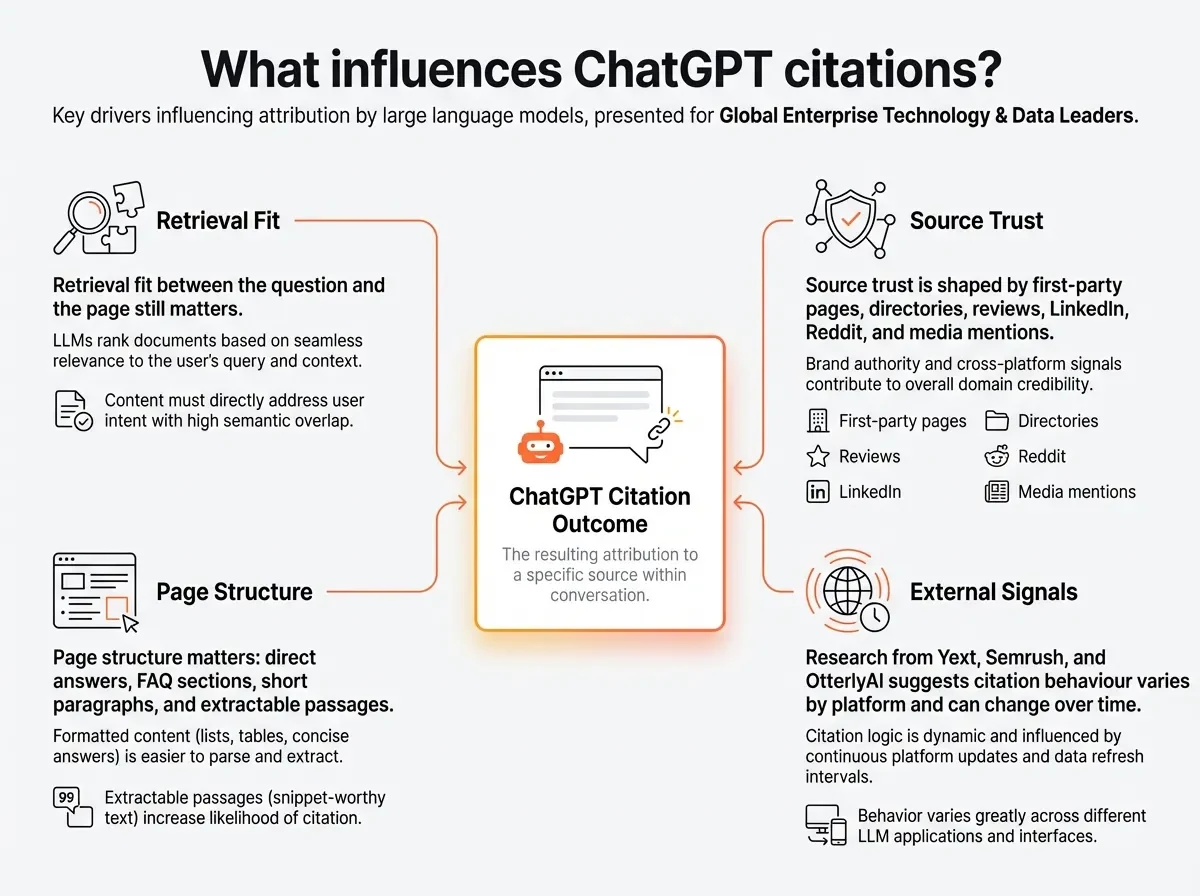
That is the bit people often miss. It is not just about your website, and it is not just about ranking first in Google. It is about whether a page gives the model something useful to lift into an answer, and whether the brand behind that page looks credible enough to mention.
Yext’s 2026 research analysed 17.2 million distinct AI citations across Q4 2025 and found that model behaviour varies quite a lot by platform. Gemini leaned more heavily toward first-party sources in several sectors, while Claude relied far more on user-generated and limited-control sources. That matters because there is no single AI visibility formula.
Semrush saw the same instability from a different angle. Its 2025 study covered 230,000 prompts and more than 100 million AI citations, and showed that ChatGPT’s most-cited domains shifted sharply over a short period. Reddit and Wikipedia were still important, but their share moved around more than many marketers expected.
So yes, retrieval matters. Authority matters. Format matters. Your mileage may vary depending on the query, the category, and what sources the system currently trusts.
What this means in practice
If your page buries the answer under a long preamble, ChatGPT has to work harder to use it.
If your business facts are inconsistent across your site, LinkedIn, Google Business Profile, and directories, the trust picture gets fuzzy.
If a third-party source like Reddit, LinkedIn, Forbes, or Wikipedia explains the topic better than you do, ChatGPT may cite them instead. Fair enough, really.
What should a small business fix first if it wants to be cited by ChatGPT?
A small business should usually fix crawlability, answer structure, and business fact consistency before it spends time on newer AEO tactics.
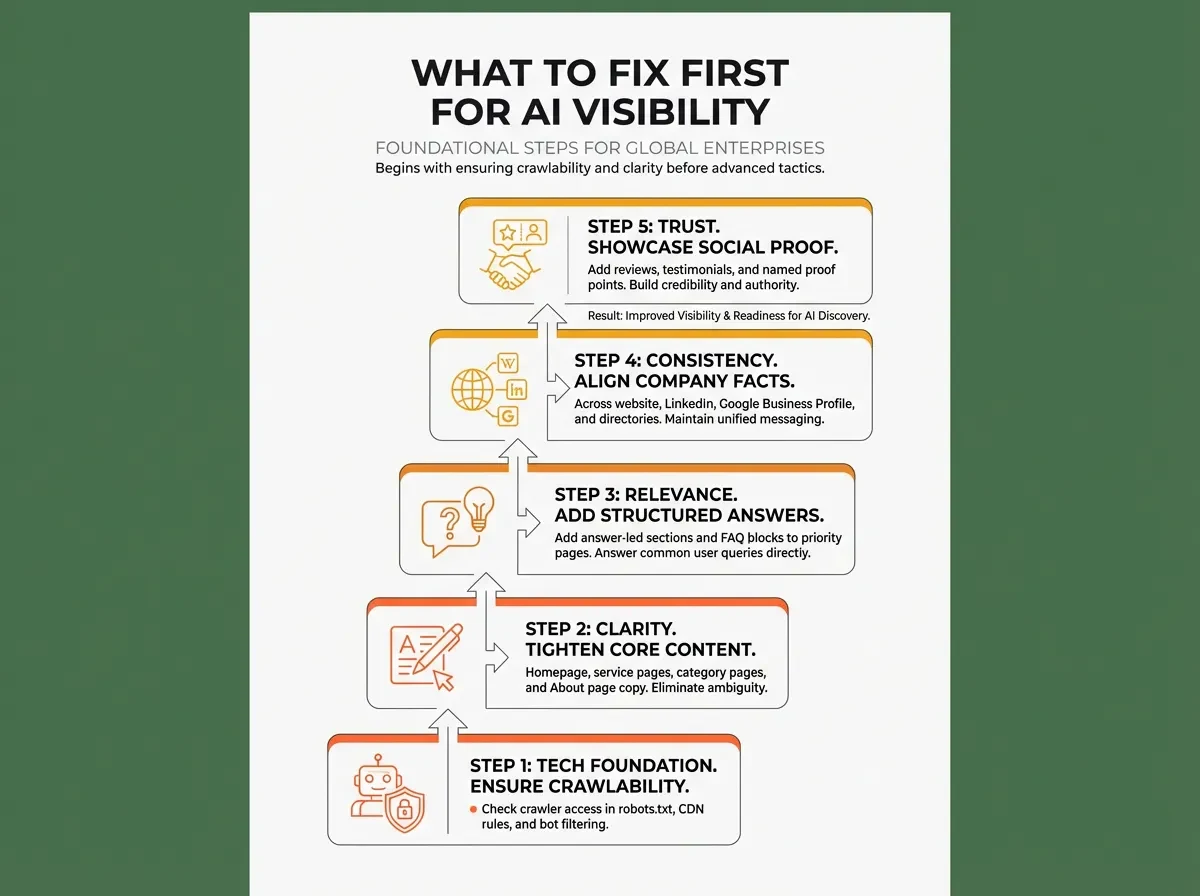
I got this wrong at first. I assumed a couple of technical tweaks would move the needle quickly. In practice, the bigger gains usually came from fixing ordinary content problems we should have sorted earlier.
OtterlyAI’s 2026 citation report analysed more than 1 million citations and reported that 73% of sites had technical barriers that blocked AI crawler access. If that figure is even directionally right, plenty of sites are making themselves invisible before content quality becomes the issue.
Start here:
- Check crawler access. Review
robots.txt, CDN rules, and any bot filtering that might block GPTBot, ChatGPT-User, or OAI-SearchBot. - Tighten your core pages. Your homepage, service pages, category pages, and About page should explain exactly what you do in direct language.
- Add answer-led sections. Build short H2 and H3 sections that answer questions in 30 to 60 words before expanding.
- Clean up your entity signals. Make sure your company name, services, locations, authors, and descriptions match across your website, LinkedIn, Google Business Profile, and major directories.
- Use reviews and proof properly. Real testimonials, ratings, and named case examples help trust far more than vague claims.
If you want a technical companion to this, we covered some of the foundation in our look at markdown vs HTML for AI crawlers. The short version is that accessible, well-structured HTML still matters a lot.
What not to fix first
Do not start with llms.txt because somebody on LinkedIn said it is the future.
Do not spend two weeks adding generic schema to everything while your main service page still does not answer the basic customer question.
And do not assume ChatGPT citations are separate from general brand clarity. They are not.
Create pages ChatGPT can quote without rewriting
The easiest way to improve ChatGPT citations is to write pages that are quotable as they are.
That means a heading that matches the question, followed by a direct answer, followed by supporting detail. Not a dramatic intro. Not six throat-clearing paragraphs. Just the answer.
A good citation-friendly section usually has:
- a question-led heading
- a first sentence that answers it directly
- one specific example, number, or named entity
- a short explanation of what to do next
This is where a lot of vendor content is accidentally useful. The better-ranking pages often use short answer blocks, FAQ sections, and lists because those formats are easier for both humans and machines to scan.
What I would avoid is writing every page like a featured snippet machine. That gets sterile fast. The goal is not robotic copy. It is reducing the effort required for ChatGPT to understand and quote your point.
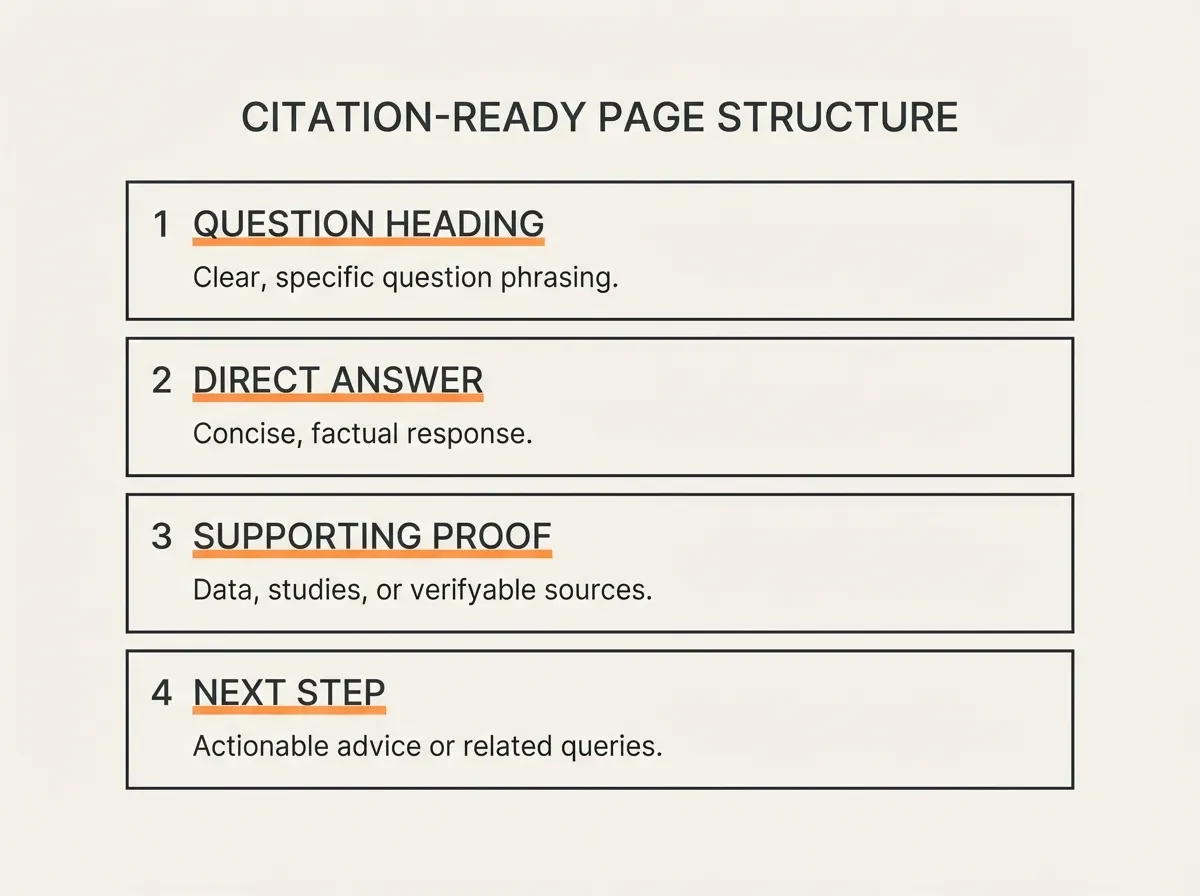
A simple structure that works
| Element | What to include |
|---|---|
| H2 question | Match a real buyer question in natural language |
| First sentence | Direct answer under 40 words |
| Support | One statistic, example, or named entity |
| Next step | A practical implication or action |
That structure is not fancy. It is just clear. And clear is usually underpriced.
Does schema markup or llms.txt actually help you get cited by ChatGPT?
Schema markup can help with clarity, but generic schema on its own does not seem to guarantee ChatGPT citations. llms.txt is worth watching, but I would treat it as optional for now.
This is where the category gets noisy. Plenty of articles treat schema as a direct ranking button for AI citations. The evidence is thinner than that.
Growth Marshal’s 2026 study looked at 730 AI citations across 75 commercial queries and found that generic schema had a null result after corrected modelling. The strongest predictor of citation was still Google organic rank position. There was one useful exception: Product and Review schema with concrete fields such as pricing, specifications, and aggregate ratings performed better than generic Article or Organization markup.
So my view is fairly simple:
- Use Article and FAQPage schema because they help machines classify the page.
- Use Product or Review schema when you have real attributes to expose.
- Do not expect schema alone to rescue weak content.
llms.txt is even murkier. It may become more useful over time, and I am keen to keep an eye on it, but the evidence today is nowhere near strong enough to treat it as a priority-one task for most businesses.
If your service pages are vague, your reviews are thin, and your business is barely mentioned off-site, llms.txt will not save you. Not bad actually, in a way. It keeps the focus on the work that matters.
The better technical priority
If you have limited time, I would prioritise this order:
- Crawlable HTML content
- Clear headings and answer blocks
- FAQ and Article schema
- Product or Review schema where appropriate
- llms.txt as a low-risk extra, not a centrepiece
Why off-site mentions still matter for ChatGPT citations
Your website is only part of the citation picture. ChatGPT also learns trust from the broader web.
OtterlyAI reported that community platforms captured 52.5% of citations in its 2026 dataset. Semrush found Reddit, Wikipedia, LinkedIn, Forbes, and other third-party domains turning up repeatedly in AI answers. Yext’s work showed that different models rely on different mixes of first-party, listing, review, and independent sources.
That means your AI visibility is partly shaped by things you do not fully control:
- reviews on Google or industry platforms
- mentions in trade publications
- founder and company credibility on LinkedIn
- directory consistency
- useful contributions in trusted communities
This is also why bland content marketing often underperforms. If the only place a claim exists is on your own blog, it carries less weight than a claim that is supported by reviews, interviews, citations, or discussion elsewhere.
We saw a broader version of this in our piece on AI search visibility and the brands winning in AI search. The winners usually have stronger entity signals, not just better blog formatting.
A practical 30-day plan to improve your odds of being cited
If I were sorting this for a normal business over the next month, I would keep it pretty tight.
Week 1: fix access and facts
- audit
robots.txtand bot access - confirm key pages render clean HTML
- standardise company descriptions across site, LinkedIn, and listings
Week 2: upgrade your core pages
- rewrite homepage and service page intros to answer the main question immediately
- add FAQ sections to priority pages
- tighten About page facts, authorship, expertise, and trust signals
Week 3: add proof and structure
- implement FAQPage and Article schema
- add named case studies, testimonials, reviews, or statistics
- create one comparison page or explainer page around a high-intent question
Week 4: build corroboration
- publish one useful LinkedIn post from a named person
- update top directories and profiles
- look for one industry publication, partner site, or community where your expertise can be referenced naturally
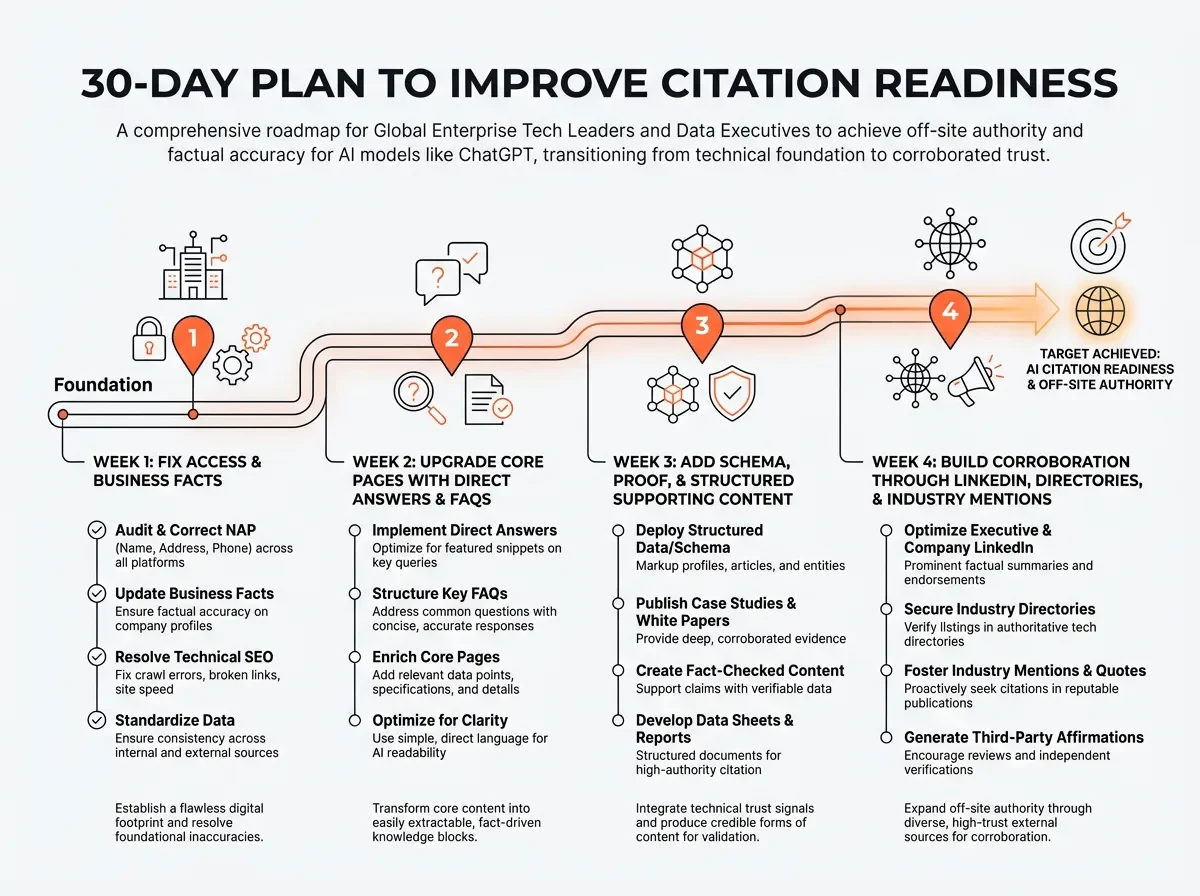
That plan will not guarantee ChatGPT citations. Nothing will. But it is a sensible way to improve your AI visibility without disappearing into the technical weeds.
Frequently Asked Questions
How does ChatGPT decide which businesses and websites to cite?
ChatGPT appears to cite sources based on retrieval fit, extractable page structure, and wider trust signals rather than a single ranking factor. Research from Yext, Semrush, and OtterlyAI suggests that source preferences also vary by model, topic, and platform.
What should a small business fix first if it wants to be cited by ChatGPT?
Most small businesses should start with crawler access, clear service-page copy, FAQ sections, and consistent business facts across the web. If ChatGPT cannot access your content or verify who you are, more advanced AEO work will have limited effect.
Does schema markup or llms.txt actually help you get cited by ChatGPT?
Schema markup helps machines interpret your content, especially when it includes concrete attributes such as reviews, prices, or product details. Current evidence suggests generic schema alone is not enough, and llms.txt is still better treated as an optional extra than a proven citation lever.
Can a business get cited by ChatGPT without ranking number one in Google?
Yes, although strong organic visibility still helps. Growth Marshal’s research suggests Google rank position remains an important predictor, but ChatGPT can still cite lower-ranked pages when they answer the question more clearly and provide better extractable passages.
Conclusion
If you want to improve your chances of being cited by ChatGPT, do the boring work first. Make your pages crawlable. Make your answers clearer. Make your business easier to verify across the web.
That is less exciting than chasing the latest technical shortcut, but it is usually the bit that works. Start with your highest-value pages, tighten the structure, add useful proof, and build authority around one topic cluster at a time. That will get you further than another shiny AEO tactic ever will.
Continue Reading
AEO Foundations19 min read
AI Discoverability: How AI Systems Find and Surface Information
AI discoverability is the layered process by which systems acquire information, interpret entities, retrieve relevant material, select sources, and present claims in generated answers; technical accessibility supports eligibility but never guarantees citation, recommendation, traffic, or influence.
Rosh Jayawardena
AEO Foundations9 min read
llms.txt Explained: Should Your Website Have One?
llms.txt explained for real businesses: what it does, where it may help, and why most sites should fix bigger issues first.
Rosh Jayawardena
AEO Foundations10 min read
The AEO glossary: AEO, GEO, LLMO, AI SEO — what they mean and which one to care about
Four acronyms describe the same shift in AI search. Here's what each one means, who uses it, and the one we recommend standardising on.
Rosh Jayawardena
Deep dives, delivered weekly
AI patterns, workflow tips, and lessons from the field. No spam, just signal.