Back to Blogs
How NZ Agencies Get Local Clients Cited in AI Answers
13 min readOct 29, 2026
How To

Rosh JayawardenaData & AI Executive
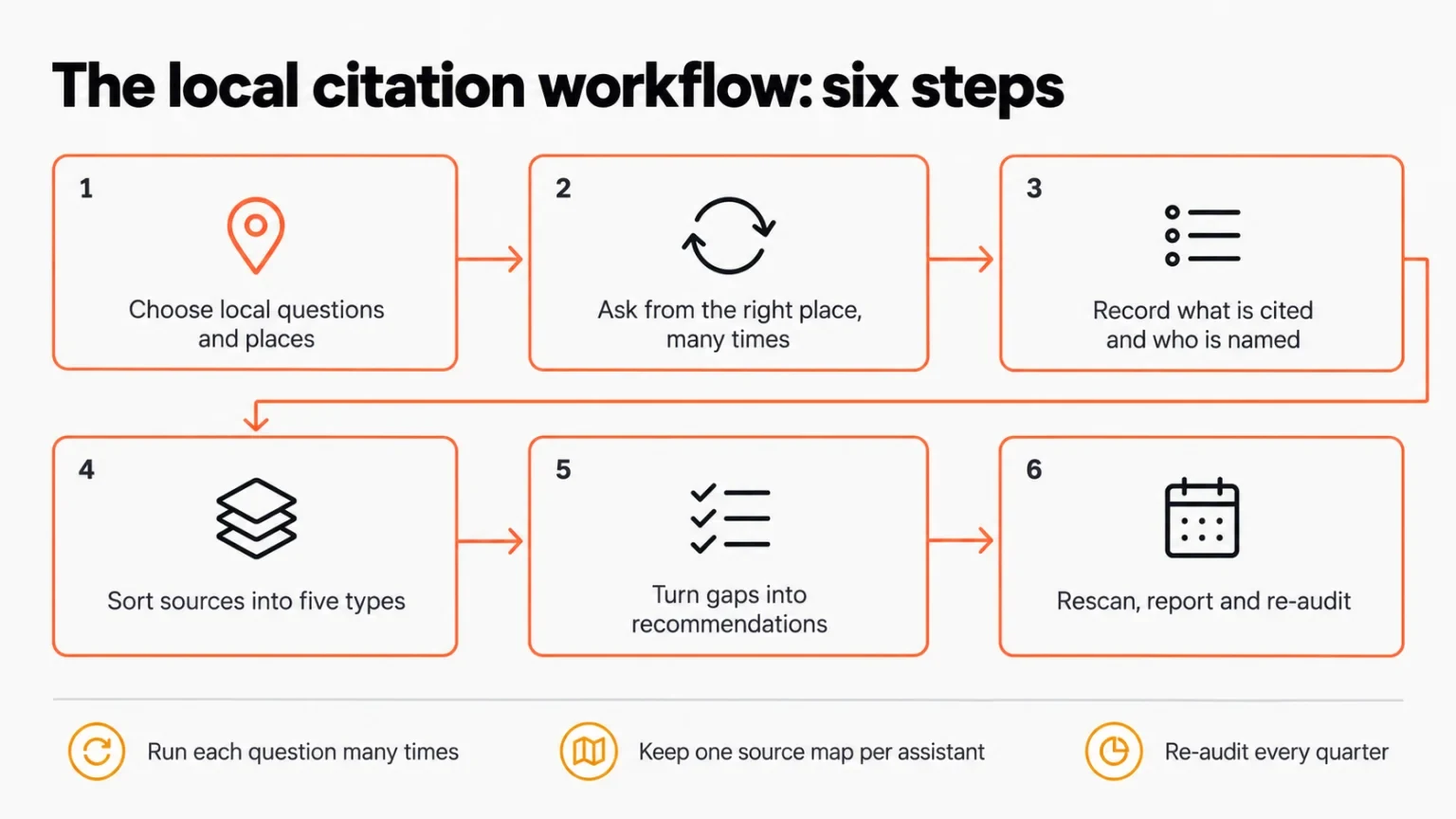
A six-step workflow for New Zealand agencies: find which sources AI cites for a local client, sort them, and turn the gaps into recommendations.
When customers ask ChatGPT for local businesses, most locations don't make the answer. SOCi, which sells local marketing software, studied more than 350,000 locations belonging to 2,751 multi-location brands for its 2026 Local Visibility Index. ChatGPT recommended 1.2% of them, while Google's local 3-Pack, the three businesses shown beside the map, showed 35.9% (SOCi, January 2026).
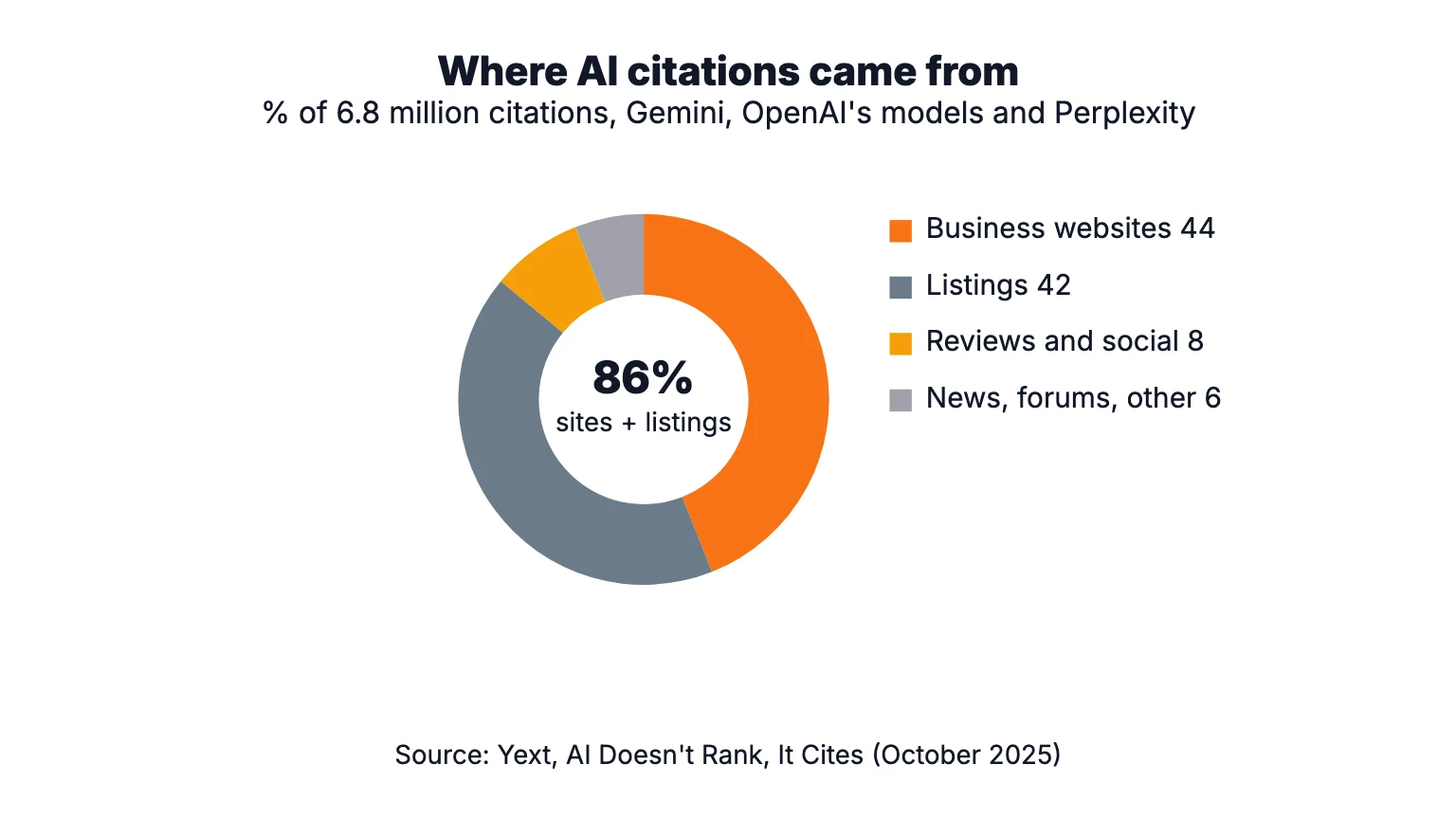
Yext, which sells listings management, analysed 6.8 million citations from Gemini, OpenAI's models and Perplexity and found that 86% came from the business's own website or its listings, sources a business manages or can influence (Yext, October 2025). A citation here means a web page the assistant links to as a source for its answer.
There's a catch for New Zealand agencies. Almost all of this research uses US data, and we couldn't find a published study of which sources AI assistants cite for New Zealand local searches. So the answer has to be found client by client. This guide sets out a six-step workflow for doing that. Onsomble makes an AI visibility platform for agencies; the workflow works with any tool that records which pages AI cites. If the terms are new to you, our glossary of AEO, GEO and related terms explains them.
Key Takeaways
- AI assistants name far fewer local businesses than Google's map results do: ChatGPT recommended 1.2% of locations in SOCi's 2026 data, against 35.9% in the local 3-Pack.
- Most citations come from sources a business manages or can influence, its website and its listings (86% in Yext's data).
- Each assistant leans on different sources, and those sources can change within weeks, so audit each assistant separately and repeat the audit.
- US directory lists don't carry over to New Zealand. Record which sites AI actually cites for each client before recommending anything.
Before you begin
Gather these for each client before the first run:
- The service area, as suburbs, towns or regions. A plumber covering the Hutt Valley needs different questions from one covering all of Wellington.
- Five to ten questions per area that a local customer would ask an assistant, such as "who's a good emergency plumber in Hamilton" or "best family dentist in Tauranga".
- Three to five local competitors, chosen from the businesses the client actually loses work to.
- The assistants that matter: usually ChatGPT, Google AI Overviews and AI Mode, Gemini and Perplexity.
If you'd like to try the questions by hand first, our AI discoverability self-audit walks through it for one business.
Step 1: Choose the local questions and places
Start with what customers actually ask, written separately for each place the client serves.
Write questions the way customers ask them. Some name a place ("plumber in Lower Hutt"), and many don't ("who can fix a burst pipe tonight"). Include both kinds, because assistants work out a location even when the question doesn't give one. Step 2 covers how.
Mix three kinds of question:
- Recommendation questions, such as "who's the best electrician in Nelson for an old villa".
- Comparison questions, such as "is it better to use a big firm or a local accountant in Napier".
- Specific needs, such as "dentist in Tauranga open on Saturdays".
Keep one list per service area rather than one for the whole client. A business that serves three towns can be named often in one and never in the others.
This step is done when each client has five to ten questions for every area they serve.
Step 2: Ask from the right place, more than once
The answers only count if they match what a local customer would see.
Where a question is asked changes the answer. In a study of 31,200 AI answers, Mahe Chen and Nick Koudas found that ChatGPT follows the location declared by the tool sending the question, down to the city, and localises its searches even when the question names no place. Gemini ignores the declared location and follows the country of the network. The sources cited changed with location, and so did the businesses recommended (Chen and Koudas, arXiv, October 2026). The paper is a preprint and hasn't been peer reviewed yet.
Answers also shuffle from one run to the next. SparkToro and Gumshoe.ai, which sells AI tracking, found less than a 1-in-100 chance that ChatGPT or Google's AI answers return the same list of brands twice. A brand's presence across many runs was far more stable, and the authors suggest 60 to 100 runs per question for a reliable figure (SparkToro, January 2026).
For each client, set the city for every question and run each one repeatedly. By hand, you can name the place in the question and ask from a New Zealand internet connection, but you can't set ChatGPT's declared city precisely, and the runs add up fast: seven questions in two areas on four assistants comes to 3,360 runs at 60 each. A quick manual check shows whether a client appears at all; for figures you'd report to a client, use a tool that sets the location and repeats the runs. We've written more on why AI answers vary by location and how to measure location effects.
This step is done when every question has been run many times from each of the client's areas, on each assistant.
Step 3: Record what gets cited and who gets named
Every answer gives you two different things: the pages the assistant used, and the businesses it recommended. Log both.
For every answer, record:
- the question, the place and the assistant
- the businesses named, in order
- every cited page, with its full address
Keep the names and the citations apart. A cited page shows what the assistant read. A named business is the outcome the client cares about. A client can be cited without being named, and named without its own site being cited.
Record full page addresses, not just domains. Exact addresses show which of the client's pages AI relies on, and whether it's the page the client's Google Business Profile points to.
A simple log with one row per answer is enough. These rows are a made-up example:
| Question | Place | Assistant | Businesses named | Pages cited |
|---|---|---|---|---|
| Emergency plumber open now | Hamilton | ChatGPT | Three local firms, client second | Two business websites, one directory listing |
| Emergency plumber open now | Hamilton | Google AI Mode | Four firms, client absent | Google Maps listings for all four |
Over many runs the rows add up to two counts per question: how often the client is named, and how often each site is cited.
This step is done when every run is logged with its named businesses and its cited pages.
Step 4: Sort the sources into five types
Sorting the cited pages turns a long log into a source map: the kinds of site AI relies on in each client's area.
Sort every cited page into one of five types:
- The business's own website. Yext found 44% of citations came from business websites. Steady Demand, a US local SEO firm, ran about 8,000 local-service searches through Google AI Overviews and AI Mode; business websites made up 70.7% of AI Overviews' local citations (Steady Demand, August 2026).
- Google Business Profile and map listings. BrightLocal, which sells local SEO tools, published an August 2026 study of 1,355 locations in the US, UK and Australia. It found Google Business Profile made up 28.63% of all citations and was cited for 94% of businesses (BrightLocal, August 2026). In Google AI Mode, Steady Demand found Google Maps made up 79.8% of local citations.
- Directories. In the same BrightLocal study, Yelp made up 9.53% of citations and appeared in about 80% of ChatGPT's answers. Niche directories were cited far less, around 0.1% to 0.5% each.
- Reviews and social. Yext put these at 8% of citations overall and 13.3% for food businesses.
- News, forums and other. Yext put these at 6%, with forums such as Reddit at 2%.
Each assistant has its own mix
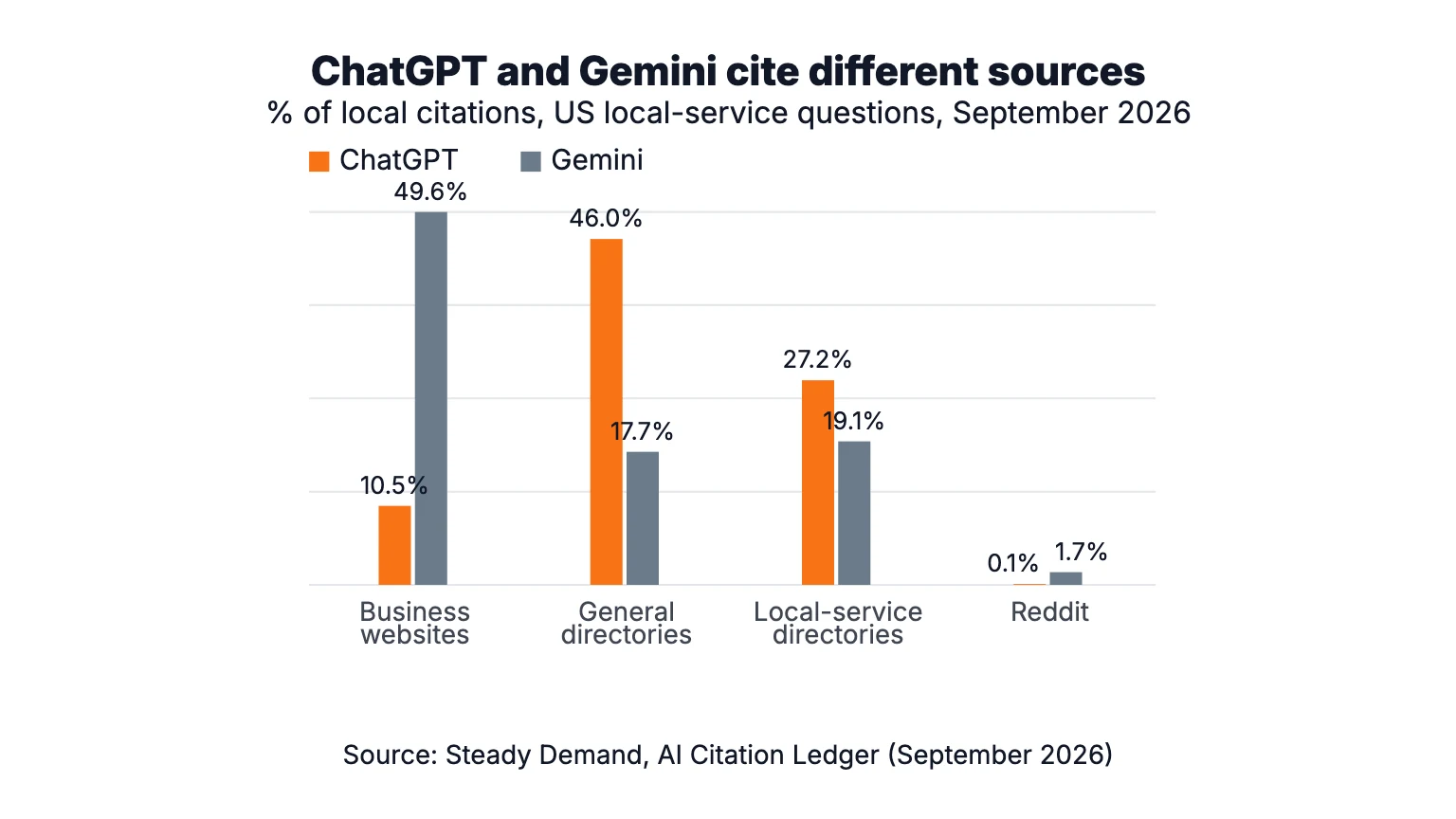
The assistants differ. Yext found Gemini favours business websites, OpenAI's models lean on third-party listings, and Perplexity spreads its citations across reviews and local pages. Keep a separate source map for each assistant.
Steady Demand's AI Citation Ledger shows the same split in US local-service questions. In its September 2026 figures, ChatGPT drew most of its local citations from directories, while Gemini drew about half from business websites (Steady Demand, September 2026).
The five types carry over to New Zealand; the specific sites may not. Yelp's weight in US data says nothing about which directories AI cites for a Christchurch builder. Sort the domains you actually recorded, and let them decide which directories matter.
Sorting rules for tricky sites
Some sites need a rule so the sorting stays consistent from client to client:
- A business's own Facebook or Instagram page counts as a listing, because the business controls it. Other people's posts and groups count as social.
- Booking and quote marketplaces, where customers find and contact a tradesperson, count as directories.
- "Best of" lists written by a local publisher count as news, because the business doesn't control them.
Write the rules down once and apply them to every client, so source maps can be compared across your client list.
This step is done when each client has a source map per assistant, with every cited domain sorted into a type.
Step 5: Turn each gap into a recommendation
Each gap in the source map becomes a specific piece of work.
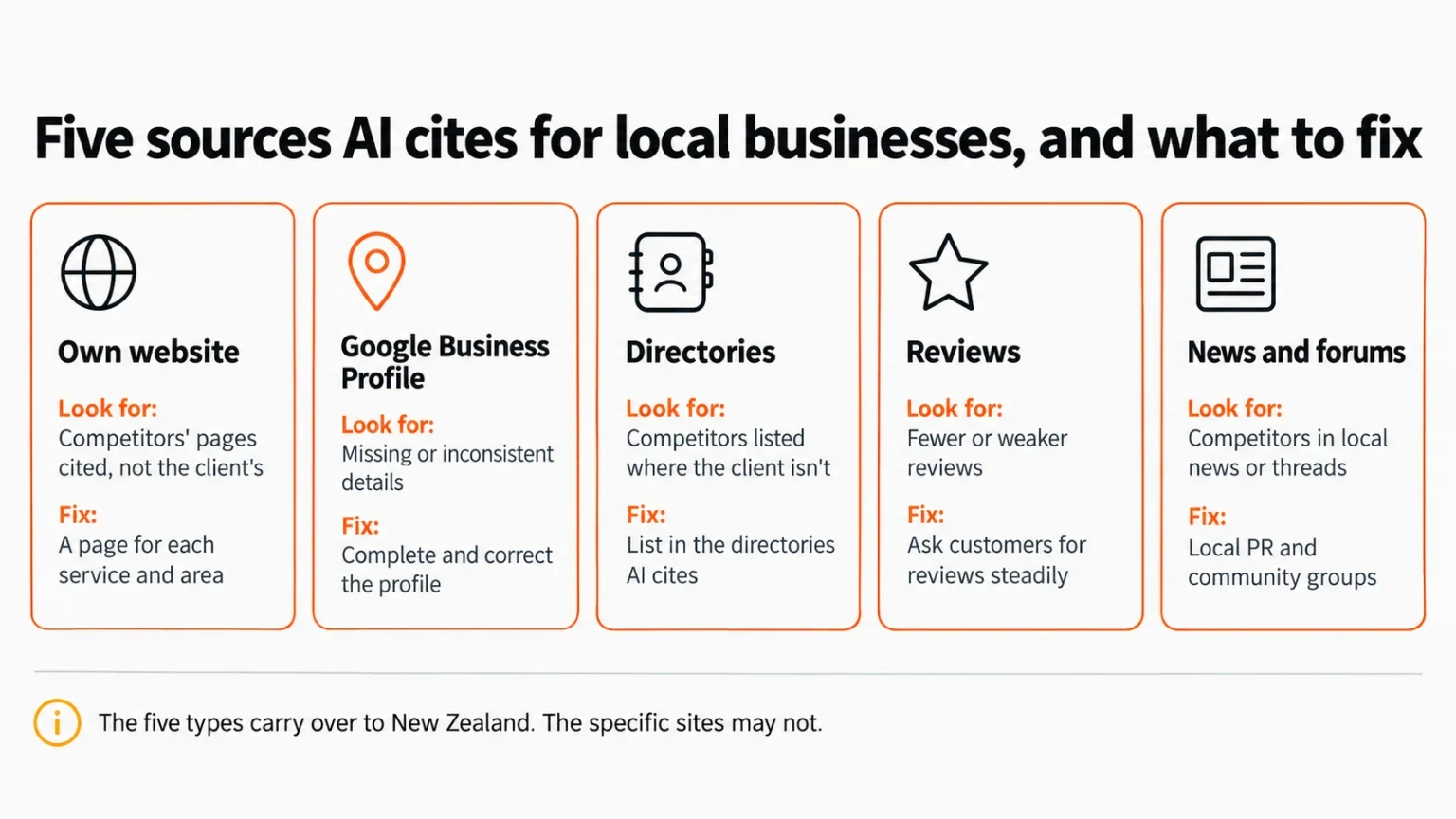
Compare the client's source map with those of the competitors AI names. Each gap points to a fix:
| Source type | Gap to look for | Recommendation |
|---|---|---|
| Own website | Competitors' service or area pages are cited; the client's aren't | A page for each service and area, with the facts customers ask about |
| Google Business Profile | Missing, incomplete or inconsistent details | Complete and correct the profile, with the same website as the client's main site |
| Directories | Competitors appear in a directory the client isn't in | A listing in the directories actually cited for that area |
| Reviews | Fewer or weaker reviews than the businesses AI names | A steady process for asking customers for reviews |
| News and forums | Competitors mentioned in local news or community threads | Local PR and genuine participation in community groups |
What to fix first
Two findings shape the priorities. SOCi found the locations ChatGPT recommended averaged 4.3 stars, and that inconsistent or incomplete listings lower an assistant's confidence in a business. Steady Demand placed a made-up word in a Google Business Profile post and searched for it 43 times across Google Search and AI Overviews, AI Mode, ChatGPT, Claude, Perplexity and Google Maps (Steady Demand, September 2026). None of them returned it, while a test phrase placed on a website was found by most of them. Put important facts on the website and in the profile's core fields rather than relying on profile posts.
For more on the website side, see how to get mentioned in Google AI Overviews and our evidence-led process for ChatGPT.
This step is done when every recommendation names the gap it closes, the assistant it affects and who will do it.
Step 6: Rescan, report and re-audit
The last step proves what changed and keeps the source map current.
Sources move quickly. In Steady Demand's US tracking, Reddit made up 41.7% of ChatGPT's local citations in July 2026. After a change on 20 August, a check of 334 ChatGPT citations found none from Reddit, and a later re-run put Reddit at 0.1% (Steady Demand, 2026).
The same pattern shows over a longer period. In BrightLocal's November 2024 study of 800 ChatGPT searches, Yelp didn't appear among the directories cited (BrightLocal, 2024). By August 2026 it appeared in about 80% of ChatGPT's answers in BrightLocal's newer study. The two studies used different methods, so treat this as a direction rather than a precise trend.
Rescan after each round of fixes, and report the before and after measured the same way: how often the client is named, and which of its pages are cited. Repeat the full source audit each quarter, because a directory that matters today can stop mattering in weeks.
A client report needs only four parts:
- How often the client was named for each question and place, before and after, on each assistant.
- Which of the client's pages were cited, before and after.
- The recommendations completed since the last report.
- Any change in which sources the assistants cite, from the quarterly audit.
This step is done when the client has a before-and-after report and a date for the next audit.
Common mistakes to avoid
Copying a US directory list. US studies show which directories matter in the US. Use your own source map for each New Zealand area instead.
Relying on profile posts. Steady Demand's test found no assistant returned a fact that lived only in a Google Business Profile post. Put the facts on the website and in the profile's main details.
Judging from one run. One answer can name anyone. Count how often a business appears across many runs.
Auditing once. ChatGPT's sources changed within weeks in 2026. Schedule the audit again.
What success looks like
After the first round, each client should have:
- questions, places and competitors set up for every area they serve
- a source map per assistant, with every cited domain sorted into a type
- a recommendation list tied to those gaps, with owners
- a before-and-after report and a date for the next audit
For background on how AI-crawled sites perform for local businesses, see our study of 850,000 sites.
Run the workflow on your own clients
Onsomble runs your clients' questions from New Zealand cities across ChatGPT, Gemini, Google AI Overviews and AI Mode, Copilot, Perplexity and Claude, records every cited source, and ties each recommendation to the finding behind it. Try it on your own clients with a 30-day free trial.
Sources
- SOCi, "In AI-driven discovery, few brands are chosen, most disappear" (2026 Local Visibility Index), 28 January 2026. More than 350,000 locations across 2,751 multi-location brands. https://www.soci.ai/news/in-ai-driven-discovery-few-brands-are-chosen-most-disappear/
- Yext, "AI Doesn't Rank, It Cites. And 86% of Its Sources Are Brand-Managed", 9 October 2025. 6.8 million citations from more than 1.6 million responses. https://www.yext.com/blog/ai-citations-86-percent-of-sources-are-brand-managed
- BrightLocal, "Top sources and directories for local AI search", 26 August 2026. 1,355 locations in the US, UK and Australia; 1,967,762 citations. https://www.brightlocal.com/resources/ai-directory-sources/
- BrightLocal, "Uncovering ChatGPT Search Sources", data collected November 2024. 800 local searches in 20 US cities. https://brightlocal.com/research/uncovering-chatgpt-search-sources/
- Steady Demand (a US local SEO firm): AI Citation Ledger, published 6 August 2026 and updated 9 September 2026, https://www.steadydemand.com/ai-citation-ledger/ ; "Gemini vs ChatGPT: Two Different Internets", https://www.steadydemand.com/ai-citation-ledger-gemini-vs-chatgpt/ ; AI Overviews vs AI Mode, 22 August 2026 (revised 9 September 2026), about 8,000 searches and 86,645 citations, https://www.steadydemand.com/ai-overviews-and-ai-mode-both-cite-local-businesses-in-almost-opposite-ways-ai-optimization-is-different-for-each/ ; Google Business Profile posts test, 27 September 2026, https://www.steadydemand.com/gbp-posts-not-indexed-ai/
- Mahe Chen and Nick Koudas, "Location, Location, Generation: Where You Ask Matters for Generative Engine Optimization", arXiv preprint 2610.24081, 16 October 2026. https://arxiv.org/abs/2610.24081
- Rand Fishkin (SparkToro) and Patrick O'Donnell (Gumshoe.ai), "AIs are highly inconsistent when recommending brands or products", 28 January 2026. https://sparktoro.com/blog/new-research-ais-are-highly-inconsistent-when-recommending-brands-or-products-marketers-should-take-care-when-tracking-ai-visibility/
Continue Reading
How To14 min read
How to Choose an AI Visibility Platform for Your Agency
Seven checks for agencies choosing an AI visibility platform, from client separation and New Zealand location to measurement, reporting and cost.
Rosh Jayawardena
How To13 min read
How to Get Your Brand Mentioned in Google AI Overviews
Getting a brand mentioned in Google AI Overviews requires indexed, useful pages, credible supporting evidence, carefully chosen queries, and repeated testing that separates mentions, citations, recommendations, and owned-source appearances.
Rosh Jayawardena
How To15 min read
How to Get Your Brand Mentioned in Google Gemini
Google Gemini brand mentions are variable, context-dependent outputs, not permanent rankings. Brands improve accurate discoverability by clarifying identity, maintaining accessible facts, publishing useful evidence, earning legitimate corroboration, and testing defined prompts across named Gemini surfaces.
Rosh Jayawardena