
Back to Blogs
How to Get Your Brand Mentioned in Google Gemini
15 min readAug 18, 2026
How To

Rosh JayawardenaData & AI Executive
Google Gemini brand mentions are variable, context-dependent outputs, not permanent rankings. Brands improve accurate discoverability by clarifying identity, maintaining accessible facts, publishing useful evidence, earning legitimate corroboration, and testing defined prompts across named Gemini surfaces.
A brand can appear in a Gemini-generated answer today and disappear from an ostensibly identical answer tomorrow. This is not necessarily evidence that somebody broke the website, that a competitor discovered a secret optimization technique, or that Gemini has assigned the brand a lower rank. It is evidence that generated answers are variable, context-dependent outputs—not a conventional search-results page with a durable first position.
That distinction determines whether a Google Gemini brand visibility program produces useful information or merely a large spreadsheet of anecdotes. You cannot command Gemini to mention a brand, but you can improve the conditions for accurate discovery: establish an unambiguous identity, make relevant facts accessible to Google, publish genuinely useful material, maintain legitimate corroboration, and test the resulting representation systematically.
Start by defining the Gemini surface and the outcome
Begin by writing down what counts as success and where it must occur. A brand mention is any appearance of the company, product, or service in an AI-generated answer, recommendation, comparison, or cited or linked context. These are not equivalent outcomes. A passing reference is different from a recommendation, and a mention without a link is different from an answer that uses an owned page as supporting evidence.
Next, name the surface. “Gemini” can refer colloquially to several experiences that should not be combined into one measurement:
- Gemini chat
- Google Search AI Overviews
- Google Search AI Mode
- Local experiences involving Google Search, Maps, or Business Profile information
- Shopping experiences such as Business Agent
- Other Gemini integrations in Google products
Google describes AI Mode as an AI-powered Search experience that supports follow-up questions, recommendations, product comparisons, and links to the web. By contrast, Business Agent is a shopping experience on Google Search through which consumers can chat with a brand; it uses Gemini models with Merchant Center information and additional business data, including the brand’s website. Neither should be treated as a proxy for standalone Gemini chat.
Local visibility is another separate problem. Google says that complete and accurate Business Profile information helps a business appear in relevant local results, which are based mainly on relevance, distance, and prominence. That establishes how businesses should maintain their local information; it does not prove that every local result or profile fact will be reproduced in a generic Gemini recommendation.
Record the conditions under which each surface is observed. Location, language, account status, browser activity, connected apps, personalization, feature rollout, and time can all affect the experience. For example, Google says AI Mode may tailor responses using connected apps, while some Business Profile connections and Gemini integrations are gradually released or have account restrictions. Particular features can also have device, language, or regional requirements; Gemini in Chrome on Android, for example, is documented as requiring a compatible device and, at present, English settings and a United States location.
The operating objective should therefore be precise: improve the frequency and accuracy with which the brand appears for a defined set of relevant prompts, on a named surface, under documented conditions. It should not be “rank number one in Gemini.” There is no documented permanent position, universal prompt, or exposed formula by which a brand can secure inclusion, and Google itself warns that Gemini can produce inaccurate answers.
Build a clear, accessible source of truth for the brand
Before asking how Gemini interprets a company, inspect whether the company explains itself coherently. The official website should give a reader—and, secondarily, a machine—a clear account of the organization’s name, description, logo, identifiers, locations, contact methods, offerings, and other applicable administrative facts. Those details should agree with customer-facing profiles and feeds.
Google’s Organization structured-data documentation recommends placing relevant organization information on the home page or a single organization page. The available properties can describe such facts as the organization’s name, logo, address, contact details, description, founding date, and identifiers. Not every property applies to every company, and Google explicitly says there are no universally required Organization properties; completeness means supplying the relevant facts, not filling fields for sport.
For an eligible local business, claim and verify its Google Business Profile, then keep its name, website, address or service area, hours, phone number, photographs, products, and services current. Google permits owners to edit verified profile information through Search or Maps. The visible website, profile, and any machine-readable data should tell the same factual story.
Apply technical mechanisms according to the business, rather than installing every available schema type and hoping one is a Gemini incantation:
- Use Organization structured data for applicable organization facts.
- Use LocalBusiness structured data for relevant physical-location information such as the business name, address, coordinates, departments, and opening hours.
- For ecommerce, use relevant Product structured data and, where applicable, Merchant Center feeds.
- For physical retail locations, maintain accurate location and opening-hours information.
- Keep important pages indexable, link to them through crawlable links, use sensible crawlable URLs, and avoid accidentally blocking them.
- Maintain a sitemap, particularly for a new, moved, large, or substantially changed site.
After implementation, validate applicable markup with Google’s Rich Results Test, fix critical errors, and confirm that the marked-up facts are visible and accurate on the page. If important pages have changed, request recrawling where appropriate or submit a sitemap for larger URL sets. Recrawling is not instantaneous: Google says it can take from several days to several weeks, depending on the circumstances.
Structured data is useful because it gives Google standardized, machine-readable information and can establish eligibility for particular Search features. It is not a guaranteed route into a generated answer. Google states that structured-data features are not guaranteed to appear, and even compliance with Search Essentials does not guarantee that a page will be crawled, indexed, or served. More pointedly, Google’s generative-AI guidance says no special schema.org markup is required for AI Search features. Claims that one schema type “unlocks Gemini” go substantially beyond the documented evidence.
Publish useful answers instead of content designed to manipulate AI responses
A technically legible site can still be informationally useless. If its product page says a service is “revolutionary,” its About page says the company is “leading,” and neither page explains what the service does, who it suits, what it costs, where it is available, or what constraints apply, the logical pathway from those slogans to an accurate recommendation is mysterious.
Build content around the questions people genuinely need answered. Depending on the business, that can include:
- What the company, product, or service does
- Who it is and is not suitable for
- Product specifications, price, availability, shipping, and returns
- Service processes, costs, prerequisites, risks, and limitations
- Locations, hours, service areas, and local availability
- Comparisons and alternatives, including material differences
- Setup, use, maintenance, troubleshooting, and support
- Evidence for important claims
- Company history and contact details
Google’s Search documentation describes “query fan-out,” meaning that an AI system may generate related searches to address subquestions around the original request. The practical implication is not to manufacture one thin page for every imaginable prompt variation. It is to answer the main question thoroughly enough to handle the natural follow-ups a careful customer would ask.
Google’s guidance for generative AI in Search emphasizes original, useful, trustworthy, people-first material. Use relevant first-hand experience or expertise, explain the evidence behind consequential claims, and keep time-sensitive facts current. Where appropriate, identify authors or reviewers and show meaningful update information. Product and service facts should be explicit; readers should not have to reverse-engineer them from promotional prose.
Machine-readable information must match the visible page. Google’s structured-data policies prohibit misleading or irrelevant markup, fake reviews, and structured data that misrepresents ownership, affiliation, or purpose. A useful discipline is to separate facts from claims: “The service is available in these states” is a verifiable fact; “the best service in America” is a promotional assertion unless supported by a clearly defined and credible basis.
Do not mass-produce near-duplicate pages for prompt variants, stuff pages with keywords, copy and lightly rewrite other sources, hide text, or create low-value AI-generated material solely to influence generated answers. Google explicitly warns that many supposed AEO or GEO “hacks”—including unnecessary AI text files, unreliable mentions, and content rewritten only for AI systems—may be ineffective or conflict with its spam policies. AI-assisted drafting is not the relevant dividing line; producing scaled, non-original content primarily to manipulate visibility is.
Develop legitimate external corroboration without manufacturing authority
A company is naturally the primary source for some facts: its current prices, operating hours, product specifications, and support policies, for example. It is not an independent witness to its own reputation. That is why an audit of the public information environment should distinguish owned statements from independent descriptions.
Search for the brand and its products across sources that are appropriate to the category: legitimate reviews, relevant industry reporting, established directories, expert material, local publications, community discussions, and other independent references. Check whether those sources identify the right company, describe its offerings accurately, use the correct location and website, and disclose commercial relationships where required. The objective is accurate corroboration, not indiscriminate mention volume.
Practitioner research has observed Gemini drawing on company sites, news and blog content, directories, local landing pages, and third-party review platforms. One local-search study found citations to business pages and established travel, property, and review sites. This is suggestive, not a published Google ranking rule: the study used limited local-query samples, found results that varied by industry, and did not prove that external coverage caused a brand to be included.
The responsible interpretation is that consistent independent information may reduce uncertainty about what an organization is and what it offers. It is not that buying enough mentions will force Gemini to recommend it. Google’s own guidance says generative Search features may reflect discussions from blogs, videos, and forums, but also warns that pursuing unreliable mentions is less useful than advocates sometimes claim because quality and spam systems still apply.
Exclude fabricated or incentivized reviews, fake user-generated content, automated link creation, scraped pages without added value, paid links intended to manipulate rankings, and third-party content placed mainly to exploit a host site’s ranking signals. Google’s spam policies prohibit link and scaled-content schemes, while Business Profile rules require contributions to represent the location accurately. Negative reviews are not automatically illegitimate, either; Google says businesses should report reviews for policy violations, not merely because they disagree with them.
This is not generic link building or reputation laundering. It is the narrower task of making sure the independently observable description of the brand is accurate, relevant, and earned through real products, expertise, service, and relationships.
Create a repeatable Gemini visibility test
A useful test begins with prompts, not keywords. Build a fixed panel from real user intents and include both branded and non-branded questions:
- Branded discovery: “What does [brand] offer?”
- Category discovery: “What are suitable [category] options for [use case]?”
- Comparison: “[Brand] vs. [competitor] for [use case]”
- Alternatives: “Alternatives to [competitor] for [constraint]”
- Validation: “Is [brand] suitable for [requirement]?”
- Problem-solving: “How do I [task] using a [category] product?”
- Local: “[Category] near [location] with [requirement]”
- Purchase-oriented: “Which [category] should I choose for [specific need]?”
Include relevant competitors in the same runs; otherwise, “visibility improved” may mean only that the entire category appeared more often. Keep the panel focused initially, then expand it when additional regions, surfaces, products, or competitors make the extra sample useful. Practitioner recommendations vary widely on ideal prompt counts, so there is no defensible universal minimum.
For each run, record:
| Field | What to capture |
|---|---|
| Prompt | Exact wording, including punctuation and qualifiers |
| Timing | Date, time, and time zone |
| Environment | Named surface or model, device where relevant, and any known version |
| Context | Location, language, account/login state, personalization or connected-app state |
| Output | Full answer or the complete relevant passage |
| Mention | Yes/no and whether it names the company, product, or service |
| Mention type | Reference, recommendation, comparison, warning, or other context |
| Framing | Positive, neutral, negative, primary, or incidental |
| Accuracy | Correct, partly correct, outdated, misleading, or unsupported |
| Competition | Other brands included and their framing |
| Sources | Citations, linked URLs, and domains |
Store mention and citation as separate fields. A response can name the brand without linking to it, cite an owned page without prominently naming the brand, or use an independent source to support the mention. Collapsing these into one “visibility” field destroys useful diagnostic information.
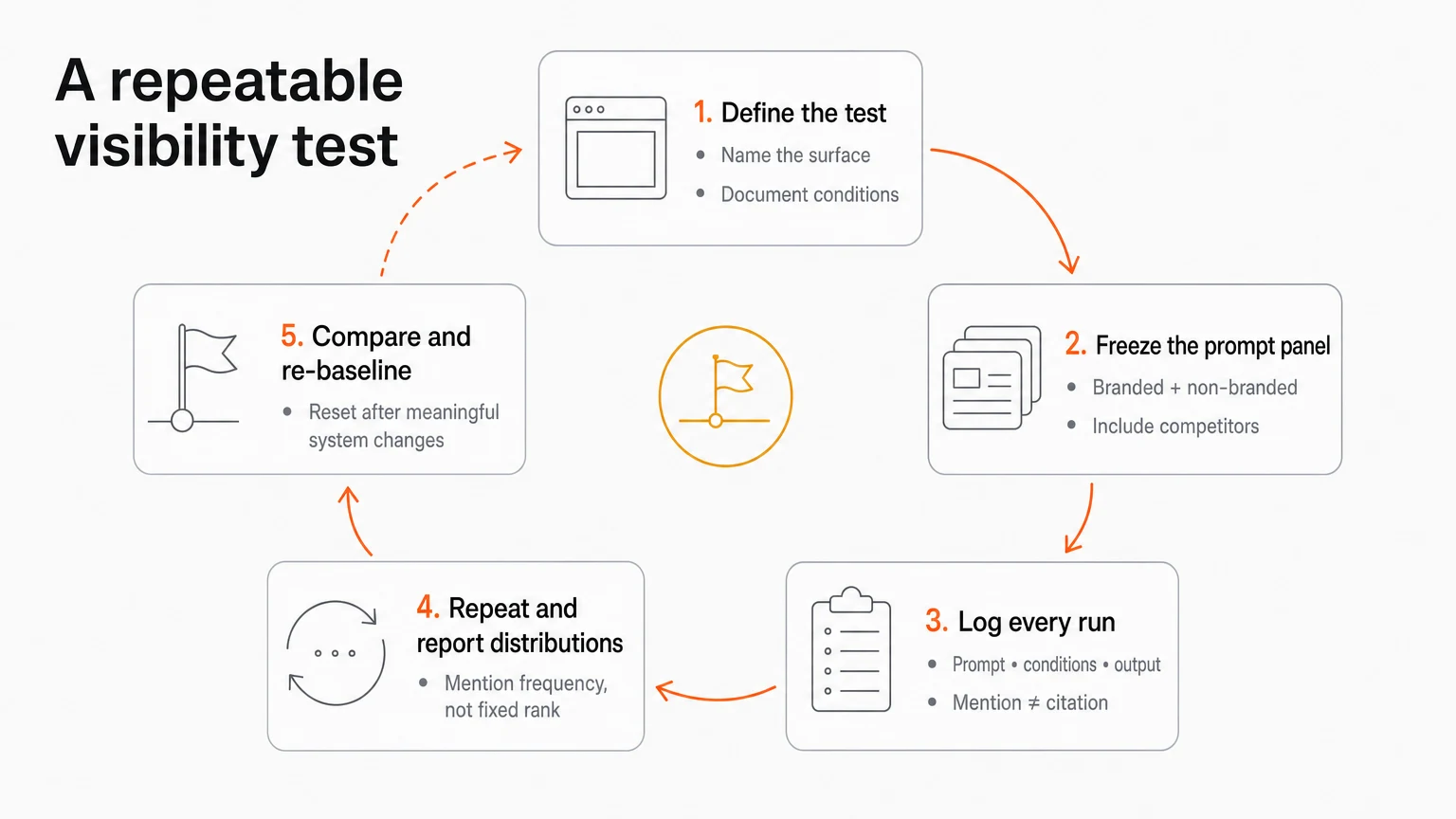
Hold prompt wording, language, geography, account state, surface, and testing window constant where possible. Log any unavoidable change instead of pretending it did not happen. Incognito mode or a VPN may alter some conditions, but the supplied evidence does not establish that either reproduces a neutral user or eliminates personalization.
Repeat every prompt within each measurement cycle. Generated answers can vary even with unchanged input, so report a distribution—such as the proportion of runs containing a mention—rather than declaring a fixed rank from one answer. If the testing interface exposes a model version, record it. Google’s Gemini API model documentation says “latest” aliases can be replaced, experimental models are unstable, and specific stable models usually do not change; consumer surfaces do not always expose equivalent controls, which is itself a condition worth recording.
Finally, re-baseline after a meaningful model, retrieval, or product-surface change. A test panel is a measuring instrument, and changing the instrument while silently continuing the same trend line is an excellent way to manufacture confidence.
Measure representation quality and decide what to improve
Compare each cycle with a frozen baseline, but do not claim that one change followed by one improved run proves causation. The site edit, recrawl, model behavior, competitor activity, user context, and simple output variance can all coexist. Repeated observations under consistent conditions make an interpretation more credible; they do not convert an observational program into a controlled experiment.
Track separate measures rather than blending everything into an impressive but uninterpretable score:
- Mention rate: runs in which the brand appears divided by applicable runs
- Recommendation rate: runs in which it is affirmatively recommended
- Comparison presence: runs in which it appears in a relevant comparison
- Accuracy rate: appearances that state the material facts correctly
- Prominence: whether the brand is central or incidental (not a stable “rank”)
- Framing: positive, neutral, negative, or cautionary treatment
- Citation rate: runs containing a citation associated with the brand
- Citation share: brand-associated citations relative to tracked competitors
- Cited page or domain: the specific owned or independent source used
- Competitor share of voice: the brand’s mentions as a proportion of tracked-brand mentions
Report each metric by surface. Google Search Console now documents organic impressions for supported generative AI features in Google Search, but that is not comprehensive impression reporting for standalone Gemini chat or every Gemini integration. Search data and the prompt-panel observations can complement one another; they cannot be silently substituted for one another.
Choose an operating cadence proportional to the consequences. Weekly checks can identify trends and anomalies, monthly reporting can summarize sustained movement, and quarterly reviews can refresh prompts, competitors, and priorities. Daily monitoring may be justified during a launch or crisis. These are operating choices, not universal scientific standards, and any prompt-panel revision should be versioned so that pre-change and post-change results are not compared blindly.
When a metric changes materially, first repeat the test. Then investigate:
- Did the prompt wording, location, language, account state, or surface change?
- Was there a model, retrieval, or product update?
- Did an important page fall out of the index or acquire a technical problem?
- Did the brand change its site, profile, product feed, or structured data?
- Did competitors publish materially better or newer information?
- Did the cited domains or pages change?
- Is the movement sustained across runs, or is it ordinary variance?
Prioritize interventions by business impact, importance of the affected query, competitive opportunity, and implementation effort. Correct a consequential factual error before pursuing a marginal increase in mentions; improve a high-value comparison page before creating dozens of speculative pages for remote prompt variants. Then rerun the affected panel and compare the resulting distribution with the baseline.
Correct inaccurate representations and reset expectations
Visibility without quality control can be actively harmful. Monitor for invented product capabilities, obsolete prices or hours, incorrect locations, misleading affiliations, inappropriate negative framing, and contradictions among the website, Business Profile, feeds, and independent sources. Gemini can hallucinate and present inaccurate information as fact, and Google says its apps may produce inaccurate or inappropriate responses.
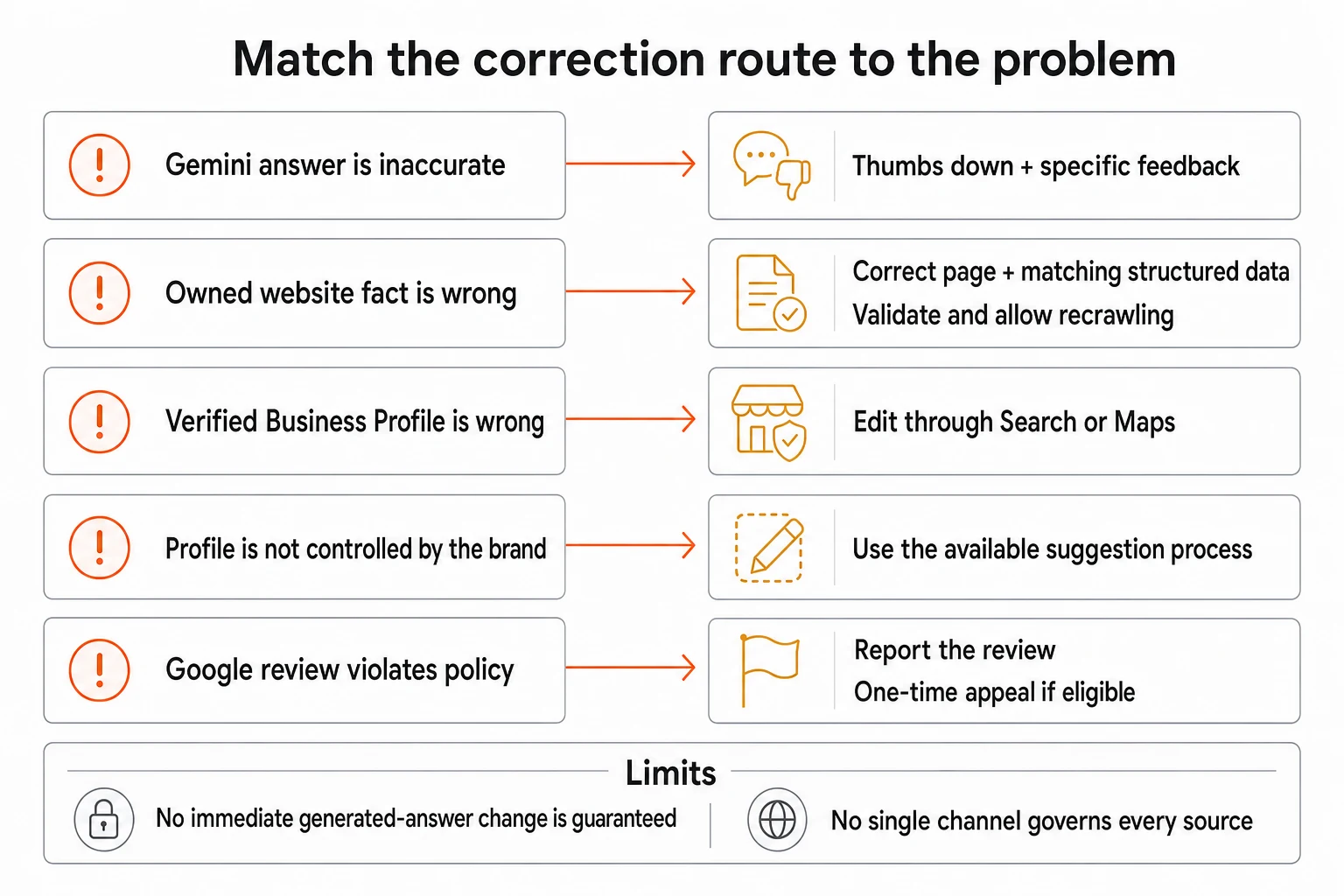
When an answer is wrong, use the correction route that matches the problem:
- For an inaccurate Gemini-generated answer, use the in-product thumbs-down control and provide specific feedback. Google explicitly recommends this for hallucinations and inaccuracies.
- For wrong information on an owned website, correct the visible source and any corresponding structured data, then validate the implementation and allow time for recrawling and reindexing.
- For incorrect owned Business Profile information, edit the verified profile through Search or Maps.
- For a profile the brand does not control, use the available suggestion process where appropriate.
- For a Google review that violates policy, use the review-reporting process; if eligible and the initial decision is disputed, Google documents a one-time appeal. Do not report a review merely because it is unfavorable.
Each route has limits. Editing a website or Business Profile does not guarantee an immediate change in a generated answer, feedback is not a universal factual-appeal mechanism, and no single correction channel governs every source Gemini might use. Continue testing the affected prompts, watch the cited sources, and escalate the next intervention according to impact and evidence.
The durable strategy is consequently less exotic than much “Google Gemini SEO” advice suggests. Make the brand easy to identify, its facts easy to access, its claims easy to verify, and its public representation easy to audit. Institutions that synthesize information from many changing systems tend not to offer permanent placement; they reward, imperfectly and probabilistically, a well-maintained information environment. The work is never to declare that Gemini visibility has been won. It is to keep that environment accurate enough that the brand has a reasonable chance of being represented correctly the next time the question is asked.
Continue Reading
How To13 min read
How to Get Your Brand Mentioned in Google AI Overviews
Getting a brand mentioned in Google AI Overviews requires indexed, useful pages, credible supporting evidence, carefully chosen queries, and repeated testing that separates mentions, citations, recommendations, and owned-source appearances.
Rosh Jayawardena
How To16 min read
Get Your Brand Mentioned in ChatGPT: An Evidence-Led Process
Getting a brand mentioned in ChatGPT requires crawlable, clear information, relevant independent evidence, and repeated testing across realistic prompts; these actions can improve discoverability and accuracy but cannot guarantee a mention, citation, or recommendation.
Rosh Jayawardena
How To15 min read
How to Run an AI Discoverability Self-Audit
An AI discoverability self-audit tests technical retrievability, answer appearance, citation, and accurate representation separately using fixed prompts, documented evidence, entity checks, and cautious retesting.
Rosh Jayawardena
Deep dives, delivered weekly
AI patterns, workflow tips, and lessons from the field. No spam, just signal.