
Back to Blogs
How to Get Your Brand Mentioned in Google AI Overviews
13 min readAug 21, 2026
How To

Rosh JayawardenaData & AI Executive
Getting a brand mentioned in Google AI Overviews requires indexed, useful pages, credible supporting evidence, carefully chosen queries, and repeated testing that separates mentions, citations, recommendations, and owned-source appearances.
Start with the outcome Google can—and cannot—provide
The first problem is that “visibility” can mean four different things.
A Google AI Overview is a generative summary shown in Search when Google’s systems decide that generative AI may be especially useful—for example, when a searcher wants to understand information drawn from several sources. It does not appear for every query, and Google does not publish a complete list of the conditions that trigger one. Its presence can also vary with the query and the search context. Google’s documentation describes the feature as conditional, not as a standard block that accompanies every result.
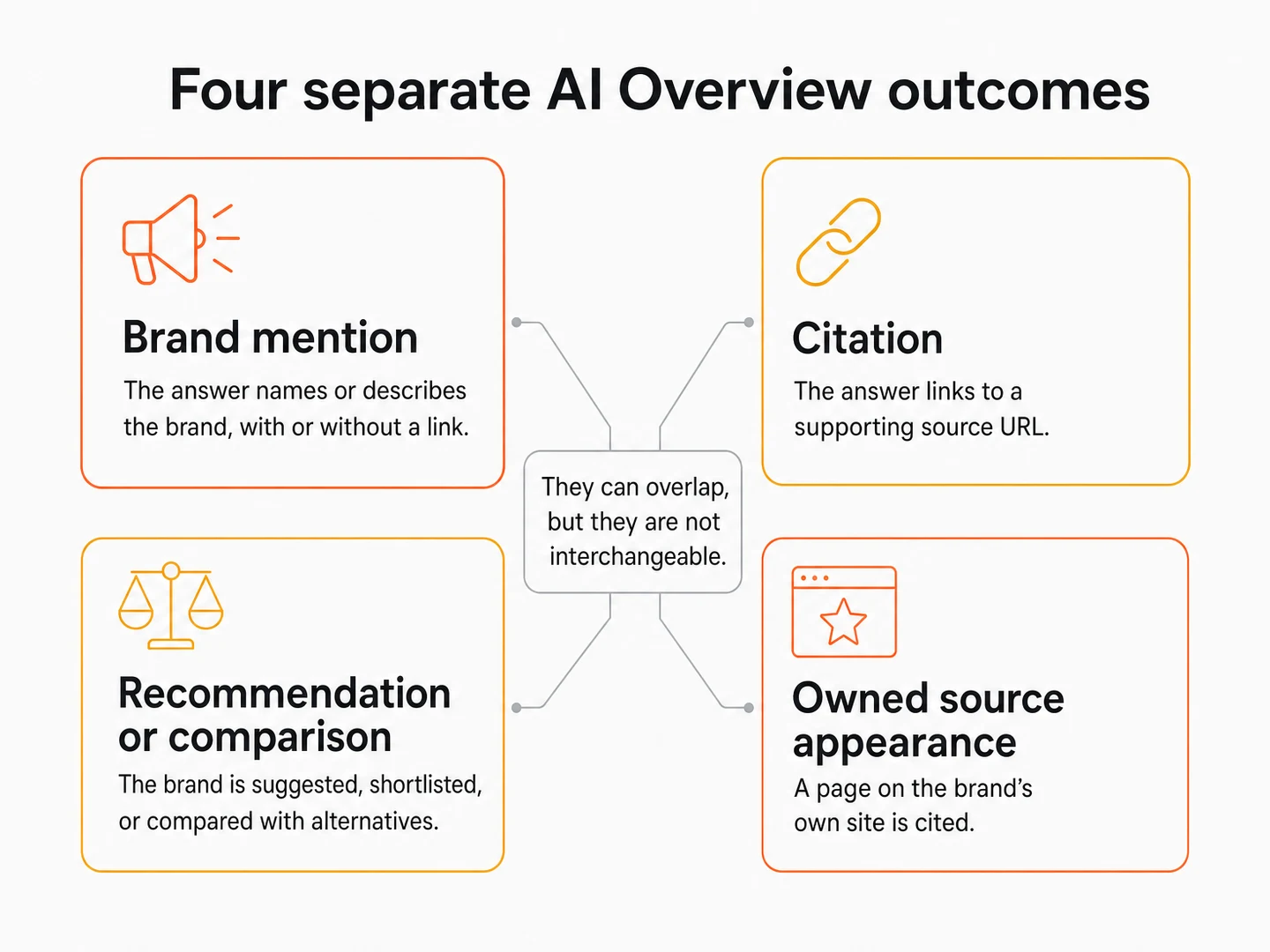
Within an AI Overview, keep these outcomes separate:
- A brand mention occurs when the answer names or describes the brand, with or without a link.
- A citation is a link to a source URL that supports some part of the answer.
- A recommendation or comparison occurs when the brand is suggested, shortlisted, or compared with alternatives.
- An owned source appearance occurs when a page on the brand’s own site is cited.
These can overlap, but they are not interchangeable. Your brand might be named while a third-party review is cited. Your page might be cited without the generated text naming your brand. Or a competitor might be recommended while your site is absent altogether. If you lump these events into one “AI visibility” number, you lose the information needed to decide what to fix.
There is another complication. Google says AI Overviews and other AI search features may use query fan-out, which means the system runs related searches across subtopics and data sources before combining what it finds. A seemingly simple comparison query may therefore draw on product documentation, reviews, definitions, implementation questions, and other material. This helps explain why the page cited for an answer may not be the page you expected—or even a page aimed at the exact wording the searcher used.
So what does it mean to optimize for Google AI Overviews? Not to submit a brand for inclusion, because there is no such submission process. Not to force a citation, because Google does not guarantee that an otherwise compliant page will be crawled, indexed, or served at all. The practical goal is narrower: make the brand and its pages eligible, relevant, useful, and well supported for a defined set of queries.
Clear the ordinary Google Search eligibility baseline
Before changing the content, make sure Google can use it.
Google’s guidance for AI features says a page must be indexed and eligible for a normal Search snippet before it can qualify as a supporting link in an AI Overview. Google describes no extra technical conditions for this feature.
For each page that could answer one of your target questions, check that:
- Googlebot is allowed to crawl and access it through the site, hosting stack, and content delivery network.
- The URL returns a successful HTTP 200 response.
- The page contains indexable material, with important information available as visible text.
- Content loaded through JavaScript renders in a form Google can see.
- The page is discoverable through sensible internal links.
- Indexing directives do not exclude it.
- Duplicate or substantially similar URLs are handled coherently, and the intended canonical page is the one Google is likely to select.
Canonicalization matters because Google groups duplicate or similar pages and chooses a representative version. If you have several near-identical product, location, or campaign pages, the URL you want may not be the one Google treats as canonical. And even after Google crawls a page, indexing is not guaranteed.
Use structured data where it supports an applicable ordinary Search feature and accurately describes the visible page. Do not use it to make claims that users cannot see. More importantly, do not look for an “AI Overview schema.” Google’s AI optimization guidance says generative Search requires no special schema.org markup.
The same guidance also rejects several supposed prerequisites: breaking every page into artificial content chunks, rewriting material only for AI systems, creating an unnecessary llms.txt file, or chasing inauthentic mentions. There is no ideal AI page length either. A short page can work when the answer is short; a long page can work when the subject needs depth.
This distinction is worth holding onto. Technical work can remove barriers to eligibility; it cannot compel Google to use the page.
Build a bounded query set around real questions
You cannot test whether a brand is visible “in AI Overviews” in the abstract. You can only test what happens for particular searches under particular conditions.
Start with the questions customers ask when they are trying to understand a problem or make a choice. Build a manageable query set that covers category discovery, trust and review questions, comparisons, alternatives, recommendations, use cases, implementation concerns, and other decision-oriented searches relevant to the brand. Include both branded and unbranded queries. Branded searches help you monitor reputation and factual accuracy; unbranded searches show whether the brand appears when someone is exploring the category rather than looking for it by name.
Phrase these as real questions, not just clipped keyword labels. “Which products solve this problem under these constraints?” represents a search situation more faithfully than a two-word category phrase. AI Overviews are often associated with questions that need synthesis, though observed trigger rates differ greatly by dataset, intent, device, and date. There is no useful universal percentage to apply to your category.
Prioritize queries where the brand could honestly be part of the answer. A brand should not appear merely because it wants exposure. It should fit the problem, comparison, use case, or recommendation. Queries where competitors already appear and your brand does not can be especially revealing: they show that the answer permits brand inclusion, while leaving open the question of why yours was omitted.
Do not borrow a universal query count. Choose a set small enough to run repeatedly and broad enough to cover the search situations that matter. Then version it. If you add or remove queries later, save that as a new version rather than silently changing the baseline.
For a U.S. English-language test, document the exact wording, U.S. location or locale, language, device, date and time window, and signed-in or logged-out state where relevant. Keep these conditions fixed during comparisons. Results may vary with wording, location, language, device, account or personalization context, timing, and system changes, so a single run is an observation—not a verdict.
Make the brand a useful, supportable answer—not an inserted reference
Once you know the questions, inspect the pages that ought to answer them. The key question is not “Where can we add the brand name?” It is “What would make this page a better answer?”
Lead with a clear response to the underlying question. Then cover the subquestions a reader actually needs to resolve: relevant use cases, limits, tradeoffs, requirements, alternatives, and supporting evidence. Where the query concerns a product, publish concrete documentation of features, integrations, pricing, implementation, certifications, or other facts that bear on the decision. If a comparison is useful, make it fair and specific rather than turning it into disguised ad copy.
Google’s guidance emphasizes content that is useful, original, reliable, easy to follow, and made for people. It specifically favors material that adds something beyond a recycled summary of what is already on the web. That might be first-hand expertise, original research, product documentation, a well-supported comparison, or a distinct analysis. It should also be clear who produced the material and what evidence supports its claims.
Structure helps readers and machines find their way through the page, but structure is not a ritual. Use descriptive headings and coherent sections because the subject calls for them, not because someone claimed every answer must fit a fixed number of words. Google says its systems can understand related ideas on one page and that publishers do not need to rewrite content solely for generative AI.
Keep changing facts current where freshness matters. Outdated pricing, integrations, capabilities, certifications, or positioning can support an outdated answer even if the page remains technically eligible. Freshness is a sensible accuracy practice, not a guaranteed selection lever.
Be equally clear about what not to publish. Do not generate a page for every slight query variation. Do not recycle the same claims across scores of thin pages. Do not hide stronger claims in structured data than the page itself supports. And do not confuse self-praise with evidence.
Google’s spam policies apply to attempts to manipulate generative AI responses as well as ordinary Search. Large volumes of unoriginal, low-value material made mainly to influence rankings can violate those policies, regardless of whether a person or a tool produced the pages.
The reveal here is that “answer-first content” is not really an AI format. It is simply a page that does the job the query asks it to do.
Strengthen corroboration without manufacturing credibility
Your own site can say what the brand is. Independent sources can help show whether that description holds up.
Keep basic entity information—the brand name, product category, capabilities, audience, use cases, and company facts—consistent across owned pages and appropriate external profiles. Consistency does not guarantee inclusion, but contradiction creates an obvious accuracy problem. If the homepage, product documentation, partner listing, and review profile all describe the product differently, a generated summary has several incompatible stories to choose from.
Then examine the sources that already shape your target AI Overviews. Are they product documentation, reputable reviews, comparison pages, partner or analyst listings, industry coverage, research, videos, or substantive community discussions? Evaluate them by relevance, context, authority, and authenticity, not raw volume.
Useful corroboration may come from original research, expert evidence, earned coverage, relevant comparisons, genuine customer reviews, partner pages, or real discussions in which people are trying to solve the same problem as the searcher. But no source type is a guaranteed route into an AI Overview.
One Ahrefs correlation study found that branded web mentions and YouTube mentions were associated with AI visibility, while the number of pages on a site had little relationship with it. The study covered several AI surfaces, not AI Overviews alone, and it explicitly warns that correlation is not causation. It is evidence against mindless page volume; it is not a recipe for buying mentions or flooding video platforms.
That line matters. Google advises against inauthentic mention-building, and its spam rules prohibit tactics such as buying links for ranking purposes, automated link creation, low-quality directory links, scaled low-value content, and site-reputation abuse. Google’s review guidance also bars fake reviews and undisclosed incentivized reviews from review markup.
The point of third-party evidence is corroboration. Once you manufacture it, it stops being evidence.
Measure mentions and citations as separate, repeatable outcomes
The measurement system can be simple. It just has to preserve what actually happened.
Create one row for each query run. Record:
- query-set version and exact query wording;
- date and time window;
- United States location or locale and English-language setting;
- device and signed-in or logged-out state where relevant;
- whether an AI Overview appeared;
- the exact generated answer;
- whether the brand was named or described;
- whether it was recommended, shortlisted, or compared;
- its position or prominence and the surrounding sentiment;
- competing brands that appeared;
- every visible cited URL and domain;
- whether each cited source was owned or third-party;
- the corresponding organic results; and
- a screenshot or other preserved response record.
Define the fields before the first run. A mention is a name or description. A citation is a linked source. A recommendation or comparison is a separate inclusion event. A cited page belongs in an owned or third-party source field even when the generated text does not name the brand.
Then check important statements for accuracy, currency, attribution, and support. Google itself warns that AI Overviews can make mistakes. An inaccurate mention is therefore not a clean win; it is an accuracy issue that happens to be visible. Read the cited material and verify important claims against authoritative sources rather than assuming that the presence of a link proves every sentence around it.
Run the fixed query set on a documented cadence. Weekly observation may suit a stable category; more volatile or reputation-sensitive queries may justify more frequent checks. There is no established ideal number of repetitions, so choose a cadence you can maintain and report it plainly.
Compare aggregate rates rather than anecdotes: AI Overview appearance rate, brand mention rate, recommendation or comparison rate, owned citation rate, favorable third-party citation rate, competitor inclusion, and accuracy rate. Screenshots show that an event occurred. The structured data shows whether it keeps occurring.
That is the standard to aim for: not “we saw ourselves once,” but “under these conditions, across this versioned set of queries and repeated runs, this is how often and how accurately the brand appeared.”
There are tools out there for automating this process such as Onsomble. But doing this manually to start with is a great way to get started.
Iterate cautiously and report what the evidence can support
Once you have a baseline, change one class of things at a time where feasible. Separate technical eligibility work from content revisions, entity clarification, and independent corroboration. If all four change at once, an improvement may still be useful, but you will know less about what produced it.
Let observed gaps set the order. If the right page is not indexed, fix eligibility first. If competitors appear because they answer a comparison your site avoids, improve the answer. If the AI Overview uses an old source, update the relevant facts and strengthen the page that should replace it. If the brand is described inconsistently, reconcile the underlying descriptions. If a certain kind of independent source appears repeatedly, ask what evidence those sources contain—not how to imitate their URLs.
After a defined observation window, rerun the same query-set version under the same conditions. Compare AI Overview presence, mention frequency, recommendation or comparison frequency, prominence, citations, competitors, accuracy, sentiment, and source support.
Join that record with Google Search Console and Google Analytics where available. Search Console can show impressions, clicks, queries, pages, countries, and Search performance. Analytics can show sessions, engagement, traffic sources, and conversions on the site. The two systems use different metrics, so their totals will not match exactly. More importantly, neither gives complete attribution for an unlinked mention or for a decision influenced by an AI Overview without a click.
Finally, report pre/post movement as directional evidence unless you have a suitable control or quasi-experimental design. Algorithm updates, platform changes, query volatility, competitor activity, device and location differences, personalization, and simple timing can all alter the result. A rise after a content change means the change is a plausible contributor; it does not prove that you found a ranking formula.
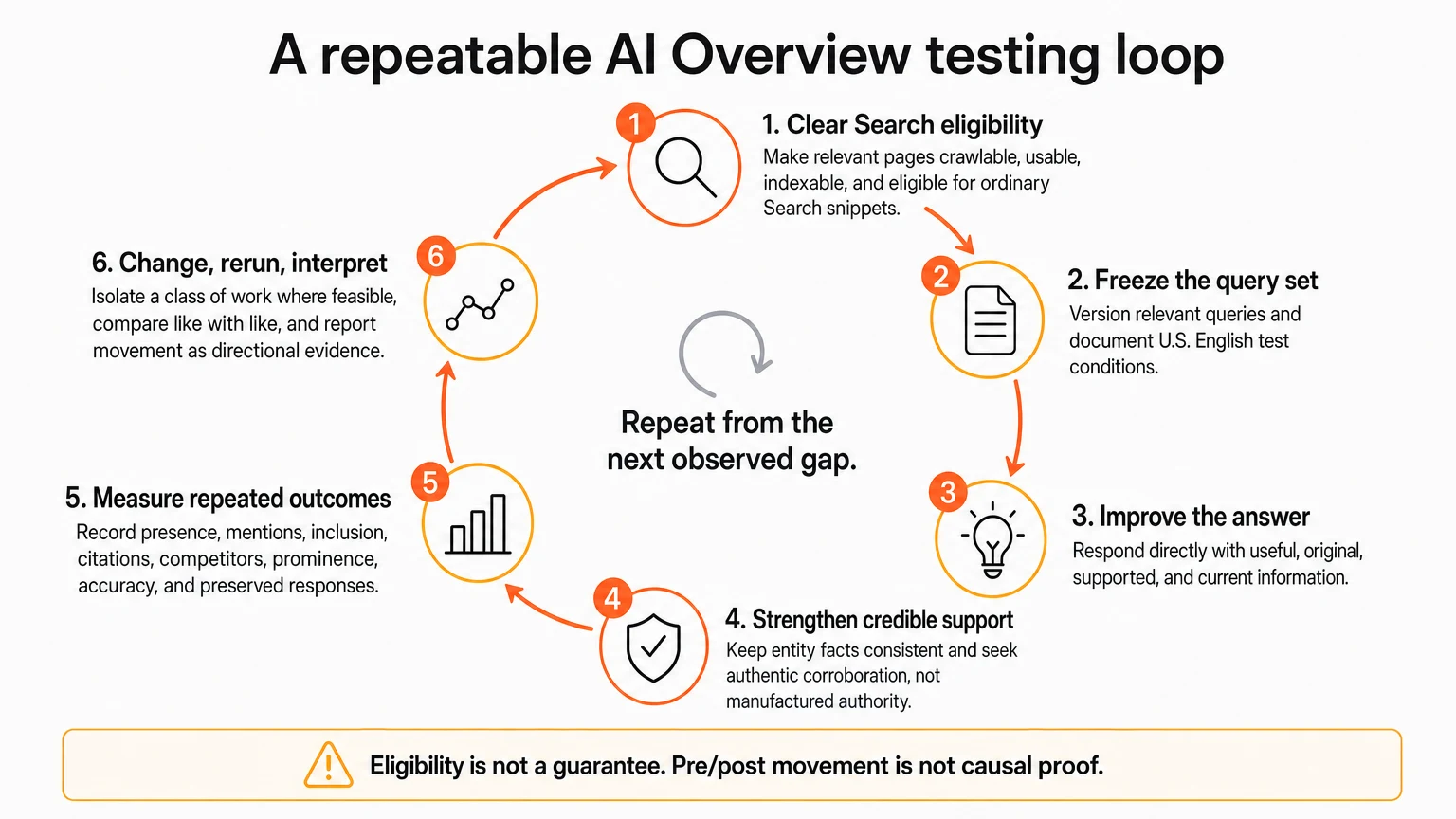
This is the practical answer to how to get your brand mentioned in AI Overviews: make the brand eligible to appear, make it genuinely relevant to questions worth answering, give important claims solid support, and measure what Google actually shows. Then ask the next narrow question: which observed gap can you fix without pretending you control the answer?
Continue Reading
How To15 min read
How to Get Your Brand Mentioned in Google Gemini
Google Gemini brand mentions are variable, context-dependent outputs, not permanent rankings. Brands improve accurate discoverability by clarifying identity, maintaining accessible facts, publishing useful evidence, earning legitimate corroboration, and testing defined prompts across named Gemini surfaces.
Rosh Jayawardena
How To16 min read
Get Your Brand Mentioned in ChatGPT: An Evidence-Led Process
Getting a brand mentioned in ChatGPT requires crawlable, clear information, relevant independent evidence, and repeated testing across realistic prompts; these actions can improve discoverability and accuracy but cannot guarantee a mention, citation, or recommendation.
Rosh Jayawardena
How To15 min read
How to Run an AI Discoverability Self-Audit
An AI discoverability self-audit tests technical retrievability, answer appearance, citation, and accurate representation separately using fixed prompts, documented evidence, entity checks, and cautious retesting.
Rosh Jayawardena
Deep dives, delivered weekly
AI patterns, workflow tips, and lessons from the field. No spam, just signal.