
Back to Blogs
The 320% Effect: What 850,000 Sites Tell Us About Local AEO in 2026
11 min readMay 3, 2026
Thought Leadership

Rosh JayawardenaData & AI Executive
The case for local AEO used to rest on extrapolation. After 858,457 sites and 68.9M crawler visits, the data has caught up. Here is the synthesis.
The 320% Effect: What 850,000 Sites Tell Us About Local AEO in 2026
By the Onsomble research team. Last updated 5 May 2026.
For years, the case for local AEO rested on extrapolation and vibes. In 2026, it has numbers. The headline is clean: AI-crawled local-business sites in Duda's just-published 858,457-site study averaged 527.7 human sessions a month against 164.9 for sites the AI ignored. That is 3.2 times the traffic. Form completions and call clicks move in the same direction on the same dataset, at 2.7x and 2.5x respectively.
Local AEO statistics for 2026 finally have a primary source worth quoting. The Duda dataset is the largest on local-AEO outcomes currently in the public record. The numbers stand up on their own. They get sharper alongside other recent research. Pew has shown that AI summaries roughly halve traditional click-through rates. SparkToro has counted that 58.5% of US Google searches end without a click. Eight Oh Two has found that 37% of consumers now start their search inside an AI tool. Place those measurements next to the Duda numbers and a coherent picture emerges. Local visibility is no longer about ranking on a results page. It is about being the answer.
This article is the synthesis. Five findings, every claim sourced, two clear takeaways for agencies and SMBs, and an honest section on what the data does not yet support. No paywall, no email capture, just the evidence base.
What is local AEO? Local AEO (answer engine optimisation) is the practice of structuring a local-business website so that AI assistants — ChatGPT, Gemini, Perplexity, AI Overviews — find, verify, and recommend it when someone asks a location-specific question. It is the local-search counterpart to traditional SEO, applied to AI-driven discovery rather than the ten blue links. For a fuller breakdown of AEO and adjacent terms (GEO, LLMO, AI SEO), see our AEO glossary.
What was studied
Before the findings, the methodology. Duda analysed 858,457 sites hosted on its own platform during February 2026, observing 68.9 million AI-crawler visits in the month and matching them against site characteristics, traffic, and conversion behaviour. Roughly 59% of analysed sites received at least one AI-crawler visit. AI crawling has reached real scale. It is no longer just experimental.
The sample is the right one for our question. Duda mostly hosts small and mid-sized businesses, agency-built client sites, and multi-location service brands. That is exactly the audience local AEO is for. It is also a limitation, which we cover in the caveats below.
The shape of the crawler activity matters too. Search Engine Journal, analysing the same study, reported that ChatGPT alone accounts for 81% of AI-crawler activity, and that 56.9% of all AI-crawl visits are now real-time answer retrieval rather than training or indexing. That distinction matters. Real-time retrieval is what happens when a user asks ChatGPT or Perplexity a question right now and the model fetches a page to ground its answer. The crawler visit is, increasingly, an answer being built in real time.
A note on our method. We synthesised the Duda findings against six independent industry studies (Pew, SparkToro, Eight Oh Two, Previsible, Princeton GEO, plus Roger Montti's Search Engine Journal analysis). We use multiplier framing (3.2x) rather than the press release's "+320%" phrasing because the multiplier matches what the underlying numbers actually show; the percentage version is mathematically loose. (527.7 ÷ 164.9 = 3.2, which is +220% over baseline, not +320%.) Known dataset biases are named in the Honest caveats section.
With the methodology in hand, here are the findings worth quoting.
Finding 1: AI-optimised local sites earn 3.2x more human traffic
The headline number is consistent across reporting. Sites that AI crawlers visit in the Duda dataset average 527.7 human sessions per month. Sites that AI crawlers do not visit average 164.9. That is a 3.2x ratio. Duda's own headline frames this as "+320% more traffic", which is the framing the press release will be quoted in for the next six months. Strictly, the lift over baseline is +220%. The multiplier is the cleaner number, and the multiplier is 3.2.
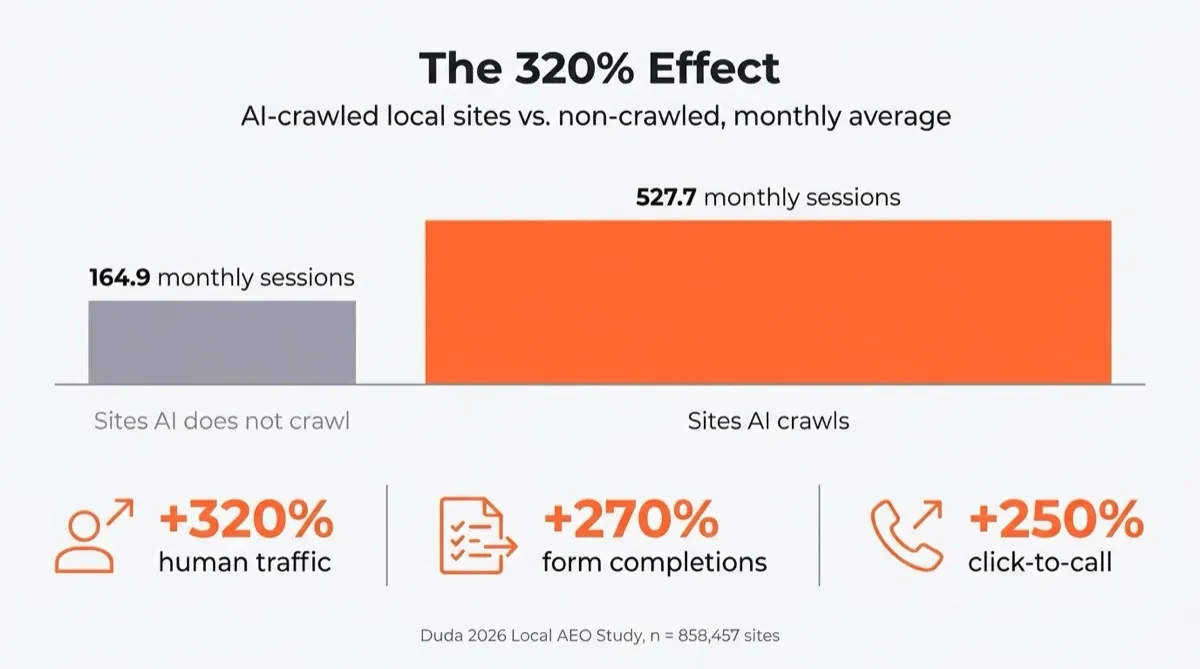
Form completions move with the traffic, just at a smaller scale: 4.17 per crawled site against 1.57 per non-crawled site, a 2.7x ratio. Click-to-call events move at 2.5x. Take a local services business doing 20 form fills a month, which is a plausible baseline for a single-location plumber, dentist, or law firm. The difference between the crawled and non-crawled cohorts is the difference between 20 leads a month and roughly 53. That is not a statistical curiosity.
Two things are worth pointing out. The first is that this is a correlation, not a causal lift. As Search Engine Journal's Roger Montti points out, AI crawlers are following human traffic more than they are creating it from nothing. The directional reading is reasonable: the sites people are looking for in 2026 are the sites AI is feeding back as answers. The causal reading, that crawling drives the traffic rather than following it, is a stretch the data does not support yet.
The second is that AI traffic, when it does arrive, appears to convert better, not just arrive more often. Duda's reporting flags an insurance site that recorded a 3.76% conversion rate on LLM-referred traffic against 1.19% on organic search, roughly three times. An ecommerce site in the same dataset recorded 5.53% on LLM traffic against 3.7% on organic. Two data points are not a trend, but the signal is consistent: AI-driven discovery seems to deliver users with higher intent, in the same way that branded organic search has always done. We saw a similar pattern in our own breakdown of AI visibility for insurance brokers.
What separates the crawled from the uncrawled? Five signals, and they are not surprises.
Finding 2: Five signals drive 4x more crawler attention
Sites with the full kit (blogs, local schema, Google Business Profile sync, dynamic pages, and multiple page types) receive roughly four times the AI-crawler visits of the median Duda site. The signals do most of their work in combination.
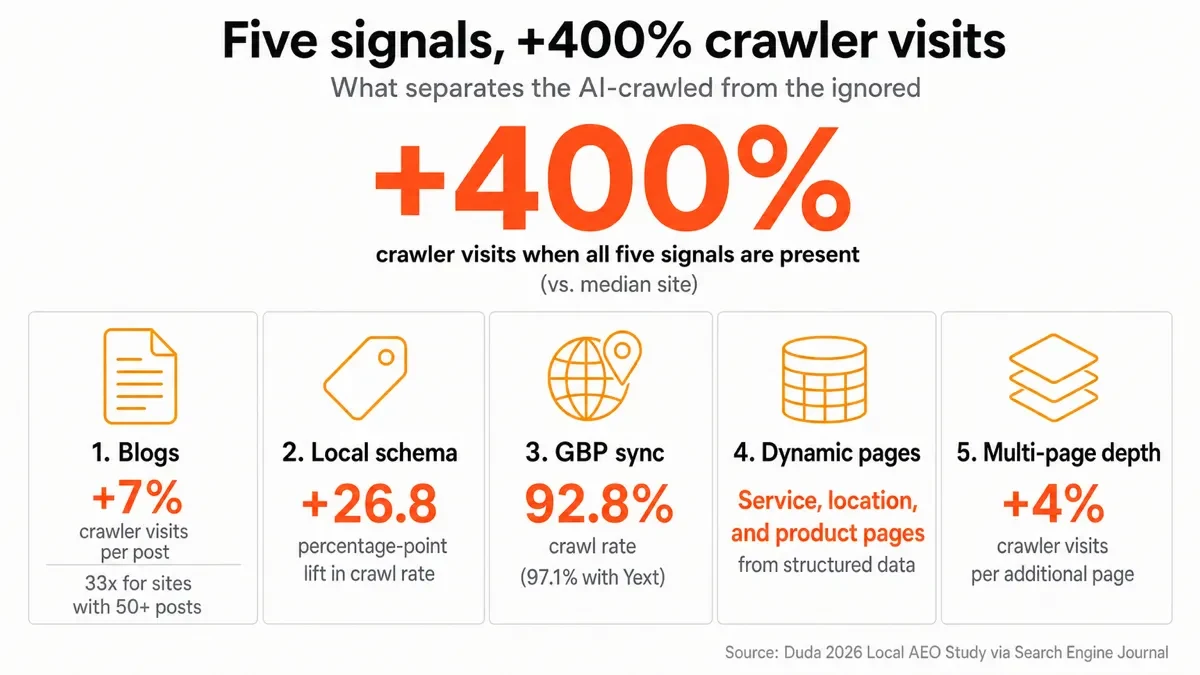
The breakdown rewards a closer read.
Blogs
Each additional blog post on a site correlates with a 7% increase in crawler visits. Compounded across volume, the effect is large: sites with 50 or more blog posts in the Duda dataset average 1,373.7 crawler visits a month against 41.6 for thin sites. That is a 33x ratio. The takeaway is not that you need to publish constantly. It is that a real content library is the raw material AI uses to build its answers.
Local schema
Sites with completed LocalBusiness schema show a 26.8 percentage-point higher crawl rate than sites without. Schema completeness is the unsexy practice of filling in your address, hours, services, payment types, and geo coordinates. The data suggests AI uses it almost directly.
Google Business Profile sync
Sites that sync their Google Business Profile to their website recorded a 92.8% crawl rate. The Yext integration variant pushed it to 97.1%. The mechanism here is intuitive: AI assistants need to verify that the business they are about to recommend actually exists and is reachable. When the website and the Google Business Profile match, that verification is fast.
Dynamic pages
Sites generating service, location, and product pages from structured data got crawled more often than sites of equivalent depth that did not. This is the same location-and-service-page strategy that has driven local SEO for a decade, now applied to AI search.
Multi-page depth
The headline figure is +4% crawler visits per additional page. The marginal effect is small; the compounded effect across a 30-page service business is meaningful. Depth tells AI you are a real business.
Two notes on how to read this. First, the signals correlate with crawl rate, not directly with revenue. The chain is signal → crawl → traffic → conversion. The Duda dataset is strong on the first three links and reasonable on the fourth. Second, this is the same checklist that has served local SEO for years, not a new playbook. The implication is encouraging for anyone who has been doing the work and has been waiting for the case to harden: it is hardening now. Our practical AEO guide walks through the on-page tactics in more detail.
These signals matter because local search itself has shifted underneath them.
Finding 3: AI is now the front door of local search
The Duda numbers show that local search itself has tilted.
Eight Oh Two's 2026 AI & Search Behavior Study, reported by Search Engine Land, found that 37% of US consumers now begin their searches inside an AI tool rather than a traditional engine. Taking that as a proxy for global behaviours; a third of the market has moved already.
The Google searches that remain are increasingly zero-click. SparkToro's 2024 zero-click research, the most recent comprehensive measurement, found that 58.5% of US Google searches end without a click to the open web. Pew Research Center's July 2025 follow-up sharpened the picture: on Google searches that surface an AI summary, users click a traditional result just 8% of the time, against 15% on searches that do not. AI summaries are roughly halving the click-through rate of the SERP they sit on top of.
Meanwhile, the traffic that does come from AI is growing fast. Previsible's measurement, reported by Search Engine Land, put year-over-year growth in AI-search referral traffic at +527% between January–May 2024 and the same window in 2025.
For local specifically, the demand has not gone anywhere. Duda's blog cites 76% of local searches resulting in same-day store visits, 80% of US consumers searching for local businesses weekly, and 46% of all Google searches carrying local intent. The intent is there, the volume is there, and the entry point has changed. The Duda findings reflect the new entry-point reality. They are what local visibility looks like when AI is the front door.
What this means for agencies and SMBs
Two audiences, two different actions.
For agencies, the data makes local AEO a service worth selling. The five signals (blogs, local schema, GBP sync, dynamic pages, multi-page depth) are easy to audit on a client site: they either have them or they don't, and the gaps are simple to scope. The 3.2x traffic, 2.7x form completions, and roughly 2x conversion-rate findings give you ROI numbers you can put in a pitch deck and defend, easier than the usual SEO promises, because they come from a study with a defined methodology and an 858K-site sample.
Mike Deluca's Rocket Driver piece flagged the reporting gap behind all this: keyword rankings are a poor proxy for AI visibility. That is the opening for a service that reports on AI Overview citations, GBP engagement, and crawl rates as the headline metrics. We have written about productising AI visibility services at the agency level for the same reason.
For SMBs, AEO is not a tech project. It is a revenue lever, and the work to start is mundane. Local schema, complete GBP, blog cadence, multiple service or location pages: none of these require a re-platform or a rebuild. Most are tasks an in-house team or a competent contractor can deliver in a week. The Princeton GEO research from KDD 2024 reinforces that the highest-leverage signals at the page level are equally undramatic: stating a statistic, attaching a citation, including a quotation. Adding those three patterns to existing pages lifted AI-answer visibility by up to 40%.
Oded Ouaknine, Duda's CRO, summarised the shift well: "for years, local visibility meant ranking on a search results page; now it means being included in the answer itself." What that captures, in one line, is that the mechanism has changed and the objective has not.
Where you go from here depends on which side of this you sit on. If you are an agency, the cleanest entry point is a five-signal audit on a representative client and a productised-service spec. If you are an SMB, it is a schema-and-GBP review with whoever owns your website, plus a content-cadence call. In both cases the workload is bounded and the upside is no longer hypothetical. Our walkthrough of getting cited by ChatGPT covers the on-site work in more detail.
Frequently asked questions
How is local AEO different from local SEO?
Local SEO targets the ten blue links and the Google Map Pack. Local AEO targets AI assistants (ChatGPT, Gemini, Perplexity, AI Overviews) that answer the question directly without sending the user to a results page. The five-signal checklist (blogs, local schema, Google Business Profile sync, dynamic pages, multi-page depth) overlaps heavily with local SEO best practice; the difference is that the success metric is being cited in the answer, not ranking on the SERP.
Does AEO actually help small businesses?
In the Duda dataset, AI-crawled small-business sites averaged 3.2x more human traffic, 2.7x more form completions, and 2.5x more click-to-call events than sites AI ignored. That is correlation, not causation, but the directional case is strong. AI traffic also appears to convert better when it does arrive: an insurance site in the same dataset recorded a 3.76% conversion rate on AI-referred traffic against 1.19% from organic search.
Is Google Business Profile still important for AI search?
Yes, materially. Sites with Google Business Profile synced to the website recorded a 92.8% AI-crawler rate in the Duda dataset, climbing to 97.1% with Yext integration on top. The mechanism is straightforward: AI assistants need to verify that a business they are about to recommend actually exists and is reachable, and synced authoritative data sources are the lowest-friction way to do that.
Should small businesses invest in AEO or stick with traditional SEO?
The short answer is that they are not in conflict. The five signals that drive AI-crawler attention are largely the same on-page and off-page work that has driven local SEO for years: complete schema, complete Google Business Profile, content depth, structured location and service pages. The investment is the same; the success metric is broader. The Princeton GEO research from KDD 2024 found that the highest-leverage page-level patterns for AI visibility (adding statistics, citations, and quotations) were similarly mundane and lifted AI-answer visibility by up to 40%.
Honest caveats
Three things to keep in mind before this brief gets quoted in a board pack.
Single-platform dataset
The Duda study only sees Duda-built sites. That is a real selection bias. We cannot say from this data alone how the same signals would behave on Wix, Squarespace, WordPress, or hand-rolled stacks.
Correlation, not causation
AI crawlers find sites that already attract humans. The directional reading (invest in the five signals, expect AI visibility to follow) is reasonable. The causal reading, that AI crawls cause the human traffic, is a stretch the data does not yet support.
Vendor publisher
Duda has a commercial interest in promoting the performance of Duda-built sites, and the five-signal list is conveniently a list of features Duda offers. The numbers are defensible; the editorial framing is worth keeping in mind.
Why we still take it seriously: scale, consistency with adjacent research, and the lack of a stronger alternative.
The bottom line
For the first time, the case for local AEO does not rest on extrapolation. It rests on 858,457 sites, 68.9 million crawler visits, and a correlation strong enough to defend in a budget meeting. It rests on adjacent measurement from Pew, SparkToro, Eight Oh Two, Previsible, and the Princeton GEO paper that all point the same direction. The market has tilted. The five-signal checklist is not new. What is new is that it is the local-visibility playbook, not just the SEO playbook.
If you are an agency, the next move is a five-signal audit on a representative client. If you are an SMB, it is a schema-and-GBP review with your web owner. Visibility used to mean ranking. Now it means being the answer. The data finally agrees.
Continue Reading
Thought Leadership8 min read
The 30% Advantage: How Independent Consultants Are Outworking Big Firms with AI
The consulting industry's biggest shift isn't happening at McKinsey or BCG. It's happening in home offices and co-working spaces, where independent consultants are using AI to punch above their weight.
Rosh Jayawardena
Thought Leadership7 min read
Your Notes Are Everywhere. Your AI Forgets Everything. Now What?
Your knowledge is scattered across a dozen tools, and none of them talk to each other. The AI tools are supposed to help, but they forget everything the moment you close the tab.
Rosh Jayawardena
Deep dives, delivered weekly
AI patterns, workflow tips, and lessons from the field. No spam, just signal.