Back to Blogs
AI Visibility for Insurance Brokers in ChatGPT
1 min readApr 28, 2026
AEO Foundations

Rosh JayawardenaData & AI Executive
AI visibility for insurance brokers explained, with practical fixes for reviews, listings, trust signals, and broker service pages.
AI Visibility for Insurance Brokers: What ChatGPT Says About Your Business
AI visibility for insurance brokers is shaping up as a trust problem before it becomes a technical one.
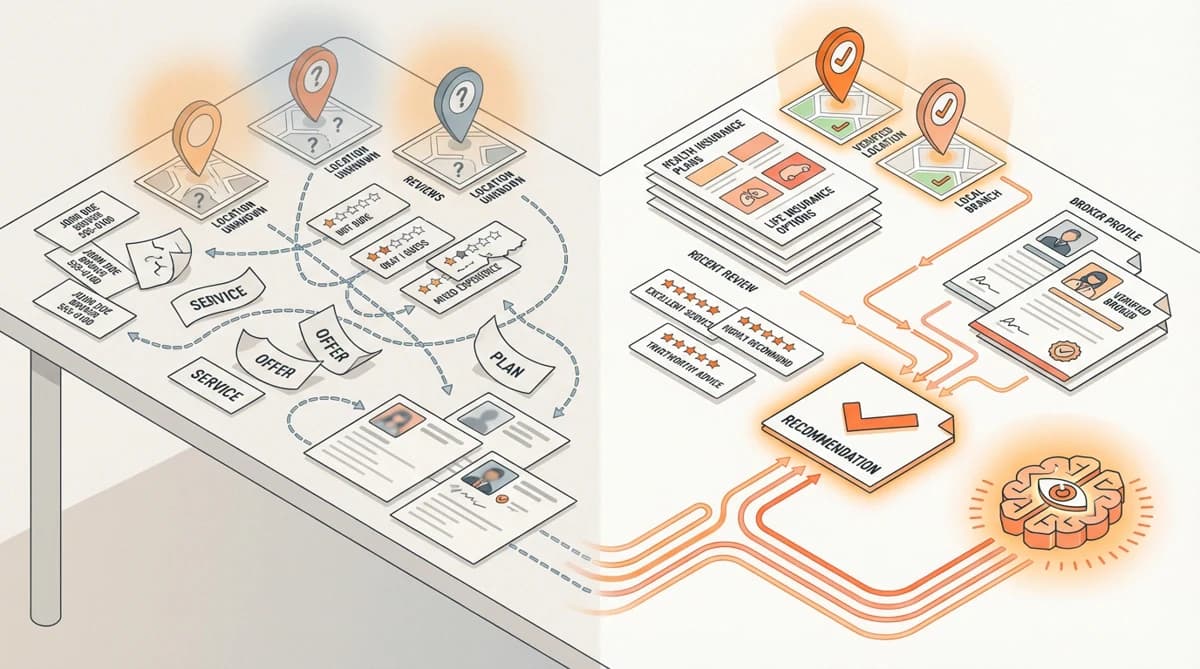
That is useful to know, because plenty of businesses still assume AI assistants work like a magic ranking layer on top of Google. Sometimes they overlap. Often they do not. In categories like insurance broking, where customers are weighing risk, advice, and credibility, assistants need enough evidence to describe a business with confidence.
If that evidence is thin, inconsistent, or spread across stale profiles, you tend to disappear into generic answers. Or worse, you get described vaguely enough to be forgettable.
We covered the broader mechanics in how to get cited by ChatGPT for your business. This piece is about the broker-specific version of the problem, and what to fix first.
How do AI assistants decide which insurance brokers to mention or recommend?
AI assistants appear to choose insurance brokers based on a mix of query fit, trust signals, directory and profile data, review evidence, and how clearly the brokerage explains what it actually does.
That mix matters because finance and insurance are not casual categories. If someone asks ChatGPT to compare business insurance brokers in Christchurch, or asks Gemini which broker might be worth speaking to for landlord cover, the model has to piece together a view of credibility. It is not just looking for a homepage. It is looking for corroboration.
Yext’s 2026 research is useful here. It analysed 17.2 million AI citations across Q4 2025 and found that model behaviour varies by sector. In Finance, some models leaned heavily on what Yext calls Some Control sources, things like directories and managed profiles, rather than only on first-party websites. Banking and Lending showed a 58.52% preference for those sources.
That is not a perfect one-to-one match with insurance broking, but it is close enough to be instructive. In practical terms, it suggests assistants do not want to rely solely on your website when money, risk, and trust are involved.
What that means for brokers
If your brokerage website is clear but your Google Business Profile is outdated, there is friction.
If your service pages are vague and your reviews say more about your value than your own site does, the model may lean harder on third-party sources.
If your business is not easy to distinguish from insurers, advisers, or comparison sites, assistants may struggle to describe you cleanly. Fair enough, really.
What should an insurance broker fix first to improve AI visibility?
An insurance broker should usually fix category clarity, local listings, review quality, and service-page specificity before doing anything more advanced for AI visibility.
I have made this mistake before in other categories. It is tempting to go looking for the AI-specific lever, because that feels newer and more interesting. What usually moves first is the boring stuff, the business facts, the trust signals, and the pages that should have been sharper already.
BrightLocal’s 2026 Local Consumer Review Survey found that 97% of consumers read reviews for local businesses, and 47% will not use a business with fewer than 20 reviews. It also found that ChatGPT and other generative AI tools jumped from 6% to 45% as a source of local business recommendations. That is a fairly strong reminder that review quality and review quantity now influence both humans and machines.
For the broader data behind that local-AI shift, see our local AEO industry study.
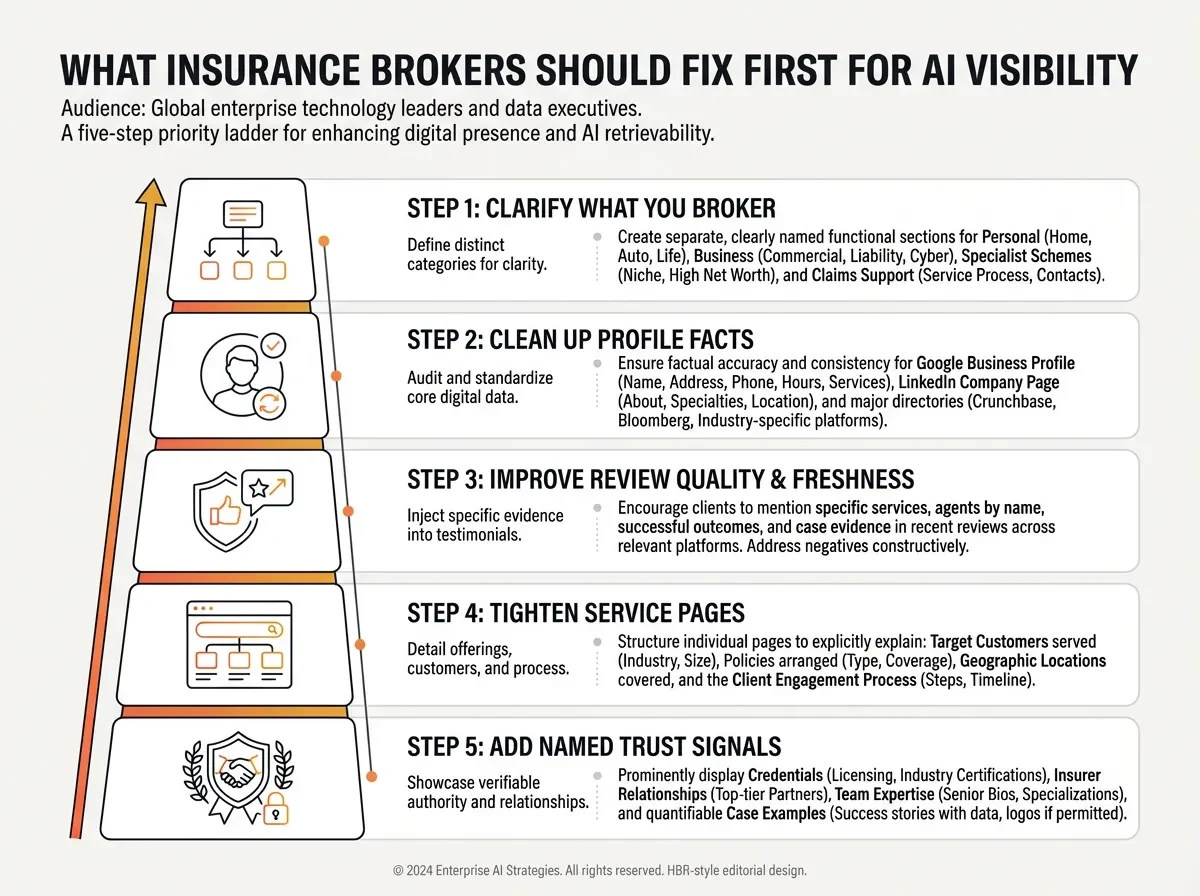
Here is the priority order I would use for a broker:
- Clarify what you broker. Separate personal insurance, business insurance, specialist schemes, and claims support clearly.
- Clean up your profiles. Make sure Google Business Profile, LinkedIn, and any major directories match your website facts.
- Improve reviews. Fresh, specific reviews about advice quality, responsiveness, and claims support carry more weight than generic praise.
- Tighten service pages. Explain who you help, what policies you arrange, where you operate, and how the process works.
- Add named trust signals. Broker credentials, partner insurers, team expertise, case examples, and location-specific detail all help.
The basics that matter more than people expect
OtterlyAI reported that 73% of sites have technical barriers blocking AI crawler access. So yes, crawlability still matters. But for a brokerage, access without clarity is not much use.
A crawlable page that says “we offer tailored insurance solutions” is still weak. A crawlable page that says “we help Canterbury manufacturers compare business interruption, liability, and plant cover, then support claims when something goes sideways” is more useful.
That difference is not subtle.
Which trust signals matter most when ChatGPT describes an insurance brokerage?
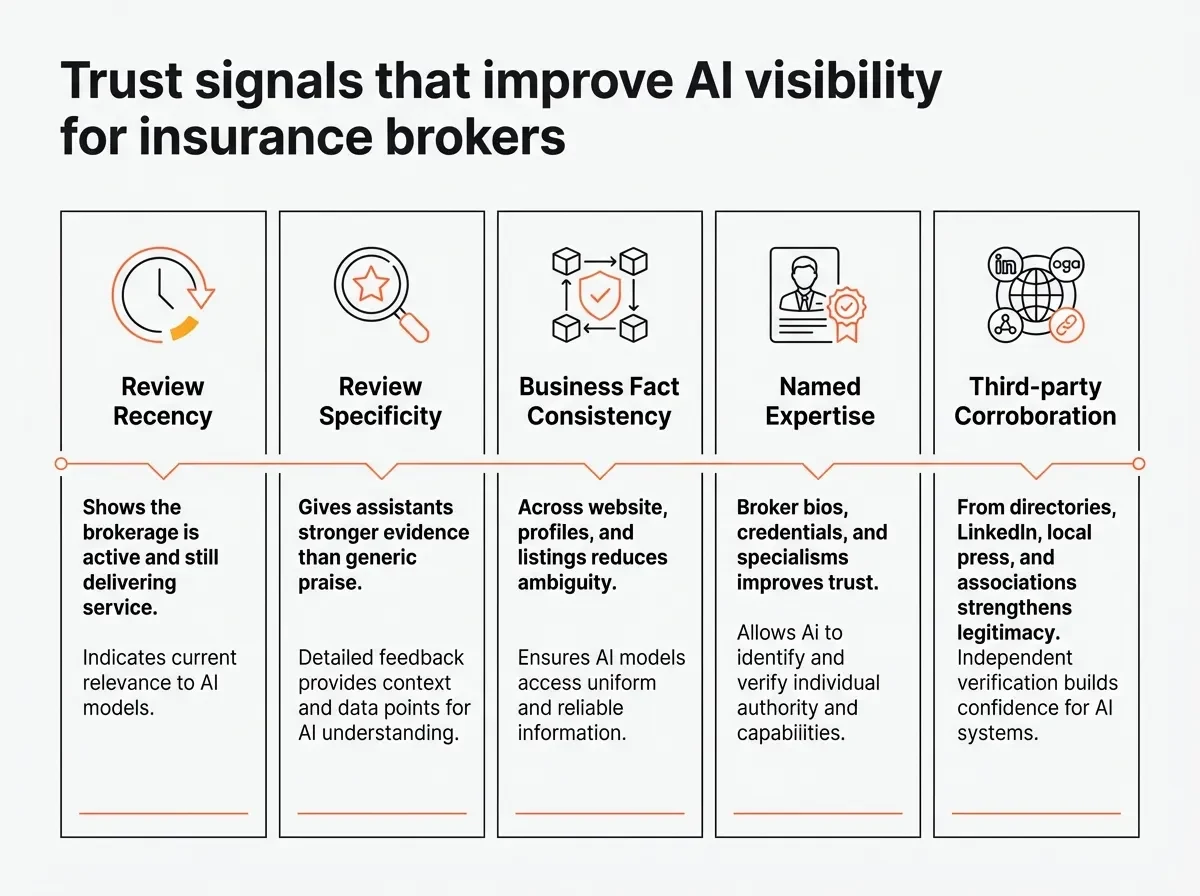
The trust signals that matter most are review quality, business fact consistency, named expertise, service specificity, and credible third-party mentions.
Insurance is one of those categories where vague trust language wears thin quite quickly. “Trusted advisors” does not mean much unless something on the page, or elsewhere on the web, backs it up.
BrightLocal found consumers now use an average of six review sites when choosing businesses. That matters because a brokerage’s trust picture is not built on one property alone. It comes from the whole web footprint.
The signals worth tightening first
| Trust signal | Why it matters for AI visibility |
|---|---|
| Review recency | Fresh reviews suggest the brokerage is active and still delivering service |
| Review specificity | Named mentions of responsiveness, claims help, or policy advice are more meaningful than “great service” |
| Business fact consistency | Matching address, phone, service scope, and descriptions across the web reduce ambiguity |
| Named expertise | Broker bios, credentials, specialisms, and years in market help assistants describe the business more confidently |
| Third-party corroboration | Directory listings, LinkedIn profiles, local press, and association mentions help verify legitimacy |
Yext’s model-level research also matters here. Claude leans harder on Limited Control sources such as reviews and social discussion. Gemini tends to lean more heavily on first-party sources. That means the same brokerage may appear stronger in one model than another depending on where its trust signals live.
That can be annoying, but it is useful. It means there is no single AI search visibility insurance playbook that works identically everywhere.
What a citation-ready insurance broker website looks like
A citation-ready insurance broker website clearly explains what the brokerage does, who it helps, where it operates, and why a customer should trust it with a high-consideration decision.
This is where many broker sites fall over a bit. They often sound polished enough, but not specific enough. They talk about protection, peace of mind, or tailored advice, but they do not make it easy for a model, or a customer, to understand the actual service.
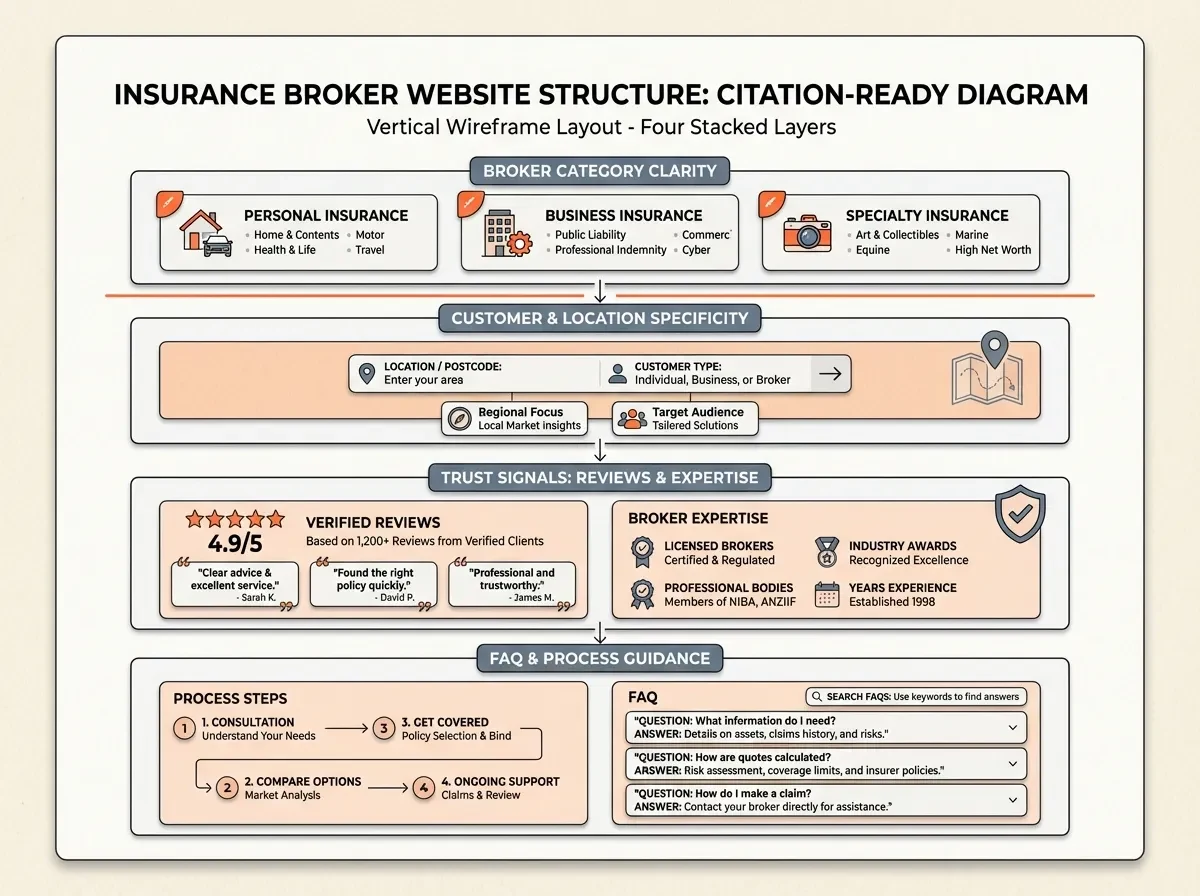
A better page structure for brokers
Your core pages should answer these questions quickly:
- What kinds of insurance do you broker?
- Which customers do you help most often?
- Which locations do you serve?
- What is your process, compare, advise, place, support, claims?
- Why should someone trust your brokerage rather than going direct?
You do not need every page to sound like a compliance document. You do need enough specificity for a model to tell the difference between a broker, an insurer, and a generic lead-generation site.
For the foundational side of this, what answer engine optimization is is still worth reading. For tooling, keep it boring at first: use whatever helps you monitor mentions, profile consistency, and unanswered buyer questions without distracting from the basics.
What to include on key broker pages
- clear product categories
- industries or customer types served
- named locations or regions
- broker team bios and expertise
- FAQ blocks around advice, claims, and policy comparisons
- testimonials that mention specific outcomes or service moments
That is the sort of detail an assistant can work with.
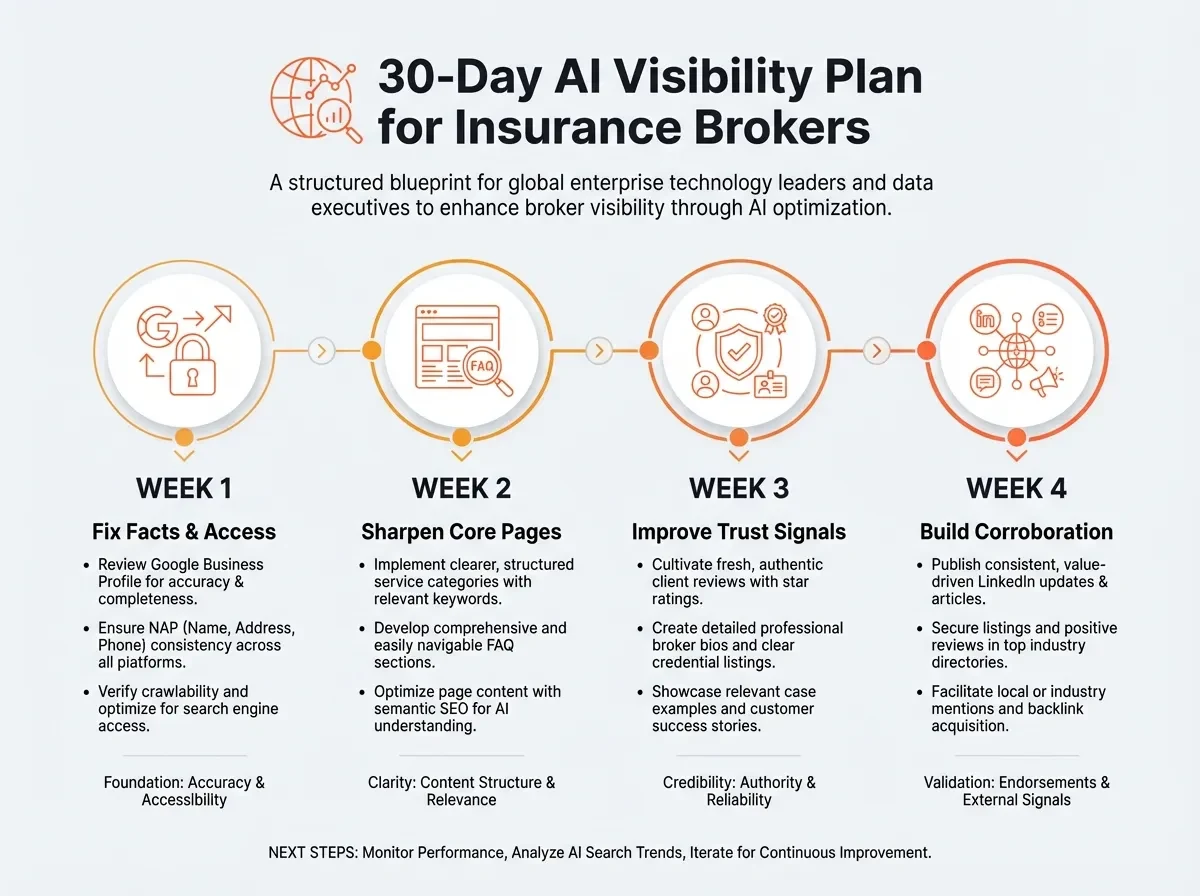
A 30-day AI visibility plan for insurance brokers
If I were sorting this for a brokerage over the next month, I would keep it fairly disciplined.
Week 1: fix facts and access
- review your Google Business Profile
- check NAP consistency across listings
- confirm key pages are crawlable and visible without JS issues
Week 2: sharpen core pages
- rewrite service pages with specific product and customer language
- split broad insurance pages into clearer categories where needed
- add FAQ sections to main service pages
Week 3: improve trust signals
- ask for a small batch of fresh reviews
- update broker bios and credentials
- add named case examples or policy scenarios where appropriate
Week 4: build corroboration
- update LinkedIn company and adviser profiles
- review major directory listings
- look for one or two local or industry mentions worth earning properly
That plan will not guarantee AI assistants start recommending you tomorrow. Nothing sensible can promise that. It will make your brokerage easier to verify, easier to describe, and easier to compare, which is generally the point.
Frequently Asked Questions
How do AI assistants decide which insurance brokers to mention or recommend?
AI assistants appear to rely on a mix of first-party content, directories, reviews, and other third-party sources when evaluating insurance brokers. In trust-heavy sectors such as finance, Yext’s research suggests some models lean strongly on managed profiles and directory-style sources rather than only on the business website.
What should an insurance broker fix first to improve AI visibility?
Most brokers should start with clearer service pages, accurate local profiles, stronger review coverage, and consistent business facts. If assistants cannot tell what you broker, where you operate, or why customers trust you, visibility will stay patchy.
Which trust signals matter most when ChatGPT describes an insurance brokerage?
The strongest signals are review quality, review recency, business fact consistency, named expertise, and credible third-party corroboration. Those signals help assistants decide whether a brokerage is active, legitimate, and specific enough to mention confidently.
Can a smaller insurance broker still show up in AI answers?
Yes. A smaller brokerage can still appear if its website is clear, its profiles are accurate, and its trust signals are stronger than larger but vaguer competitors. AI assistants do not only reward size. They often reward clarity and verifiability.
Conclusion
AI visibility for insurance brokers comes back to one thing quite quickly. Can an assistant verify who you are, what you do, and why a customer should trust you?
If the answer is fuzzy, your brokerage will likely get blurred into generic advice. If the answer is clear, your odds improve. Start with your highest-value pages, your review profile, and your business facts across the web. Get those sorted first. Then worry about the clever stuff.
Continue Reading
AEO Foundations19 min read
AI Discoverability: How AI Systems Find and Surface Information
AI discoverability is the layered process by which systems acquire information, interpret entities, retrieve relevant material, select sources, and present claims in generated answers; technical accessibility supports eligibility but never guarantees citation, recommendation, traffic, or influence.
Rosh Jayawardena
AEO Foundations9 min read
How to Get Cited by ChatGPT for Your Business
Learn how to get cited by ChatGPT with practical fixes for crawlability, page structure, schema, and off-site authority.
Rosh Jayawardena
AEO Foundations9 min read
llms.txt Explained: Should Your Website Have One?
llms.txt explained for real businesses: what it does, where it may help, and why most sites should fix bigger issues first.
Rosh Jayawardena
Deep dives, delivered weekly
AI patterns, workflow tips, and lessons from the field. No spam, just signal.