Back to Blogs
The 30% Advantage: How Independent Consultants Are Outworking Big Firms with AI
8 min readDec 26, 2025
Thought Leadership

Rosh JayawardenaData & AI Executive
The consulting industry's biggest shift isn't happening at McKinsey or BCG. It's happening in home offices and co-working spaces, where independent consultants are using AI to punch above their weight.
It's 2am and you're finishing a due diligence report. Three years ago, this would have meant a team of four analysts working for a week — pulling financials, cross-referencing market data, drafting the executive summary. Tonight, it's just you, a laptop, and a stack of AI tools that do the grunt work while you focus on what actually matters: the strategic insight your client is paying for.
This isn't a hypothetical. It's the new reality for independent consultants who've figured out how to use AI effectively.
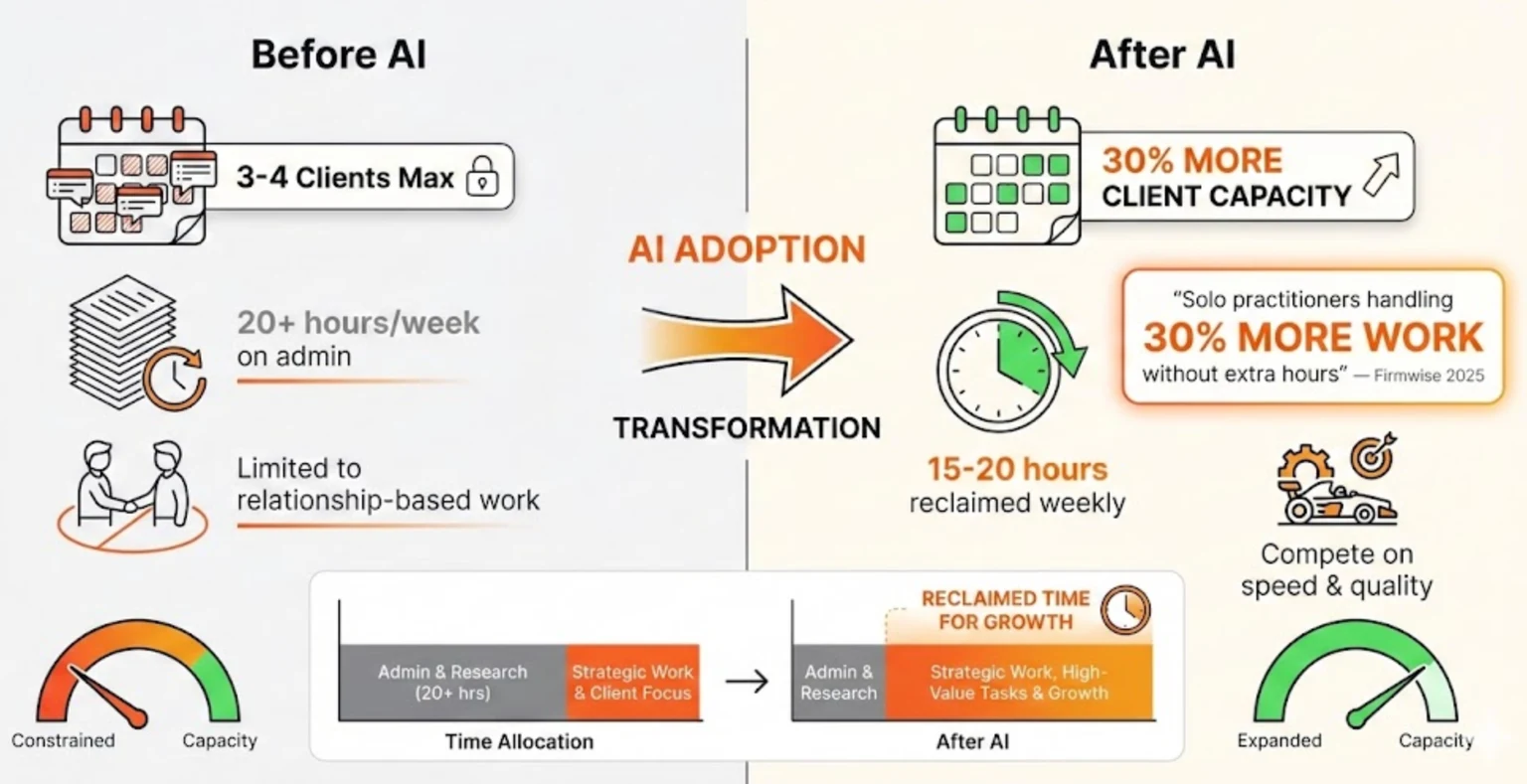
According to Firmwise's 2025 State of the Industry Report, solo practitioners using AI are now handling 30% more client work without adding hours. They're reclaiming 15-20 hours weekly from administrative and analytical tasks — time that used to disappear into research, formatting, and the kind of tedious synthesis that big firms throw bodies at.
The consulting industry's biggest disruption isn't happening at McKinsey or BCG. It's happening in home offices and co-working spaces, where independents are using AI to punch above their weight.
The New Math of Independent Consulting
For decades, big firms had an unassailable advantage: scale. They could staff a project with analysts, associates, and engagement managers. They had proprietary databases. They had the brand that made Fortune 500 procurement teams feel safe.
Independent consultants competed on specialization and relationships, but the math worked against them. You can only bill so many hours. You can only handle so many clients. And certain engagements — the ones requiring armies of analysts — were simply off-limits.
AI has rewritten that equation.
A Harvard Business School study at Boston Consulting Group found that consultants using AI completed tasks 25% faster and performed 12% more tasks overall. McKinsey's research shows AI has slashed non-billable work by 60%. Deloitte found that firms using AI-enabled processes can triple their client capacity without adding staff.
Here's what that looks like in practice: A fractional CFO I know uses AI to auto-generate financial models from raw data exports. She drafts board presentations with Gamma, saving 5-20 hours per project on deck creation alone. Market comparables that used to take days now take minutes.
The billable hour calculus has fundamentally shifted. Lower overhead plus AI leverage equals competitive pricing without sacrificing quality or margin. That's the 30% advantage.
The Practical AI Stack
Here's the thing nobody tells you about AI-enabled consulting: it's not about one tool. It's about orchestrating many.
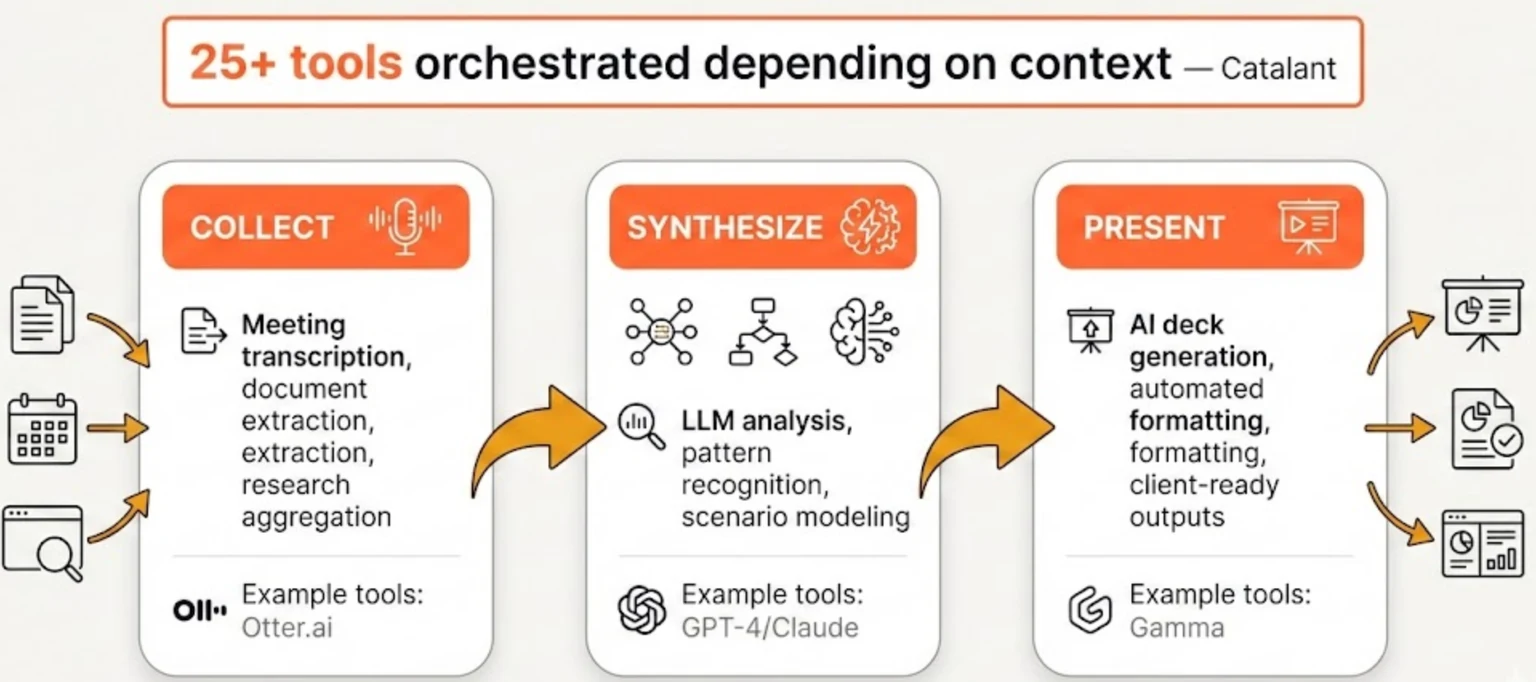
Catalant's research on AI-powered consultants found that every consultant surveyed uses AI daily, with ChatGPT as the universal anchor. But they're layering in 25+ different tools depending on context and task. This is a maturing, multi-tool approach — not a magic wand.
The most effective framework I've seen is what Catalant calls "Collect, Synthesize, Present":
Collect
This is where you gather raw material. Meeting transcription with pendant devices or Otter.ai. Document extraction and summarization. Research aggregation from multiple sources. The goal is to get everything into a format AI can work with.
Synthesize
This is where the magic happens. LLMs like GPT-4 or Claude process transcripts and generate first drafts. You're doing pattern recognition across large document sets — the kind of work that used to require a team reading for days. Scenario modeling. Projections. The analytical heavy lifting.
For a more structured version of that step, see the 5-step workflow for synthesising research from multiple sources.
Present
AI presentation platforms like Gamma transform your synthesis into polished decks with appropriate imagery and formatting. Client-ready deliverables in hours, not days.
Real use cases:
- Due diligence reports: Upload 500 pages of company documents, get an executive summary with key risk flags
- Market analyses: Competitive landscape in an afternoon instead of a week
- Strategy presentations: From messy meeting notes to boardroom-ready deck
One caveat: garbage in, garbage out. The consultants getting the best results are spending significant time on data quality and hallucination mitigation. Best practice: require AI to cite sources directly, break complex requests into verifiable steps, and never trust a number without checking it.
Where Big Firms Still Win (And Where They Don't)
Let's be honest about what AI doesn't solve.
| Big Firm Advantage | Still True in 2025? |
|---|---|
| Brand credibility for Fortune 500 | Yes — procurement still wants safe choices |
| Armies of junior analysts | No — AI handles the grunt work now |
| Proprietary databases | Eroding — most data is accessible |
| Network and relationships | Neutral — AI doesn't schmooze |
| Specialization depth | No — independents can go deeper |
Big firms still win large transformation programs where you need 50 people on-site for 18 months. They win the engagements where a Board needs to point at a recognizable name and say "we hired the best."
But the battleground has shifted:
- Speed to insight: AI-enabled independents win. No layers of review, no staffing delays.
- Price for comparable quality: Independents win. No associate billing, no office overhead.
- Risk tolerance for innovation: Independents win. Less bureaucracy, faster pivots.
The sweet spot for AI-enabled independents: strategy work, specialized analysis, fractional executive roles, and engagements where speed and customization matter more than brand.
The Economics Are Changing
The consulting marketplace itself is evolving to favor independents.
The marketplace sector hit $3.2 billion in 2025, now driving 40% of independent consulting deals. Platforms like Catalant are connecting senior talent directly with enterprise clients who've realized something important: they're paying for the partner's brain, not the analyst spreadsheets.
The fractional executive model is exploding. According to Deloitte, the number of fractional leaders doubled from 60,000 to 120,000 in just two years. By 2025, 35% of US businesses will have adopted fractional hiring.
What's driving this? Clients are getting smarter about what they're actually buying.
When you hire McKinsey, you get a partner with 20 years of experience... plus a team of 26-year-olds building your slides. You're paying for the senior expertise, but you're also paying for the junior learning curve.
The new independent pitch flips this: "You get me — the person with 20 years of experience — plus AI that does the work of a team. No bloated project staffing. No junior associates learning on your dime. Just senior expertise with AI leverage."
That's a compelling value proposition when clients are scrutinizing every line item.
The Inflection Point
2025 is the year this stops being optional.
Professional services leads all sectors in AI adoption, with implementation rates jumping from 33% in 2023 to 71% in 2024, according to McKinsey. The consulting industry is growing AI adoption at 32% annually. By year-end, 85% of leading firms will have AI deeply embedded in their workflows.
The consultants who learn to leverage AI effectively aren't just surviving — they're taking market share from firms that can't move as fast.
But here's the real differentiator: it's not about having AI. Everyone has AI now. It's about knowing when to use it, when to trust it, and when to apply the judgment that AI can't provide.
AI can synthesize a 500-page document set. It can't tell you which findings will make your client's CEO nervous. It can generate a polished presentation. It can't read the room and pivot your narrative mid-meeting. It can crunch the numbers. It can't build the relationship that turns a one-off project into a five-year retainer.
The 30% advantage isn't about replacing your expertise with AI. It's about amplifying it — freeing up the hours you used to spend on grunt work so you can focus on the strategic insight and client relationships that no algorithm can replicate.
The question isn't whether AI will change consulting. It's whether you'll be using it to compete, or be competed against.
Continue Reading
Thought Leadership11 min read
The 320% Effect: What 850,000 Sites Tell Us About Local AEO in 2026
The case for local AEO used to rest on extrapolation. After 858,457 sites and 68.9M crawler visits, the data has caught up. Here is the synthesis.
Rosh Jayawardena
Thought Leadership7 min read
Your Notes Are Everywhere. Your AI Forgets Everything. Now What?
Your knowledge is scattered across a dozen tools, and none of them talk to each other. The AI tools are supposed to help, but they forget everything the moment you close the tab.
Rosh Jayawardena
Deep dives, delivered weekly
AI patterns, workflow tips, and lessons from the field. No spam, just signal.