Back to Blogs
Your Notes Are Everywhere. Your AI Forgets Everything. Now What?
7 min readDec 24, 2025
Thought Leadership

Rosh JayawardenaData & AI Executive
Your knowledge is scattered across a dozen tools, and none of them talk to each other. The AI tools are supposed to help, but they forget everything the moment you close the tab.
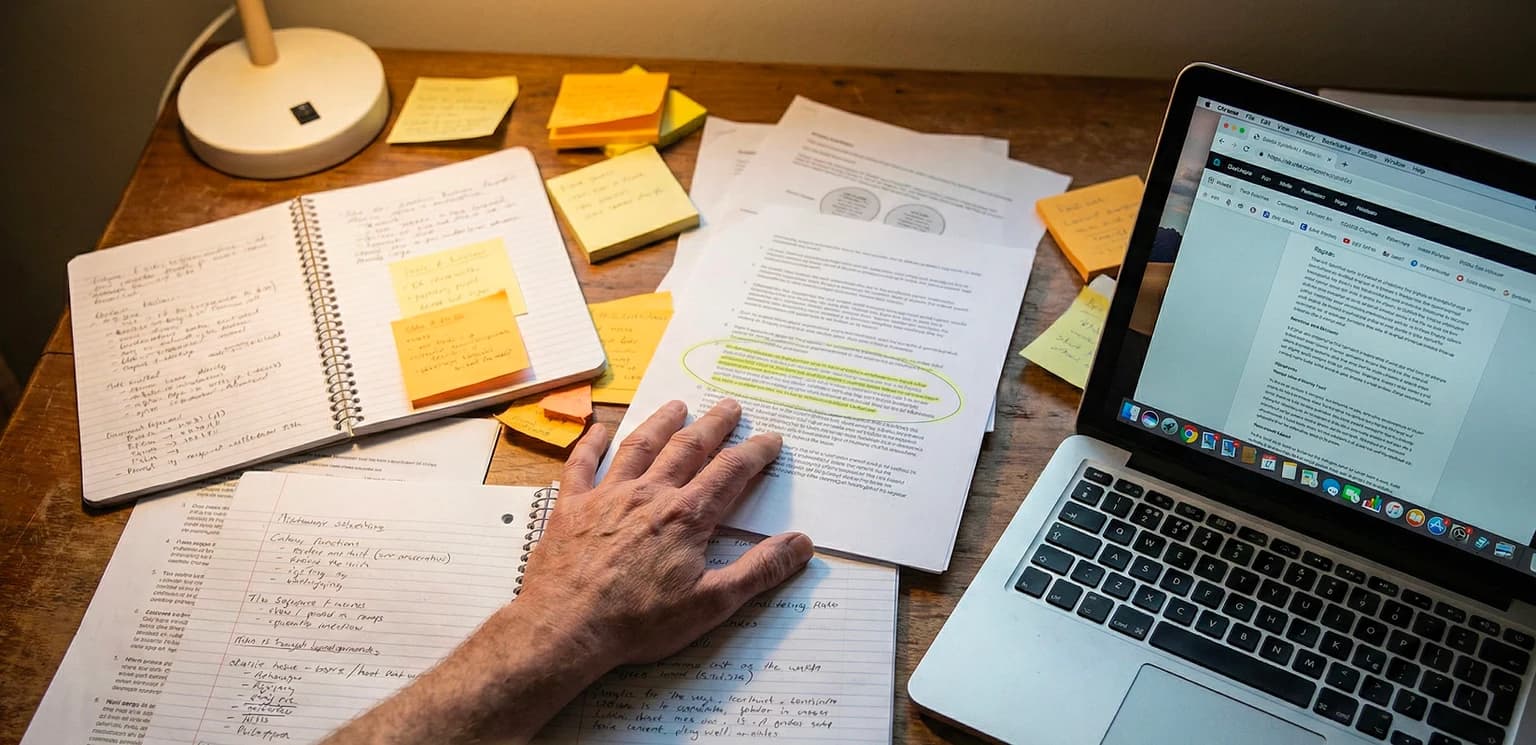
Right now, I have Notion open in one tab, a Google Doc in another, Slack in a third, and two separate AI chat windows. Somewhere in this mess is a competitive analysis I did three weeks ago. I know it exists. I just can't find it.
So I'm probably going to redo it.
This happens constantly. Not because I'm disorganised — I've tried every productivity system going — but because my knowledge is scattered across a dozen different tools, and none of them talk to each other. The AI tools are supposed to help, but they forget everything the moment I close the tab.
Here's the thing: this isn't a personal failing. It's a systemic problem with how knowledge work actually works in 2025. And if we don't fix it, it's going to get worse.
The Fifth Employee Is Just Looking for Information
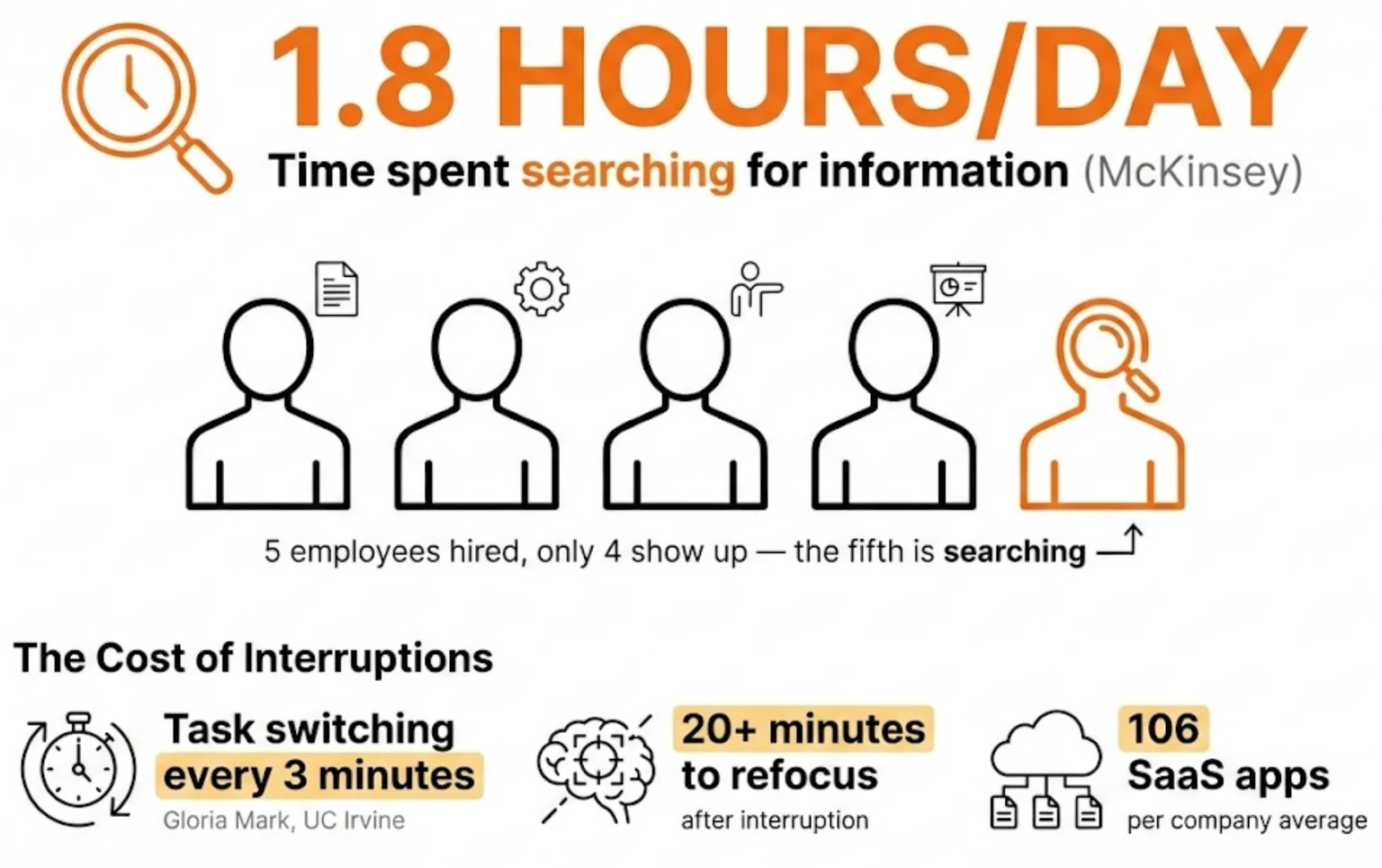
McKinsey Global Institute put a number on this problem years ago, and it's haunting: employees spend 1.8 hours every day — every single day — searching for and gathering information.
Their framing stuck with me: "Businesses hire 5 employees but only 4 show up to work. The fifth is off searching for answers."
That was 2012. It's gotten worse.
A 2024 study found some workers now spend up to 1.5 working days per week on searching and gathering tasks. Not doing the work. Not thinking. Just... looking for things.
Add to that the context switching. Research by Gloria Mark at UC Irvine found that knowledge workers switch tasks every three minutes on average, with significant interruptions hitting every eleven minutes. And it takes over twenty minutes to fully refocus after each one.
The average company now uses 106 different SaaS apps, according to Productiv's 2024 State of SaaS report. And 40% of workers spend more than 30% of their time jumping between tools. Each tool is another place your knowledge might be hiding.
Your knowledge isn't in one place. It's everywhere. And "everywhere" means nowhere useful.
We Didn't Mean to Fragment Everything
Nobody set out to create this mess. Each tool you added solved a real problem.
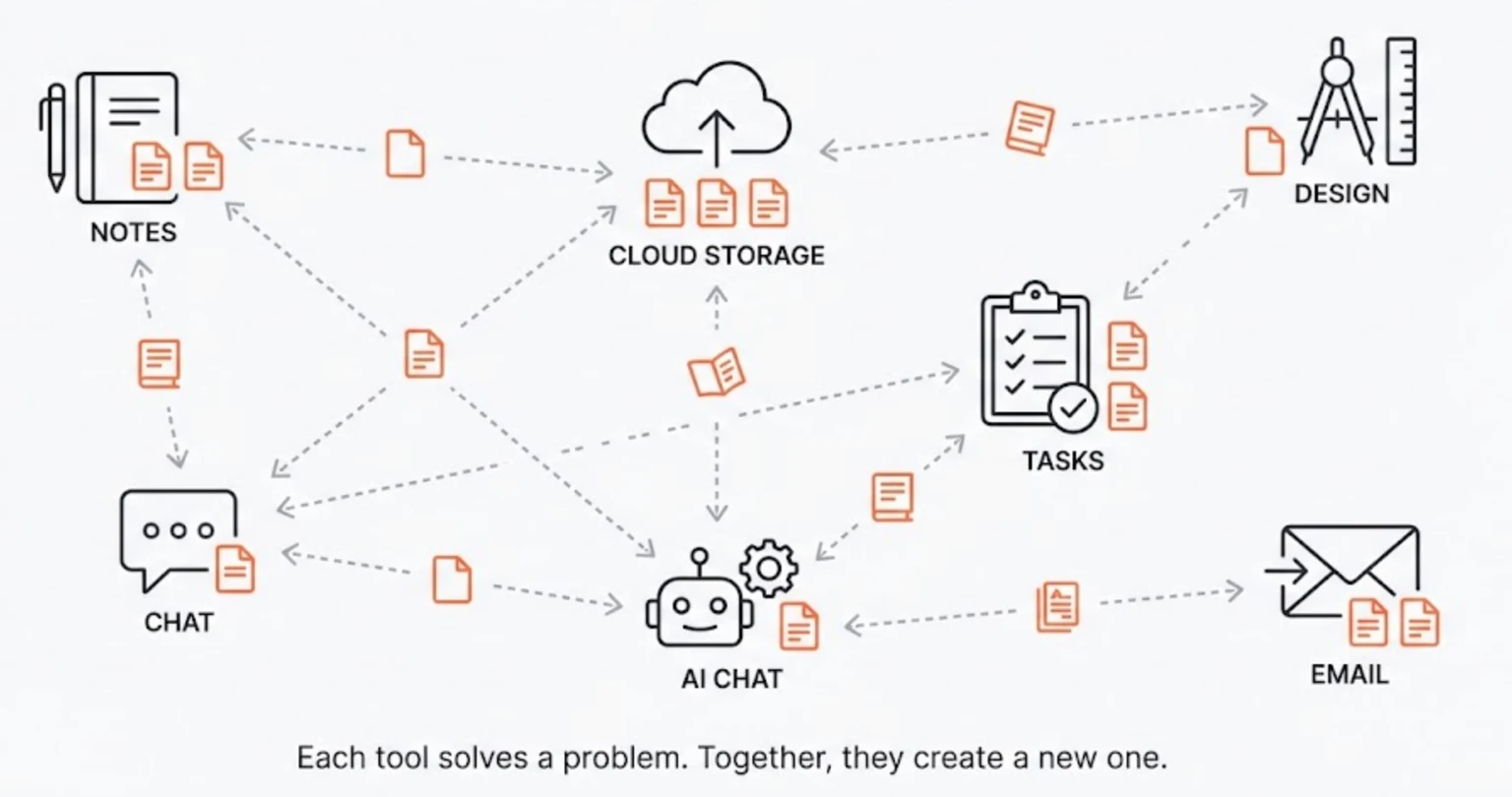
Notion for project docs. Slack for quick questions. Google Drive for file storage. Figma for designs. Linear for tasks. A notes app for fleeting thoughts. ChatGPT for research. NotebookLM for deep dives on specific documents.
Each one is good at what it does. The problem is they don't talk to each other. Your notes app doesn't know what you discussed in Slack. Your AI chat doesn't remember what you uploaded last month. Your project docs don't surface when you're doing related research.
I've felt this acutely. I'll be working on a report, and I know — I know — that I researched something relevant three months ago. But that research lives in a ChatGPT thread that's now buried under 50 other conversations. Or in a NotebookLM notebook I created for a different project. Or in a Notion page I forgot I made.
So I do the research again. From scratch. Because finding my old work would take longer than just redoing it.
That's insane. But it's also completely normal.
Current AI Tools Make This Worse, Not Better
Here's what frustrates me about today's AI tools: they're incredibly smart within a session and completely amnesiac across sessions.
Take NotebookLM. It's genuinely useful for deep research on a specific set of documents. You upload your sources, and it becomes an expert on exactly that material. Great for a single project — and yes, when you come back next week, your notebook is still there.
But here's the limitation: each notebook is an island. You can't see across notebooks, can't link insights between projects, can't ask "what did I learn about competitor pricing across all my research?" Your knowledge stays siloed. The AI in notebook A has no idea what the AI in notebook B learned. So you end up with the same fragmentation problem, just inside a different tool.
It's the same pattern everywhere. ChatGPT gives you brilliant analysis on Monday, then has no memory of it by Wednesday. Claude helps you draft something, but next conversation, you're strangers again.
These tools assume your knowledge sits neatly in one place — that you'll upload the exact right documents and ask the exact right questions in a single session. But real knowledge work doesn't look like that. Real knowledge work is messy. It spans weeks, months, projects. The insight you need today came from research you did six months ago on a completely different problem.
Current AI can't handle that. And that's a problem.
The Real Issue: Search Is the Wrong Mental Model
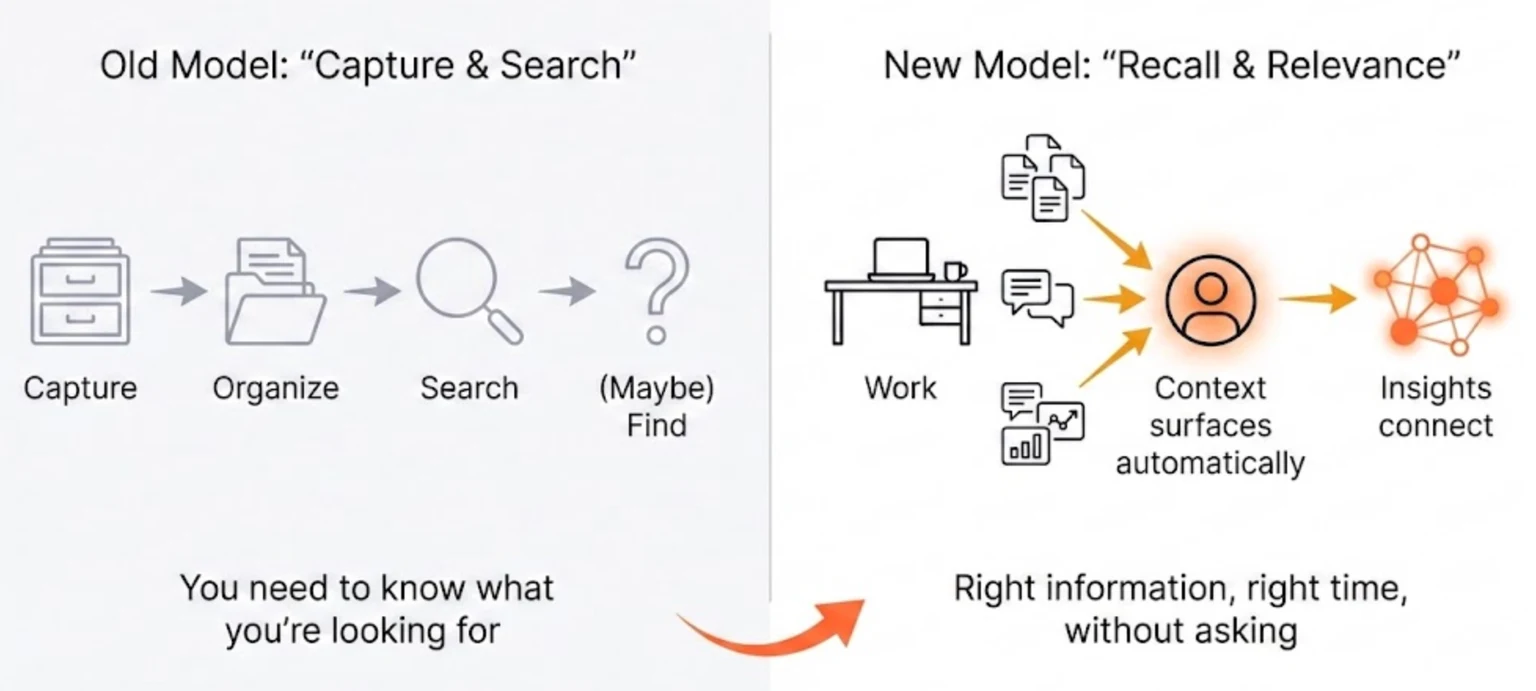
For decades, knowledge management has been about capture and search. Take notes. Organise them into folders. When you need something, search for it.
But search only works when you know what you're looking for. And often, you don't.
The insight that would help you right now might be buried in notes from a project you've half-forgotten. You wouldn't think to search for it because you don't remember it exists. The connection is invisible.
What we actually need isn't better search. It's better recall. Specifically, it's relevant information surfacing at the right time without you having to ask.
This is harder than it sounds. Research from Harvard's D3 Institute found something counterintuitive: in AI memory tests, storing everything actually performed worse than storing nothing. The key isn't hoarding information — it's curating it. Keeping what matters, forgetting what doesn't, and knowing the difference.
The shift we need is from "I'll search for it when I need it" to "It shows up when it's relevant."
What Would Actually Fix This?
Imagine an AI assistant that actually remembered your work.
Not just the current conversation. Everything. Every project you've worked on. Every document you've researched. Every insight you've generated. And — this is the key part — it would surface relevant context automatically, based on what you're doing right now.
Working on a competitive analysis? Here's the market research you did eight months ago that's suddenly relevant. Drafting a proposal? Here are three similar proposals you've written, with notes on what worked.
No searching. No re-uploading documents. No "I know I saved that somewhere." Just... the right context, at the right time.
AWS recently described this approach in the context of software development: AI that "saves and maintains persistent context across all phases... ensuring seamless continuation of work across multiple sessions."
That's the shift. From tools that forget to tools that remember. From you managing the context to the context managing itself.
The organisations that figure this out first will have a real advantage. Not because their people are smarter, but because their people won't waste a quarter of their week looking for things they already know.
The Gap Is the Opportunity
The gap between "I did this research" and "I can actually use this research" is where most knowledge workers lose. Every day.
Current AI tools are smart but forgetful. They help with individual tasks but make the fragmentation worse, not better. We keep adding tools, toggling between them, and losing more time to the spaces in between.
But gaps create opportunities. The next generation of tools won't just be smarter within a session — they'll be smarter across sessions. They'll remember. They'll connect. They'll surface what you need before you ask.
That's not science fiction. That's the obvious next step.
And whoever gets there first — the people and organisations that stop re-doing their own work — will have the advantage. Not because they're smarter. Because they'll finally stop paying the tax on forgetting.
Continue Reading
Thought Leadership11 min read
The 320% Effect: What 850,000 Sites Tell Us About Local AEO in 2026
The case for local AEO used to rest on extrapolation. After 858,457 sites and 68.9M crawler visits, the data has caught up. Here is the synthesis.
Rosh Jayawardena
Thought Leadership8 min read
The 30% Advantage: How Independent Consultants Are Outworking Big Firms with AI
The consulting industry's biggest shift isn't happening at McKinsey or BCG. It's happening in home offices and co-working spaces, where independent consultants are using AI to punch above their weight.
Rosh Jayawardena
Deep dives, delivered weekly
AI patterns, workflow tips, and lessons from the field. No spam, just signal.