
Back to Blogs
Get Your Brand Mentioned in ChatGPT: An Evidence-Led Process
16 min readAug 17, 2026
How To

Rosh JayawardenaData & AI Executive
Getting a brand mentioned in ChatGPT requires crawlable, clear information, relevant independent evidence, and repeated testing across realistic prompts; these actions can improve discoverability and accuracy but cannot guarantee a mention, citation, or recommendation.
The first thing to understand about getting mentioned in ChatGPT is that there is no submission box where you enter a brand and ask to be added to the answers.
What you can do is less direct, but more useful. You can make accurate information about the brand easy to access, make its meaning clear, earn independent evidence that fits the claims being made, and test whether the brand appears under realistic conditions. These are controllable inputs. The mention itself is not.
This distinction matters because a lot of what gets called “ChatGPT SEO,” generative engine optimization, or answer engine optimization mixes together several different outcomes. A citation is not a mention. A mention is not necessarily a recommendation. And one recommendation is not proof of lasting visibility.
The practical question, then, is not how to force ChatGPT to mention your brand. It is how to make the brand easier to find and describe accurately, then measure what happens.
Define what “mentioned in ChatGPT” actually means
Before changing anything, decide what you are trying to improve. There are at least four separate outcomes:
- Search access: ChatGPT can retrieve a page from the brand’s site.
- Citation visibility: A brand-owned or third-party page appears as an inline citation or in the Sources panel.
- Answer-text visibility: The brand’s name appears in the generated answer.
- Recommendation visibility: ChatGPT presents the brand as an option for a particular need.
Track these separately. A page can be cited without the brand being named prominently; a brand can be named without its site being cited; and a name in a factual description does not mean ChatGPT endorses or recommends the business.
There is another split underneath these outcomes. According to OpenAI’s reliability guidance, a response without search is based on information learned during training. With search or deep research, ChatGPT can access and cite current web sources. This means the apparent source of a brand mention may be learned information, live or cached web retrieval, or some combination the public evidence does not fully describe.
When search is used, ChatGPT may show inline citations. If it does not, the Sources panel may still contain cited sources and other relevant links, as explained in OpenAI’s ChatGPT Search documentation. But neither form of citation guarantees that the cited brand will appear in the answer text.
Recommendations are narrower still. “What does this company sell?” asks for a description. “What are some options for solving this problem?” may produce a list. “Which option should I choose?” asks ChatGPT to make a recommendation. Commercial, comparison, alternative-seeking, and local prompts are plausible places to look for recommendations, but the supplied evidence does not establish a universal recommendation algorithm.
The conditions of the test matter too. As of August 1, 2026, OpenAI says ChatGPT Search is available to Free, Plus, Team, Edu, and Enterprise users, as well as logged-out Free users. ChatGPT may search automatically when a question could benefit from web information; a user can also select Search or regenerate a response with web search. Search queries may be rewritten, and general IP-based location, optional device location, conversation context, and enabled memories may affect that rewriting.
So two people can ask what seems like the same question and still create different retrieval conditions. The sources do not give a complete account of every region, account state, or product mode, which is why these conditions should be recorded rather than assumed away.
This gives you a cleaner target. You are not trying to “rank in ChatGPT” as if there were one fixed list. You are trying to improve several observable forms of brand visibility in ChatGPT, each under conditions that can change.
Remove the technical barriers to discovery
The simplest failure is also the easiest to miss: the useful information exists, but ChatGPT Search cannot retrieve it.
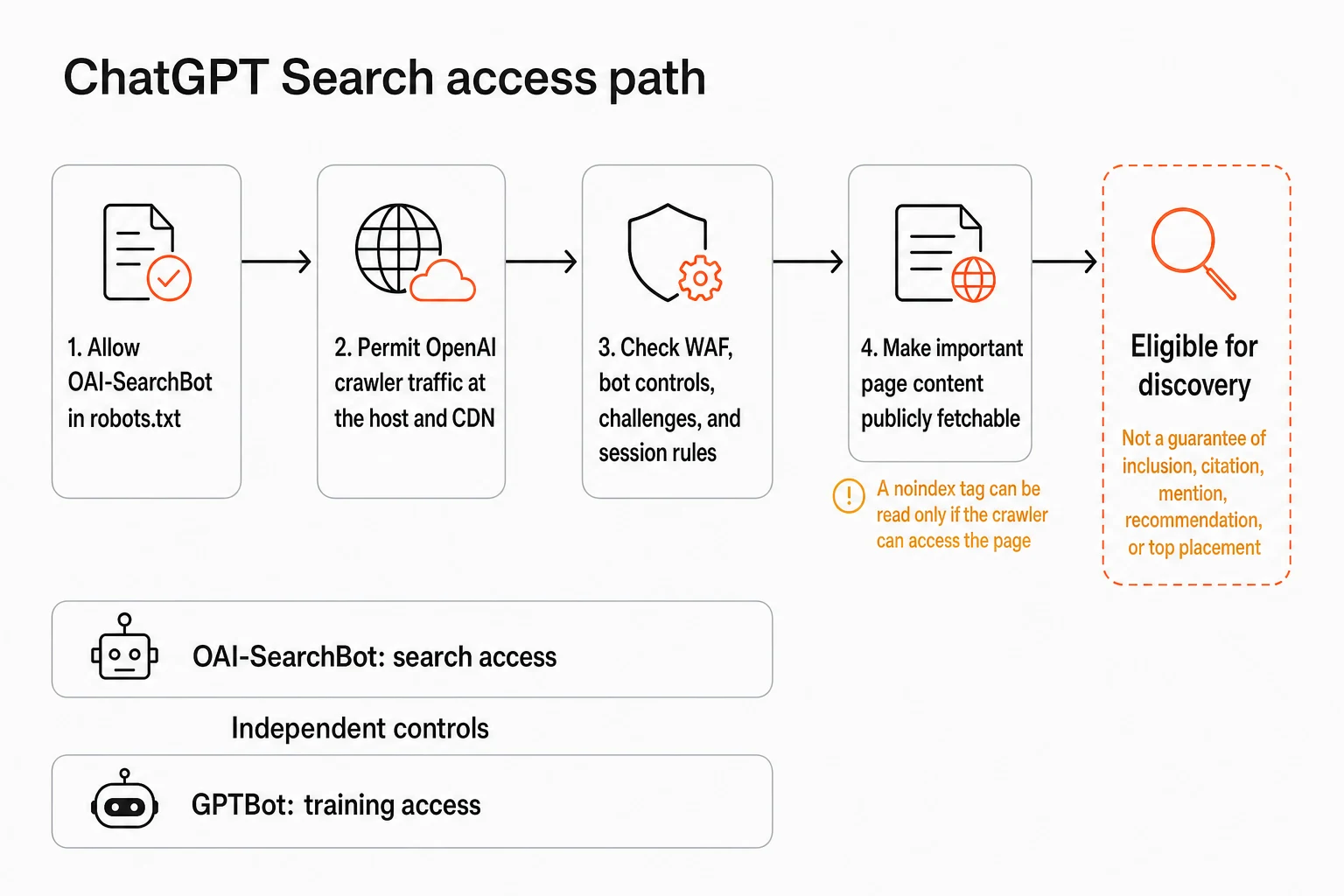
OpenAI says that any public website can appear in ChatGPT Search. Its publisher and developer guidance identifies access for OAI-SearchBot as the key crawl condition for content to be discovered, summarized, cited, and linked. Its Search documentation also says the site’s host or content-delivery network should permit traffic from OpenAI’s published IP addresses.
Start with robots.txt. Check whether OAI-SearchBot is allowed to reach the pages containing the brand’s important facts. Then check the layers behind it: the host, CDN, web application firewall, bot-management service, JavaScript challenge, CAPTCHA, and session rules. A crawler allowed by robots.txt can still receive a 403 response or get stopped by a human-verification step.
Next, inspect the pages themselves. Important information should not require an account or sit only behind a paywall. It should not depend entirely on scripts or dynamic loading that a retrieval system may fail to process. The approved evidence does not establish a complete rendering and indexability checklist, so ordinary technical checks—such as confirming that the intended page and its visible content can actually be fetched—remain an audit task rather than a documented ChatGPT ranking rule.
The role of noindex is easy to misunderstand. OpenAI says a noindex meta tag can be used to prevent a page from surfacing, but the crawler must be allowed to access the page before it can read the tag. Blocking the crawler and expecting it to honor an unseen page-level directive does not work as intended.
Keep the bots straight. OpenAI’s crawler documentation says OAI-SearchBot and GPTBot have independent controls. You can allow OAI-SearchBot for search while disallowing GPTBot for training. Changing one is not the same as changing the other.
ChatGPT Search is also not interchangeable with conventional search-engine indexing or visibility in another AI product. OpenAI says its search experience can use third-party search providers and partner content; some eligible workspaces can use OpenAI’s indexed and cached content through offline web search. The evidence does not show that Google indexing is a universal prerequisite for ChatGPT Search, nor does it show that another search engine’s crawler controls apply to OpenAI.
There is no separate brand-submission form required by the supplied OpenAI guidance. Crawl access is the practical entry condition.
But it is only an entry condition. OpenAI explicitly says there is no way to guarantee top placement. Allowing OAI-SearchBot makes content eligible for discovery; it does not guarantee inclusion, a citation, an answer-text mention, or a recommendation.
Turn the brand website into a clear, verifiable source of truth
Once a page can be reached, the next question is whether it says clearly what the brand is.
This sounds almost too basic. Yet company sites often spread the answer across taglines, product pages, press releases, and old directory descriptions, each using different words. A person can sometimes piece this stuff together. A retrieval system should not have to.
Make the core facts explicit and consistent where they apply:
- the organization’s name and plain-language description;
- the products or services it offers;
- the audience and use cases it serves;
- meaningful differentiators that can be supported;
- locations, contact details, and service categories;
- pricing, availability, and specifications where relevant;
- the people or expertise behind important claims.
These are not a confirmed OpenAI ranking checklist. They are clarity measures. Their value is that they reduce ambiguity when a system—or a customer—is trying to work out who you are, what you do, and whether a page answers the question.
Then build outward from facts to questions. Publish useful, self-contained answers to things customers and people in the industry really ask: definitions, how-to explanations, FAQs, comparisons, limitations, and problem-solution pages. Use plain headings and answer the stated question before wandering into background or sales copy.
Do not create a separate thin page for every slight variation of a prompt. That produces repetition rather than evidence. Google’s guidance for AI features in Search—which is not an OpenAI ranking policy—makes a useful quality distinction here: content should add firsthand or expert value instead of merely restating what is already available, and scaled pages made mainly to manipulate generative answers are a poor long-term strategy.
The same standard helps with comparisons. A comparison page should explain the basis of comparison, state where each option fits, and support factual claims. It should not pretend the brand wins every use case. The point is to make a decision easier, not to hide the decision inside a pitch.
Add visible signs that let a reader verify the page. Name the author where authorship matters. Provide a substantive author or leadership profile rather than an empty byline. Show publication and update dates accurately. Link claims to case studies, original research, specific reviews, expert commentary, or relevant outside validation when those materials exist. Keep organization, person, product, and contact details consistent across the site.
Structured data can help express these relationships in machine-readable form. Use valid schema that matches the visible content—for example, organization, person, article, product, service, or FAQ markup where each type really applies—and avoid duplicate or conflicting fields. But treat schema as a way to clarify a page, not as a secret switch. Practitioner sources recommend it; the supplied OpenAI documentation does not identify structured data as a guaranteed visibility or ranking factor.
The revealing part is that this work is not mainly about sprinkling special AI phrases over a site. It is about making the site harder to misunderstand.
Build relevant independent evidence without manufacturing mentions
A brand’s own site can establish what it claims. Independent sources can show whether anyone else has reason to support, qualify, or dispute those claims.
ChatGPT Search can retrieve current web content and link to sources. OpenAI does not publish a rule saying that a certain number of reviews, directory entries, press articles, or community posts produces a recommendation. Commercial sources often describe such mentions as authority signals, but that language should be treated as a hypothesis, not as a confirmed OpenAI weighting system.
Still, independent evidence is useful because it supplies information that the brand does not control. Match the source to the question a user is trying to answer:
- Genuine reviews can document customer experience.
- Relevant directories and professional associations can help establish identity, category, or membership.
- Expert publications and interviews can support claims of expertise.
- Independent comparison pages can place a brand among alternatives.
- Communities can contain specific accounts of firsthand use.
Relevance matters more than collecting mentions everywhere. A category-specific review platform may be useful for one business and meaningless for another. The same is true of an association listing, a local directory, or a technical publication.
When assessing a source, ask whether it is actually about the category, whether the publisher or user is independent, whether the account contains firsthand specifics, how recent it is, which use cases it covers, and whether basic brand facts agree with other reliable sources. Positive sentiment alone is not the standard. Accurate, balanced evidence is more useful than vague praise.
The right way to build this evidence is to do things worth documenting. Invite customers who have really used the product or service to leave honest feedback. Publish useful original material. Offer genuine expert commentary to relevant publications. Keep legitimate directory and association profiles current. Disclose paid or otherwise material relationships clearly.
Do not buy fake reviews, condition rewards on positive sentiment, or selectively ask only people expected to leave glowing feedback. The FTC’s endorsement guidance says endorsements must reflect honest experience and that material connections should be disclosed. Its consumer reviews rule guidance says incentives for five-star reviews violate the rule. The precise legal treatment can depend on the facts, platform, and jurisdiction, so this is a boundary rather than individualized legal advice.
Also reject scaled low-value publishing, keyword stuffing, spam, impersonation, and planted community mentions. Google’s anti-spam material is not a complete ChatGPT policy, but it draws a sensible line between useful original work and inauthentic mentions created to manipulate a system. OpenAI’s own Usage Policies separately prohibit deceit, fraud, scams, spam, and impersonation in the use of its services.
You cannot manufacture independence. Once you control the supposed evidence, it stops being independent—which is, I think, the key test.
Test visibility with a repeatable prompt set
A single answer is tempting because it is concrete. You ask a question, see the brand, and take a screenshot. But one answer tells you only what happened once.
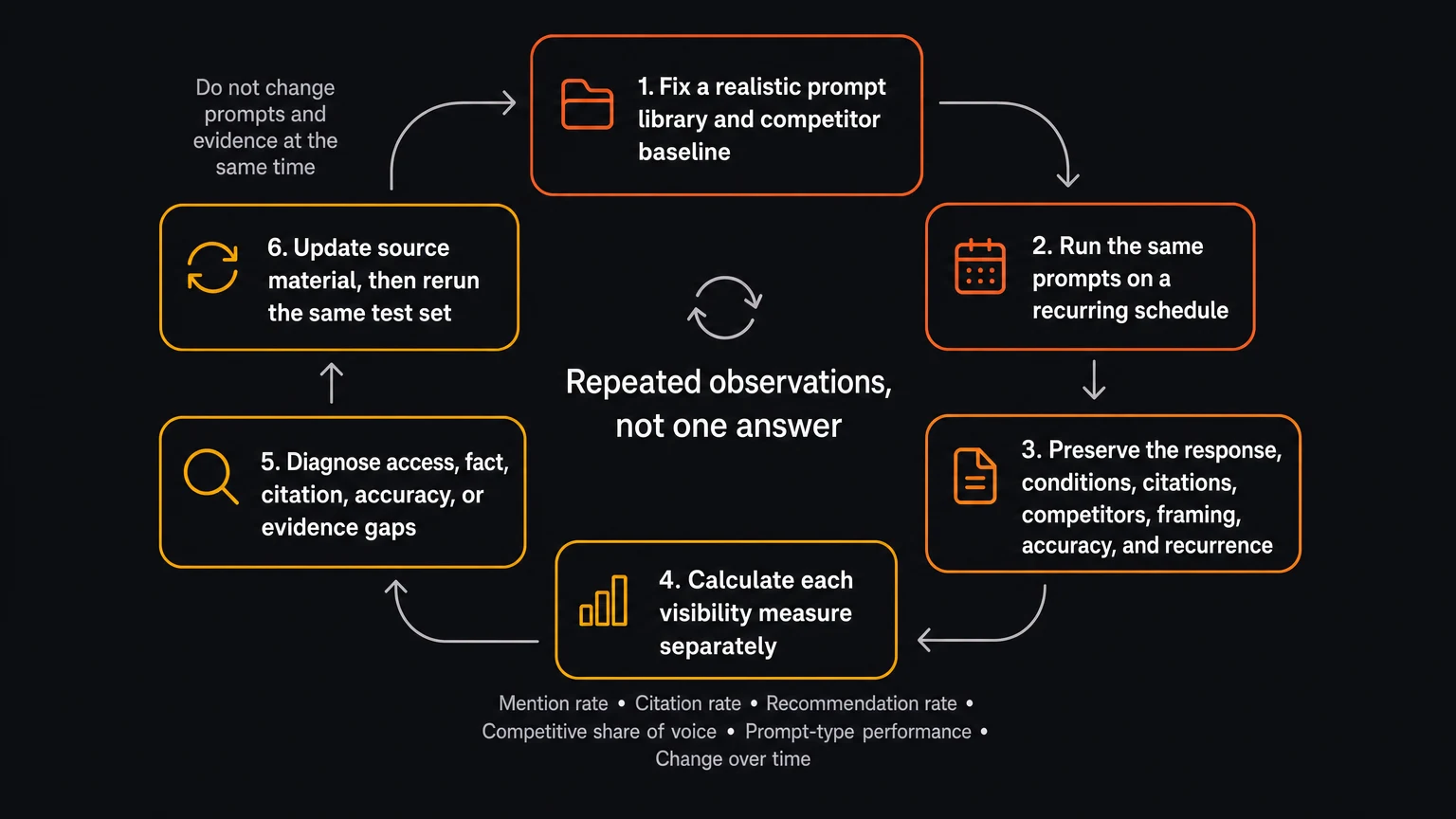
Build a fixed prompt library from real customer and industry questions. Cover several kinds of intent: broad discovery, problem-solution, comparisons and alternatives, local or commercial searches where relevant, and branded questions about the company itself. Include the competitors that a user would reasonably consider so you have a baseline rather than a score in isolation.
There is no validated universal sample size in the supplied evidence. The right number of prompts, locations, account states, and runs will depend on the category. What matters first is that the set is representative enough to be useful and stable enough to compare over time.
Run the same prompts on a recurring schedule. For each test, preserve:
- the exact prompt and complete response;
- the date and relevant location or context;
- the model, browsing, search, or other product conditions you can observe;
- whether memory was enabled when relevant;
- whether the brand was absent, named, cited, or recommended;
- every cited URL and whether it is owned or independent;
- the competitors that appeared;
- the brand’s relative position and framing;
- factual errors, omissions, or outdated claims;
- whether the result recurs in later runs.
Then calculate separate measures. Mention rate is the share of relevant prompts in which the brand is named. Citation rate tracks when a brand-owned or relevant third-party URL is cited. Recommendation rate records when the brand is actually put forward as an option. Competitive share of voice compares the brand’s presence with named competitors. You can also segment results by prompt type and watch movement over time.
These are working measurement conventions, not an accepted universal standard. They measure visibility and representation; they do not by themselves measure sales or prove that a site change caused an answer to change.
Repeated testing matters because answers can vary with prompt wording, conversational context, date, location, model version, and retrieval behavior. The evidence includes disagreement over whether answer-text mentions are more stable than citations. The safe interpretation is to treat both as variable observations and report trends rather than permanence.
There is also no native public ChatGPT brand-mention analytics dashboard in the supplied evidence. Web analytics may show referral visits after someone clicks a link, but they cannot show every time a person saw the brand and did not click. So combine response records with whatever citation and referral data you have, while being honest about the exposure you cannot observe.
This reframes the original question again. “How do we get mentioned?” becomes “Under which realistic prompts and conditions do we appear, in what form, and how often does that pattern repeat?” That is a question you can actually investigate.
Interpret results, correct information, and iterate cautiously
Use the test results as a map of information gaps, not as instructions for forcing a sentence into ChatGPT.
If the site never appears as a source, check crawl access and technical delivery. If the brand is cited but described badly, inspect the cited page and the consistency of the underlying facts. If competitors appear in comparison prompts and the brand does not, look for missing category information or relevant independent evidence. If the brand appears but is framed for the wrong audience, clarify positioning and use cases on the pages most likely to answer that prompt.
Change the source material, then rerun the same test set. Do not change both the prompts and the evidence at once if you want a meaningful comparison. Even then, treat any apparent improvement as an association unless repeated observations give you stronger grounds for inference; ChatGPT’s retrieval systems, model versions, and product behavior can change independently of your work.
Location, query rewriting, memory, conversation context, and whether search is invoked can all alter what appears. A result seen in one account or city is not a fixed brand ranking. Nor does an answer necessarily reflect the current website: without search it may rely on learned information, and even search-based product information can take time to update.
Accuracy deserves its own review. OpenAI says ChatGPT can produce incorrect or misleading information and may sound confident when it is wrong. It may also lack access to a relevant source because of technical issues, paywalls, or crawler preferences. Verify important brand claims against reliable sources, including the cited source where one is provided. A mention is not valuable merely because it exists.
Correction routes are limited and depend on the kind of result. For incorrect product information or policy-violating shopping results, OpenAI documents feedback and reporting controls in its shopping guidance. That process is specific to product results; it is not a universal route for changing every statement about a business.
OpenAI also has a personal-data removal process for affected people in applicable circumstances. Requests should include specific examples and reliable evidence, are assessed case by case, and may be declined. This is a privacy route for personal information, not a way for a company to suppress accurate but unfavorable business information.
The useful boundary is now fairly sharp. You control whether your public information is reachable, clear, current, supported, and consistent. You can earn genuine independent evidence. You can measure mentions, citations, and recommendations with more care than a screenshot.
You do not control the final answer.
That may sound like a disappointing limit, but it points to the better strategy. Instead of trying to make ChatGPT say a particular thing, make the available evidence good enough that an accurate answer has something solid to work with—and keep testing whether it does.
Continue Reading
How To13 min read
How to Get Your Brand Mentioned in Google AI Overviews
Getting a brand mentioned in Google AI Overviews requires indexed, useful pages, credible supporting evidence, carefully chosen queries, and repeated testing that separates mentions, citations, recommendations, and owned-source appearances.
Rosh Jayawardena
How To15 min read
How to Get Your Brand Mentioned in Google Gemini
Google Gemini brand mentions are variable, context-dependent outputs, not permanent rankings. Brands improve accurate discoverability by clarifying identity, maintaining accessible facts, publishing useful evidence, earning legitimate corroboration, and testing defined prompts across named Gemini surfaces.
Rosh Jayawardena
How To15 min read
How to Run an AI Discoverability Self-Audit
An AI discoverability self-audit tests technical retrievability, answer appearance, citation, and accurate representation separately using fixed prompts, documented evidence, entity checks, and cautious retesting.
Rosh Jayawardena
Deep dives, delivered weekly
AI patterns, workflow tips, and lessons from the field. No spam, just signal.