Back to Blogs
The Impact of Location on AEO: Geography and AI Search
10 min readOct 9, 2026
AI Research

Rosh JayawardenaData & AI Executive
Location can change AI recommendations, citations and source selection, especially for local, regulated and jurisdiction-sensitive queries; reliable measurement requires repeated tests across markets and assistants.
A buyer in New York asks an AI assistant which payment provider to use. The top five answers are Stripe, Square, PayPal, Helcim and Shopify. A buyer in Mumbai asks the same question and gets Razorpay, Cashfree, PayU, PhonePe and Instamojo. Not one brand appears on both lists.
That example comes from FTA Global's Context Report, published in September 2026, which tested ChatGPT and Gemini across a set of cities and seven languages. The same pattern shows up across the other research published this year. When a question has a geographic element, the place the question is asked from changes which brands the AI names and which sources it trusts.
For marketers and PR teams, the practical consequence is simple. If you check your AI visibility from one office, you are seeing the answer for one market. Your customers in other cities, regions and countries may be getting a different list, and your brand may not be on it.
The AI already knows roughly where your customer is
Most people assume an AI assistant only uses location when they type a place name into the question. For ChatGPT, that assumption is wrong.
OpenAI's help documentation says ChatGPT estimates a general location (country, state or city) from the user's IP address, even when device location sharing is switched off. OpenAI gives a direct example: if someone types "What are some good restaurants near me?" and ChatGPT places them in the San Francisco area, it may rewrite the question into the search query "top restaurants San Francisco" before it looks anything up. If ChatGPT's memory feature is on, a location the user mentioned in an earlier conversation can also shape the search.
Google works in a similar way. Its Search personalisation documentation says personalised recommendations may use the user's general location, and that a previously searched location can stand in when the current one is unavailable.
So a question with no place name in it can still have a place attached. The AI then searches the web for that place and builds its answer from what it finds there.
How much the answer changes
The size of the shift depends on the question. Four recent studies show where it is largest.
Between countries, the brand list can change almost completely
The FTA Global study found 206 brands across its answers, and 159 of them appeared in only one country. Moving away from New York and English changed nearly three of the top five recommended brands on average.
The effect was strongest in categories tied to money and local regulation. In payroll, accounting, payments and HR, an average of 4.4 of the top five brands changed between markets. In everyday tools such as video conferencing and cloud storage, the average was 1.5. In HR and recruiting, all five top brands changed compared with the New York answer.
The sources changed too. In Germany, 42% of the sources the AI cited were German web pages. In France the figure was 34%, in the UK 28% and in the UAE 12%. This matters for PR: in some markets, the AI leans heavily on local publications, and coverage in your home market does not carry across.
Within one country, the averages hide the change
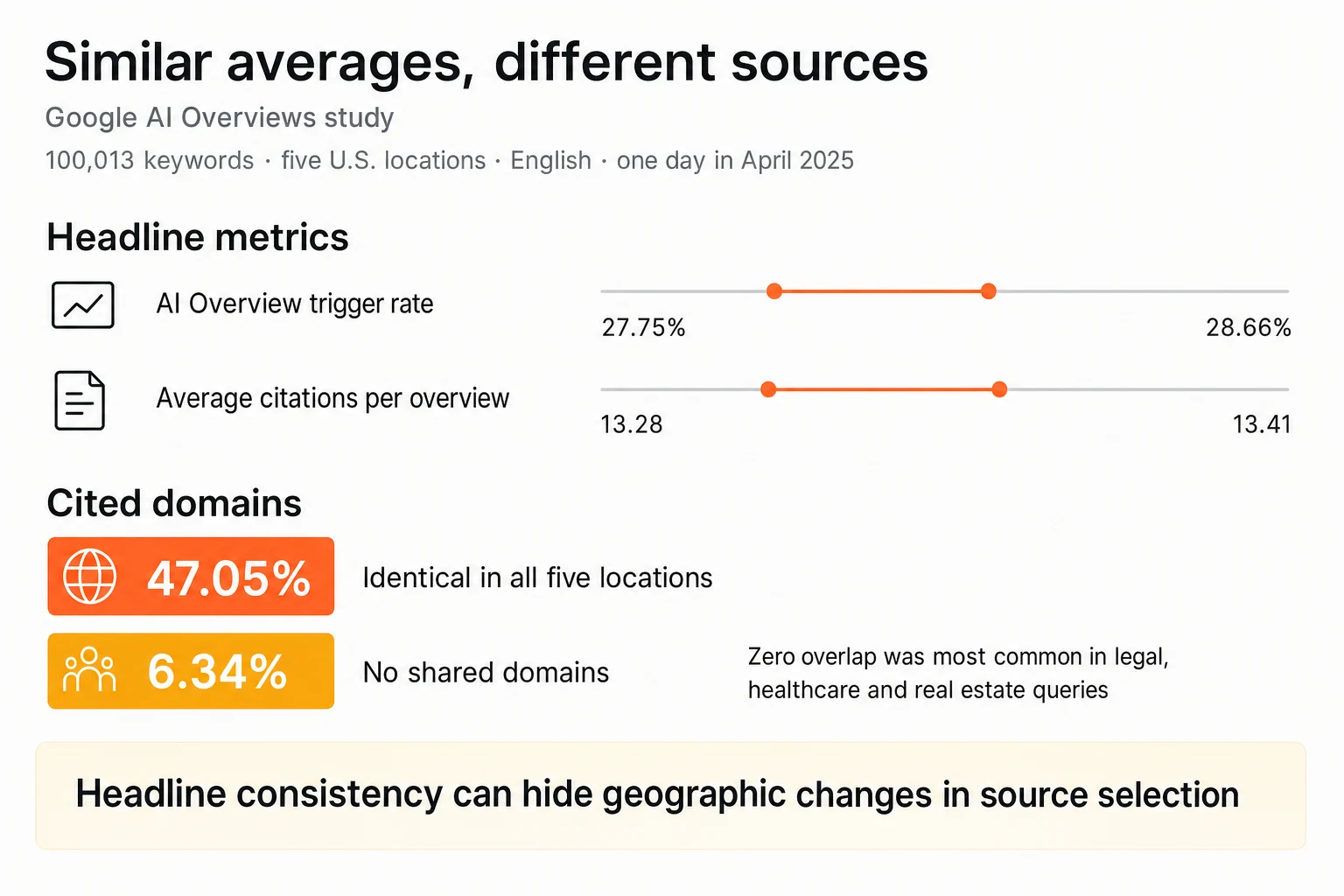
An SE Ranking study of Google AI Overviews ran 100,013 keywords from five US cities (Denver, Houston, Los Angeles, New York and Washington, DC) on a single day in April 2025, all in English.
On the headline numbers, the five cities looked almost identical. AI Overviews appeared for between 27.75% and 28.66% of queries, and each answer cited about 13 sources wherever it was asked.
The sources themselves told a different story. Only 47.05% of queries cited the same set of websites in all five cities. For 6.34% of queries, the five cities shared no cited websites at all. Legal, healthcare and real estate queries were the most likely to have zero overlap. Each city had sources that appeared only there: the Denver Bar Association in Denver, the City of Houston website in Houston, the DC Department of Employment Services in Washington.
If you only tracked how often an AI Overview appeared, or how many sources it cited, you would conclude that location makes no difference. If you tracked which websites were cited, you would see that more than half of answers changed depending on the city.
For local services, the address decides who gets named
Spearleaf asked ChatGPT "who is the best {service} in {city}" for 12 services, including plumbers, dentists and personal injury lawyers, across 18 US cities in August 2026. Of the businesses ChatGPT named, 92.0% had an address inside the city in the question. Among the businesses it considered but did not name, the figure was 73.9%. Having an address in the asked city was the strongest signal Spearleaf measured, ahead of star rating and review count.
The bar for inclusion also moved by city size. The median minimum review count among named businesses was 72 in major metros, 95 in mid-sized metros and 50 in small cities. A business that clears the bar in one market can fall short in the next.
Ranking in Google Maps does not mean the AI recommends you
SOCi's 2026 Local Visibility Index looked at about 350,000 locations belonging to 2,751 multi-location brands. Google's local 3-pack (the three map listings at the top of a local search) featured those locations 35.9% of the time. ChatGPT recommended them 1.2% of the time, Gemini 11% and Perplexity 7.4%.
For a brand with many branches, the useful question is which locations the AI names, and in which cities. Strong local search performance across the network says little about the answer to that question.
Each assistant gives a different local answer
Even within the same city, different assistants give different answers. Custom Legal Marketing sent the same 3,200 legal questions, covering the 100 largest US cities and 32 practice areas, to ChatGPT, Claude and Google AI Mode. The three platforms recommended 19,692 different law firm websites between them. Only 2.9% of those firms were recommended by all three.
8ight.AI found the same split in where the answers come from. Asked about local trades, Claude cited Yelp in 92.7% of its answers. ChatGPT cited Yelp in none of its 1,412 answers. A strong Yelp profile may help you in one assistant and do nothing for you in another.
Location measurement therefore needs two dimensions: each market you care about, and each assistant your customers use in that market.
Which questions are most affected
Location does not change every answer. The research points to three kinds of question where it matters most:
- Questions that name a place or say "near me", such as "best accountant in Denver" or "plumber open now".
- Questions in regulated or jurisdictional categories, such as legal, healthcare, property, payroll, tax, payments and HR. The right answer depends on local law and the AI cites local authorities.
- Questions in categories with strong regional players, where the brands that compete in one country are different from those in another.
Broad factual questions and globally standard products move much less. The FTA Global result for video conferencing and cloud storage (1.5 of five brands changing) is a fair guide to how stable those answers are.
Most brands have a mix. A bank's question about savings accounts is local. A question about how compound interest works is not. Sort your prompts before you decide how many locations to test.
Why one check from one place tells you very little
AI answers change even when nothing about the question changes. The same studies that show the location effect also show how much answers move between runs:
- In the FTA Global study, the same question asked from the same place in the same language produced the same top brand in only 35% of cases across five runs.
- In the Spearleaf study, when ChatGPT was asked the identical question four to nine days later, 48.2% of the businesses it had named appeared again. The same business held first place in 34.1% of markets.
- In the 8ight.AI study, two ChatGPT answers to the same question, asked a median of 39 minutes apart, shared a median of 29% of the businesses they named.
This is why a screenshot from a colleague in another city proves very little. A difference between two single answers could come from the location, from the date, or from the ordinary variation between runs. A location effect is only real when the gap between cities is consistently bigger than the gap between repeated runs in the same city.
How to measure by location
- List the markets that earn you money. Name the cities, regions, countries and languages where you sell, and rank them by commercial value. These become your test locations.
- Sort your prompts by location sensitivity. Mark which questions are local, jurisdictional or regionally competitive. Those prompts need testing in every priority market. The rest can run from one location.
- Set the location at the network level as well as in the wording. ChatGPT infers location from the IP address, so a test that only adds a city name to the question does not reproduce what a customer in that city experiences. Run both versions: the question with the place named, and the question asked from an IP address in that place.
- Run each prompt several times in each location. Compare the variation between locations with the variation within each location. Only treat a difference as a location effect when it holds up across repeated runs.
- Record who is named and who is cited. Track your brand, your competitors and the specific websites the AI cites in each market. The cited websites are your local PR and listings target list.
- Test each assistant your customers use. ChatGPT, Gemini, Perplexity, Claude and Google's AI features draw on different sources and name different businesses.
- Repeat on a schedule. Answers move from week to week. A single snapshot shows one moment, and only repeated measurement shows a trend.
Use Onsomble’s regional analysis to compare brand visibility, sentiment, competitors and cited sources across the country and city contexts in your scans. Onsomble’s browser scans use a country-level connection with instructions for the selected city; city results reflect those captured answers, rather than a browser physically located in that city.
What to fix when a market is missing
When the measurement shows a gap in one market, the research points to the local evidence the AI relies on. In the Spearleaf study, an address in the asked city was the strongest signal. In the 8ight.AI study, ChatGPT named 3.4% of businesses with fewer than 25 Google reviews and 22.2% of businesses with 1,000 or more. In the FTA Global study, local publications made up as much as 42% of cited sources in some countries.
That gives marketing and PR teams a concrete list for each weak market: a clear local address and location page, reviews on the platforms that market's assistants cite, accurate business listings, and coverage in the publications and directories the AI already trusts there.
Start with the market that earns you the most outside your home city or country. Run your location-sensitive prompts from that market, compare the brands and sources the AI names there with the ones it names at home, and use the differences to set that market's PR and listings work.
Continue Reading
AI Research17 min read
Why AI Answers Vary by Location
AI answers by location change retrieval, ranking, personalisation, language, feature availability, or regional rules; evidence does not yet show that physical location alone causes every variation.
Rosh Jayawardena
AI Research11 min read
PerplexityBot vs Perplexity-User: How Perplexity Fetches Content
PerplexityBot is associated with broad crawling and index refreshes, while Perplexity-User is associated with user-triggered retrieval; official documentation confirms separate identifiers but does not prove every fresh-fetch responsibility.
Rosh Jayawardena
AI Research18 min read
AI Crawlers Explained: Roles, Behaviour, and Access Controls
AI crawlers are automated clients whose roles vary across training, search indexing, user-triggered retrieval, and product control; user-agent strings, robots.txt, logs, and IP checks provide useful but limited evidence.
Rosh Jayawardena
Deep dives, delivered weekly
AI patterns, workflow tips, and lessons from the field. No spam, just signal.