
Back to Blogs
Why AI Answers Vary by Location
17 min readAug 20, 2026
AI Research

Rosh JayawardenaData & AI Executive
AI answers by location change retrieval, ranking, personalisation, language, feature availability, or regional rules; evidence does not yet show that physical location alone causes every variation.
Ask an AI system the same question in two places and you may get two different answers. The tempting explanation is that the model knows where you are and changes its mind accordingly.
Sometimes that is roughly what happened. Often it is not.
“AI answers by location” is really a name for several effects that happen at different points in a product. Your location may alter the evidence retrieved before an answer is written. The service may infer a location from an IP address or device. Your query may name a place explicitly. Account history, language, and other settings may change the surrounding context. And in some regions, the product, model, or feature may not be available at all.
This makes the basic question harder but more useful: not merely did the answer change?, but what changed in the system that produced it?
What counts as a location-based difference in an AI answer?
A location-based difference can be small. The answer may use different wording, give more weight to one concern, or cite a different source while reaching the same conclusion. It can also be substantive: a different business may be recommended, a different law described, or a different address, service, or fact stated. Language, format, ranking, and even the presence of the AI feature can vary too.
These are not all the same outcome.
Suppose an AI Overview appears in one place but not another. That is an availability or triggering difference, not necessarily a difference in generated content. If two answers cite different local websites, that is a source difference. If they use the same sources but draw different conclusions, that is closer to a generation or synthesis difference. And if one test uses AI Mode while another uses AI Overviews, you may be comparing different products: Google says the two experiences may use different models and techniques.
The word “location” is slippery as well. There is the place you state in the query, as in “hospitals in Denver.” There is your current physical position. And there is the position a service infers from signals such as an IP address, GPS, device settings, permissions, or user settings. Those three locations may not agree.
This is why two apparently identical tests may not be identical. Query wording, language, account status, prior conversation, saved history, device, session state, time, and the particular product surface can all matter. Generated answers can also vary from one run to the next. A difference seen once is therefore not yet a geographic effect.
The evidence itself points in both directions. A study of 100,013 keywords across five US locations found that Google AI Overview appearance rates were close, at about 28% in each location. Average answer length also differed by less than 1%, and 47.05% of queries cited identical domains in all five places. That looks fairly stable.
But stability at the average level hid narrower divergence. The same study found no shared cited domains across states for 6.34% of queries, especially in legal, healthcare, and real-estate topics; local queries also produced some domains found only in particular states. So the useful conclusion is not that geography always changes an answer, or that it rarely does. Variation depends on the query, product, provider, sources, and surrounding context.
Where location enters the answer pipeline
It helps to picture an AI answer as the end of a chain rather than a sentence produced in one step.
The first input is the query. A city name or phrase such as “near me” conveys geographic intent directly. When a place is stated, there is less for the service to infer. When it is not, the service may try to fill the gap from other signals.
Those signals can include an IP-derived area, GPS or precise device location, app permissions, device settings, user settings, history, and behavior. The supplied evidence documents such signals in particular Google search, mapping, and advertising contexts; it does not show that every AI provider uses all of them, or weights them in the same way. Inferred location is also fallible. GPS can be inaccurate, IP mappings can be stale, and location services can be disabled.
Next comes retrieval: finding material that may help answer the query. A system can rewrite or expand a query, retrieve a broad set of documents or places, and then rank or rerank them. An information-retrieval survey describes these as distinct stages: query reformulation, first-pass retrieval, reranking, and a reading component that turns retrieved material into an answer.
Location can enter several of them. It may help expand an underspecified request into a local one. It may change which documents or places are considered geographically relevant. It may affect ranking through proximity, relevance, reputation, reviews, or personalization. The selected material can then become context for the model that writes the response.
Some systems do more than retrieve once. Google says AI Overviews and AI Mode may use “query fan-out,” issuing several related searches across subtopics and data sources while developing a response. More generally, retrieval-based systems can fetch additional material during generation. This means location context can shape not just one search but a sequence of searches.
Maps-grounded products make the relationship especially clear. Google Maps Platform describes grounding language-model responses in Maps data, including place, review, and area summaries. Mapbox’s MapGPT describes access to directions, roads, traffic, weather, charging stations, and nearby places. These are provider descriptions of capabilities, not proof that every resulting answer is accurate.
Once local evidence reaches the model, it can change the final content: nearby businesses, directions, weather, reviews, hours, contact details, or recommendations. Yet an outsider usually cannot tell which stage caused a particular difference. A changed answer might follow from a different inferred location, a different query rewrite, a different set of retrieved pages, a different ranking, or different synthesis of the same pages.
Here is the reveal: what looks like geo-targeting in AI outputs may often be geo-targeting of the evidence, followed by ordinary answer generation.
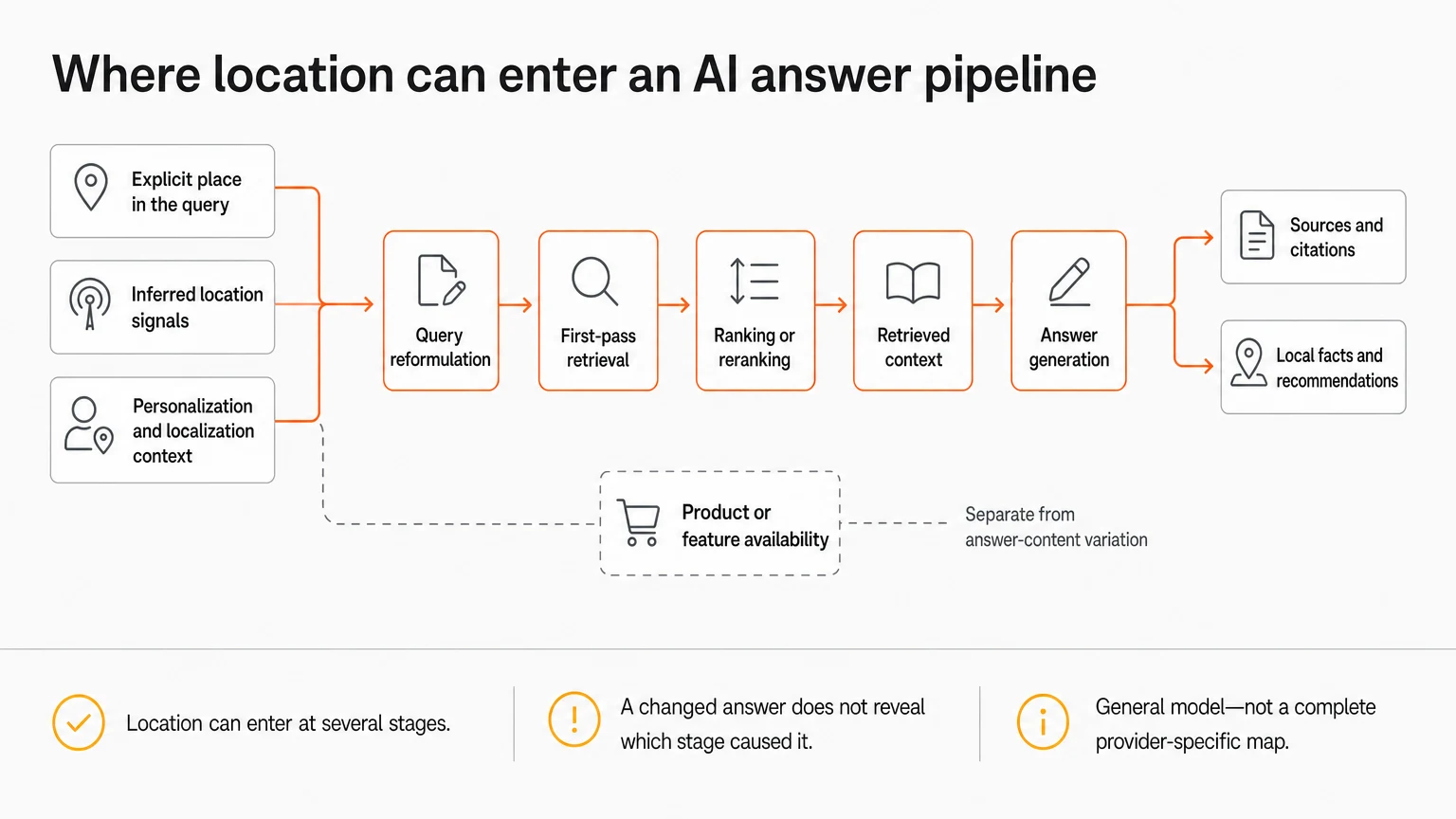
Product-level availability is another branch of the chain. A feature may be offered only in certain countries, territories, or languages, or a newer model may reach one market first. That changes the user’s experience, but it does not establish that location altered the content of an answer within the same product.
How local search context changes the evidence an answer can use
Local questions draw on a peculiar information environment. A restaurant, clinic, or shop may be represented by a map listing, an official site, directory pages, reviews, news coverage, and third-party articles. Those sources can disagree, and some will be fresher than others.
Before location matters, intent often matters more. A Whitespark study of 540 queries across Houston, Phoenix, and Denver divided searches into local, informational, and hybrid intent. AI Overviews appeared for 15% of local-intent queries, 92% of informational queries, and 97% of hybrid queries. Local packs showed nearly the reverse pattern: 93%, 6%, and 17%, respectively.
The wording makes the difference plain. “Personal injury lawyers in Phoenix” asks mainly for local entities. “How much do personal injury lawyers charge in Phoenix?” asks for information with a local qualifier. “Should I get a lawyer after a car accident in Phoenix?” mixes general guidance with local legal context. The place is the same; the system’s job is not.
Once local retrieval is triggered, proximity can affect which entities appear. Relevance and authority can matter too, including reviews, reputation, and online presence. Maps data may add routes, travel time, traffic, weather, landmarks, and nearby points of interest. An AI system can then combine those inputs rather than merely repeat a ranked list.
That synthesis widens the evidence base. In a very small Whitespark sample of nine hybrid-intent plumber searches in Houston, 60% of AI Overview citations went to third-party publishers and 40% to individual local businesses. The sample is far too narrow for a general rule, but it shows the shape of the process: a local answer may be assembled from business pages, directories, publishers, and other sources at once.
This can improve geographic relevance. A request for the nearest hospital is more useful when it accounts for where you are; directions and weather are inherently local. But the same machinery can confidently combine stale or conflicting data. Reported tests have found wrong postcodes, addresses, hours, closure claims, and unsupported claims about services. Possible causes include inconsistent official pages, old directories, review listings, and pages about similarly named businesses. The available evidence generally does not isolate which cause produced each error.
Sparse evidence is a problem too. A place with only a website and one listing gives a retrieval system less material than a place documented across many current sources. That does not prove that more coverage causes more accurate answers, but reported local-business tests found more errors among smaller businesses and suggested a thin information trail as one possible reason.
The Houston, Phoenix, and Denver comparison adds an important check. AI Overview prevalence was broadly similar by industry across the three cities, suggesting that industry and query intent explained more variation than metropolitan location in that dataset. But the researchers used city-labeled searches and were not physically in the target cities. They did not run identical generic prompts from otherwise matched users physically located in each place.
So local search context clearly changes what an answer can use. It does not follow that physical position alone caused every observed difference.
Why location is often entangled with personalization and localization
Personalization answers the question “what is relevant to this user?” Localization answers something closer to “what language, market, or regional experience fits this context?” Physical location answers “where is the user now, or where does the service think they are?” These ideas overlap, but they are not interchangeable.
Google’s documentation makes the personalization side unusually concrete. AI Mode’s Personal Intelligence can use previous searches and activity stored in Search Services History, past interactions, preferences, and information a user has shared. With consent, connected Google content such as Gmail, Calendar, and Photos can add more personal context. This is a documented Google feature, not a description of every AI system.
Now imagine two people in the same city asking for a restaurant. One has extensive saved history and connected context; the other uses a fresh session. Different answers would not prove a physical-location effect. Conversely, two people in different cities may get similar answers because their query names the destination explicitly or because the system relies on the same global sources.
Localization adds another layer. Language, device settings, and market context may travel with location without being caused by it. The same person can ask in another language without moving. A traveler can keep the language and market settings of home. The supplied evidence establishes that language and device context form part of some search experiences and that feature availability varies by language; it does not isolate language as an independent cause of changed AI answer content.
A clean comparison therefore has to vary one thing at a time. Keep the provider, product surface, model or version, interface, prompt, language, device, account state, session context, and personalization settings fixed; then change one location factor. Run the prompt more than once, because a single answer may reflect ordinary volatility. Keep a log. Where possible, compare against a non-personalized or fixed baseline.
Even that may not be enough if the service changes during the test. Models, routing, retrieval sources, and product interfaces can change over time. A commercial location-testing service also warns that a VPN changes the apparent IP but may leave device, browser, and language context intact. That is a product claim rather than independent validation, but the methodological point is sound: changing the IP is not the same as holding every other signal constant.
The evidence shows that personalization can produce different outcomes for different user groups. It does not show whether personalization generally amplifies, suppresses, or overrides physical-geography effects. That relationship remains mostly unmapped.
When regional rules change access, presentation, or answer behavior
Some regional differences happen before anyone asks a question.
A provider may offer a product only in certain markets. A feature may depend on language support, licensing, infrastructure, local capacity, rollout stage, or the product channel used. Anthropic publishes separate geographic access information for commercial API access and Claude.ai. Microsoft says some Copilot and generative-AI features are unavailable in certain regions or languages, and that limited local capacity can require cross-region processing; when such movement is not allowed, some features may not work.
Google’s rollout history shows another version of this. In May 2025, Google said AI Overviews were available in more than 200 countries and territories and more than 40 languages, while a custom Gemini 2.5 version was initially being brought to AI Overviews in the United States. If two users see different models or features during a staged rollout, location is associated with the difference, but it may be acting through product version rather than through local retrieval.
Law can shape the environment too. A comparative review of AI policy finds substantial differences among jurisdictions in scope, risk categories, transparency duties, privacy rules, enforcement, and penalties. The EU AI Act governs systems made available in the EU market, including systems supplied by actors outside the EU; it prohibits certain uses and imposes added duties on some high-risk systems.
China’s generative-AI requirements address content, security, discrimination, intellectual property, personal information, data quality, and reliability. Separate requirements effective September 1, 2025 call for explicit and implicit labels on AI-generated content. A label is a presentation difference even if the underlying answer remains the same.
Other jurisdictions take different approaches. The same comparative review describes South Korea as placing more weight on post-market oversight than the EU, while Singapore relies substantially on voluntary frameworks, testing tools, and existing sectoral laws. These are different compliance environments.
But regulatory difference is not yet proof of answer difference.
The supplied research does not include a controlled test in which identical prompts were sent to the same product and model across jurisdictions while all other conditions were fixed, showing that law or safety rules alone caused substantively different answers. The evidence supports claims about access, rollout, language, labeling, data handling, and provider obligations. Any stronger claim about changed facts, framing, or refusal thresholds would outrun it.
What the evidence can—and cannot—demonstrate
There is good evidence that search experiences are location-sensitive. There is much less evidence that physical location, by itself, causes differences in generated answers.
A 2023 legal-search audit ran legal queries across nearly 70 ZIP codes in 14 US states and collected 88,429 conventional search results. Differences depended on the topic. Eviction results varied substantially and were mostly jurisdiction-specific, while debt-collection, domestic-violence, and flood-contractor results changed less. This is strong evidence that location and subject can affect ranked URLs; it is not a test of generated AI answers.
The AI-specific audits answer different questions. A vendor-reported test covered 165 London businesses, three systems, and 13,365 questions, comparing answers with official records and profiles. Another reported test asked more than 72,000 questions about UK retailers. These provide evidence of local factual errors, but they are single-country audits rather than controlled comparisons across physical locations.
The five-location Google AI Overview study compared appearance and citation patterns at scale, but only for English searches, one product, five US locations, one collection date, and a particular keyword set. The Whitespark work compared cities, industries, and query intents, but not identical generic prompts issued by matched users physically present in different cities.
What is missing is a fully specified cross-location AI-answer experiment.
Such a test would use a fixed prompt set and the same provider, surface, model version, interface, language, device, account state, routing conditions, and personalization settings. It would vary one geographic input deliberately—perhaps an explicit place, an inferred IP region, or precise device location—rather than changing several at once. It would log prompts, outputs, timestamps, sources, and settings, then repeat each condition enough times to distinguish persistent differences from run-to-run variation.
It should also avoid reducing “difference” to one score. Sources and citations can change while factual claims remain stable. Tone can change while recommendations remain the same. A useful coding scheme would separate availability, sources, citations, factual claims, omissions, recommendation order, sentiment, tone, format, and expressed confidence.
Finally, the test should report sample size, uncertainty, volatility, and whether effects persist over time. None of the supplied AI-answer comparisons provides uncertainty estimates or demonstrates repeated-run persistence under fully specified location controls.
So the evidence supports a careful claim: geographic context can enter the answer pipeline and location-sensitive variation exists. It does not yet support the cleaner claim that physical location alone caused the differences observers saw.
Reliability, privacy, and fairness implications
Location-aware AI has a real advantage. It can make a vague question useful. “What is the weather?” “Where is the nearest hospital?” and “Which restaurants are open?” all need some kind of place context.
The same advantage creates a reliability risk. If the inferred place is wrong, the answer may be useless. If the local sources are stale or conflicting, the system may return an incorrect postcode, address, hour, closure status, or service claim. And because AI systems combine sources into fluent prose, users may read the result as a settled fact rather than one synthesis of uncertain material.
The reported error figures are striking but need their labels attached. In one vendor-run test, AI tools returned at least one false fact about 64% of UK high-street retailers; wrong postcodes were the most common error. In the London-business test, trade-press coverage reported that 93% had at least one basic fact wrong or missing. These tests show a local-answer reliability problem, but their methods are not fully disclosed here, and they do not establish that geographic personalization caused the errors.
Errors can also vary by system. A location described correctly in one product may be misdescribed in another because providers retrieve, rank, and combine information differently. Answers may change on repetition too. For anything consequential, a single fluent answer should not be treated as a stable measurement.
There is also a subtle interpretation problem. A nearby recommendation is not necessarily the best recommendation under every criterion. Proximity may be exactly what the user wanted—or it may quietly displace quality, prestige, price, or some other goal. Local relevance is a choice about what to optimize, not a universal measure of merit.
Privacy questions begin with how the system obtained the location. GPS, IP addresses, permissions, account settings, regional preferences, history, and behavior can all supply or imply geographic context in documented search-related settings. Users may not know which signal was used, how long it is retained, whether it is linked with other data, or whether it will be used for another purpose.
That matters because separate data points can become sensitive when combined. The Office of the Victorian Information Commissioner notes that apparently non-identifying information can become personal information through linkage and inference, and that AI may infer facts a person did not knowingly disclose. The issue is not only collection; it is what can be derived after collection.
These are risks, not proof of inevitable harm. Location-aware systems can be built with notice, consent, limits, and useful controls. Nor does the general evidence on AI bias prove geographic stereotyping or exclusion in AI answers. Existing research supports concern that systems can reproduce unfair patterns from data, but the supplied sources do not directly measure location-specific stereotyping, exclusion, or uneven regional coverage as AI-answer outcomes.
The practical lesson is to keep the claims separate. Wrong local facts are demonstrated. Privacy risks from collection, linkage, inference, and secondary use are documented. Geographic discrimination in generated answers is plausible enough to investigate, but not established by this evidence.
The hardest question, then, is not whether an AI answer knows where you are. It is whether you can tell which version of “where” entered the system, what it changed, and whether the answer would survive a properly controlled comparison.
Continue Reading
AI Research11 min read
PerplexityBot vs Perplexity-User: How Perplexity Fetches Content
PerplexityBot is associated with broad crawling and index refreshes, while Perplexity-User is associated with user-triggered retrieval; official documentation confirms separate identifiers but does not prove every fresh-fetch responsibility.
Rosh Jayawardena
AI Research18 min read
AI Crawlers Explained: Roles, Behaviour, and Access Controls
AI crawlers are automated clients whose roles vary across training, search indexing, user-triggered retrieval, and product control; user-agent strings, robots.txt, logs, and IP checks provide useful but limited evidence.
Rosh Jayawardena
Deep dives, delivered weekly
AI patterns, workflow tips, and lessons from the field. No spam, just signal.