Back to Blogs
I Tested 6 AI Research Approaches on the Same Project. Here's What Actually Worked
11 min readFeb 10, 2026
AI Strategy

Rosh JayawardenaData & AI Executive
Stop comparing AI research tools by features. I tested six approaches on the same project and compared what actually matters: source handling, synthesis quality, citations, and workflow fit.
Search "best AI research tools 2026" and you'll get listicles. Fifteen tools ranked by the companies that make them. Every tool claims to be #1 on its own list. None of them tell you what actually happens when you throw 30 documents at the thing and ask it to find patterns.
So I ran the test myself.
I had a real project: synthesize findings from 27 sources -- industry reports, academic papers, internal documents, and a handful of web articles -- into a set of recommendations. Instead of picking one tool and hoping for the best, I ran the same core questions through six different AI research approaches and compared what came back.
Some of the results surprised me. Most of the marketing claims didn't hold up.
The six approaches, three categories
AI research tools aren't one category. They're three fundamentally different approaches to the same problem, and understanding the difference matters more than comparing individual feature lists.
General-purpose chatbots -- ChatGPT, Claude, Perplexity. The Swiss Army knives. Broad capability, increasingly powerful context windows, but no specialized research infrastructure.
Source-grounded workspaces -- NotebookLM is the most well-known here. These tools answer only from your uploaded sources. They won't make things up, but they won't go beyond what you give them either.
Specialized academic tools -- Elicit and Consensus. Built specifically for published research papers. Strong at discovery and structured extraction across millions of studies.
I tested six specific approaches across these categories:
- ChatGPT (GPT-4o with file uploads)
- ChatGPT Deep Research (autonomous web research mode)
- Claude (200K token context window)
- NotebookLM (Google's source-grounded workspace)
- Elicit (systematic review across 125M+ papers)
- Consensus (research paper agreement analysis)
There's a useful mental model I came across during this test: ChatGPT as "The Oracle" -- delivers confident answers whether it has sufficient context or not. Claude as "The Diplomat" -- nuanced and careful, sometimes to a fault. NotebookLM as "The Mirror" -- reflects only what's in your sources, never invents.
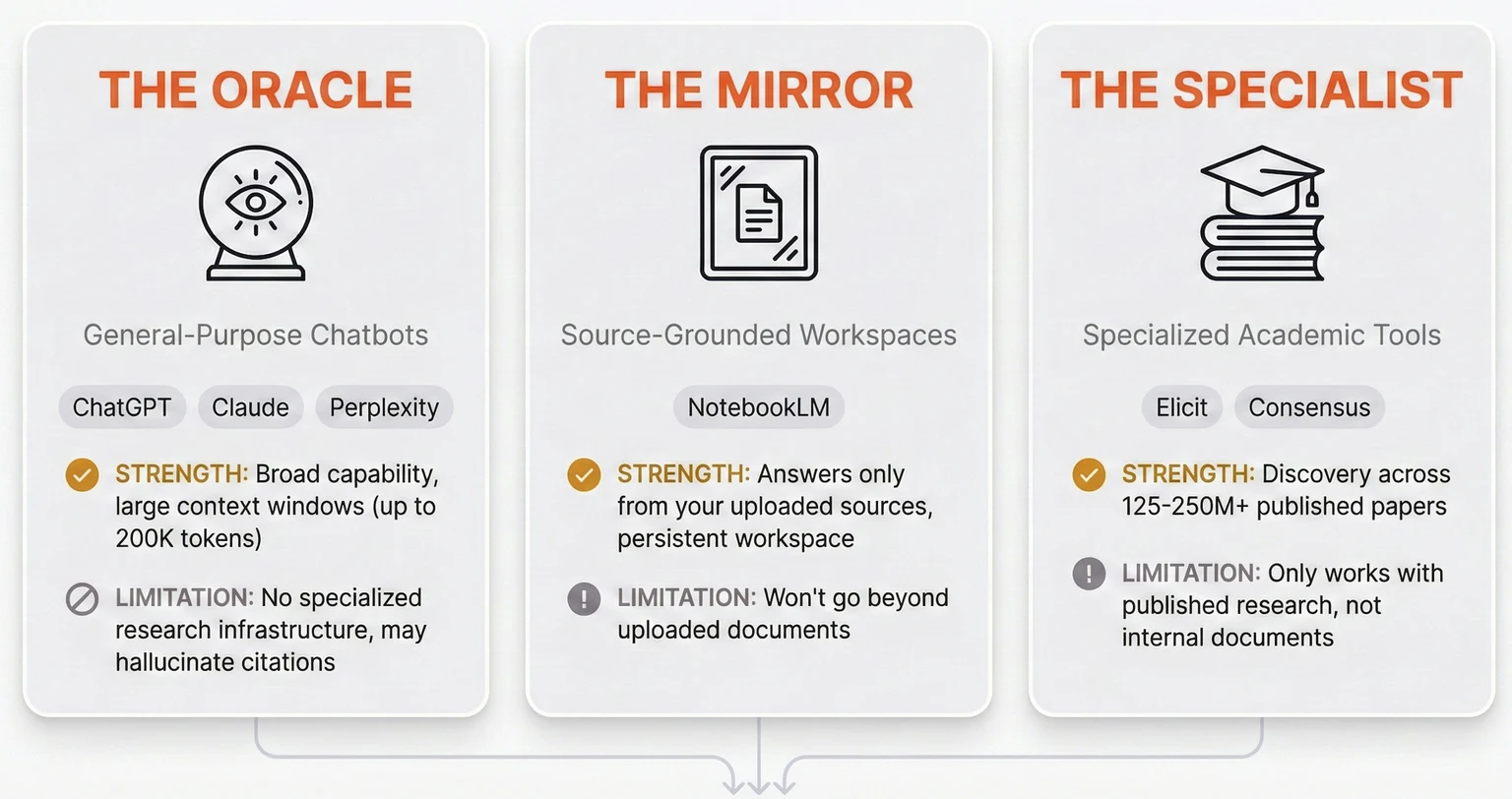
That framework held up surprisingly well across my testing.
Source handling: getting your documents in
The way a tool handles your sources determines everything downstream. This is where the differences hit you immediately.
ChatGPT let me upload files into a conversation, but I hit friction fast. With 27 sources, I couldn't fit everything into one session. I ended up splitting my analysis across multiple conversations, which killed my ability to ask cross-document questions -- the thing I needed most. ChatGPT Deep Research was better for material that's already on the web. It searched and synthesized autonomously, bringing back structured reports. But it couldn't touch my paywalled industry reports or internal documents. If your sources aren't on the open web, Deep Research can't see them.
Claude handled the raw volume best among the chatbots. The 200K token context window swallowed most of my source material in a single conversation. I could paste long documents and ask questions that spanned all of them simultaneously. The catch: when I came back the next day, that context was gone. No persistence between sessions. For a project that stretched over weeks, this meant uploading the same documents and rebuilding context from scratch each time.
NotebookLM solved the persistence problem. I uploaded my 27 sources once and they stayed. Every question I asked, every answer I got, was grounded in those specific documents. Weeks later, still there. The flip side: it wouldn't pull in anything I hadn't uploaded. If I needed to fill a gap in my research, I had to find the source myself and add it manually.
Elicit and Consensus were a different beast entirely. They search across 125-250 million published papers. For my project, they were strong at finding supporting academic research I didn't already have -- papers I'd missed, studies that contradicted my assumptions. But they couldn't work with my internal documents or industry reports at all. They only speak the language of published research.
The verdict: If you're synthesizing your own documents, source-grounded tools and Claude's large context window win. If you need to discover research you don't already have, academic tools and Deep Research win. No single approach handles both well.
Synthesis quality: can it actually think across documents?
This is where most tools fall apart. Summarizing one document is table stakes -- any of these tools handles that fine. The hard part, the whole point of research synthesis, is spotting contradictions and finding patterns across 20+ sources that no single document reveals on its own.
ChatGPT produced confident, clean summaries. Too clean. It tended to flatten nuance into tidy generalizations. When I asked it to identify where my sources disagreed, it acknowledged contradictions existed but wouldn't take a position on which source was more credible or why the disagreement mattered. The output read like a committee drafted it -- technically accurate, practically useless for making a decision.
Claude was better at nuance. It produced more layered analysis and was willing to say "Source A and Source B disagree on this point, and here's why that tension matters for your recommendation." But it could tip into analysis paralysis -- caveating everything so heavily that the synthesis lost its edge. I found myself prompting "just give me your honest read" more than once. When I did, the output was noticeably better.
NotebookLM synthesized well within its source set. Ask it a question and it pulls relevant passages from across your documents and weaves them into a coherent answer. But reviews of NotebookLM in educational settings found that its summaries "tend to gloss over practical applications, frameworks, and important examples." I noticed the same thing. Good for getting the lay of the land. Not sufficient on its own for the kind of synthesis that goes into a deliverable. I still needed to do the deep reading myself to catch what it glossed over.
Elicit surprised me for structured synthesis. Its systematic review feature let me define extraction criteria and pull findings across papers in a consistent format. For the academic portion of my project, this was genuinely useful -- it turned hours of manual extraction into minutes.
Consensus showed me where the published literature agreed and disagreed, which gave my synthesis an evidence base I couldn't have built manually in any reasonable timeframe.
Here's the uncomfortable part: a CHI 2025 study found that 72-78% of knowledge workers report reduced cognitive effort when using these tools. Sounds like a win until you realize the "cognitive effort" being reduced might be the critical thinking that makes synthesis valuable in the first place. I caught myself accepting ChatGPT's summaries uncritically more than once. The tools that make research feel effortless might actually be making it shallow.
My honest read: Claude produces the most nuanced synthesis. NotebookLM is the most reliable for staying grounded in your actual sources. Academic tools add structured evidence at scale. But none of them replace the work of actually thinking through the connections yourself.
Citation reliability: does it make things up?
For professional work, this isn't a feature comparison -- it's a career risk question. A hallucinated citation in a client deliverable can end relationships.
ChatGPT has the worst track record here. Even with Deep Research citing its web sources, I found instances where it attributed claims to sources that didn't actually say what ChatGPT claimed they said. The citations looked legitimate -- proper formatting, real URLs -- but the substance was wrong. You have to verify every single one.
Claude is more cautious. It hedges more, and it will say "I'm not certain about that specific citation" rather than fabricating one. But push it for specifics it doesn't have, and it can still generate plausible-sounding references that don't exist.
NotebookLM is the clear winner here. It answers only from your uploaded sources. If the answer isn't in your documents, it tells you. I never caught it hallucinating a citation because the architecture literally prevents it -- it can only reference what you gave it. This is the "Mirror" model in practice: reflection without invention.
Elicit and Consensus link directly to real papers with DOIs. Consensus goes further, showing citation context -- whether a claim is supported, contradicted, or merely mentioned by the citing paper. For academic work, this is the gold standard.
Where this nets out: Source-grounded tools and academic tools win on trust. Chatbots are useful for exploration but dangerous for anything that will be cited in a deliverable. Verify everything.
Workflow integration: does it fit how you actually work?
The best tool on paper is useless if it adds friction to your process.
ChatGPT and Perplexity are everywhere. No learning curve, works on any device. But neither has real project persistence. Every conversation starts from scratch. For a multi-week research project, I was constantly rebuilding context. Fine for quick one-off questions. Frustrating for sustained work.
Claude has the same fundamental problem, just with a bigger context window. Projects help somewhat, but the workflow is still conversation-centric. You're chatting, not building a persistent research workspace.
NotebookLM is built for ongoing work. Upload your sources once, come back to them whenever you want. The workspace persists. This made it my go-to "home base" for the project -- the place I always started from and returned to.
Elicit and Consensus integrate well with academic workflows: papers, citations, bibliographies. Less useful when your sources are a mix of industry reports, internal documents, and web articles that don't live in academic databases.
Here's what actually happened by the end of my project: I was using three tools, not one. NotebookLM as my persistent source base. Claude for the moments when I needed to think something through with nuance. Perplexity for quick discovery when I needed to fill a gap. The "one tool to rule them all" mentality is a trap that will slow you down.
The decision framework
After running this test, here's how I'd choose:
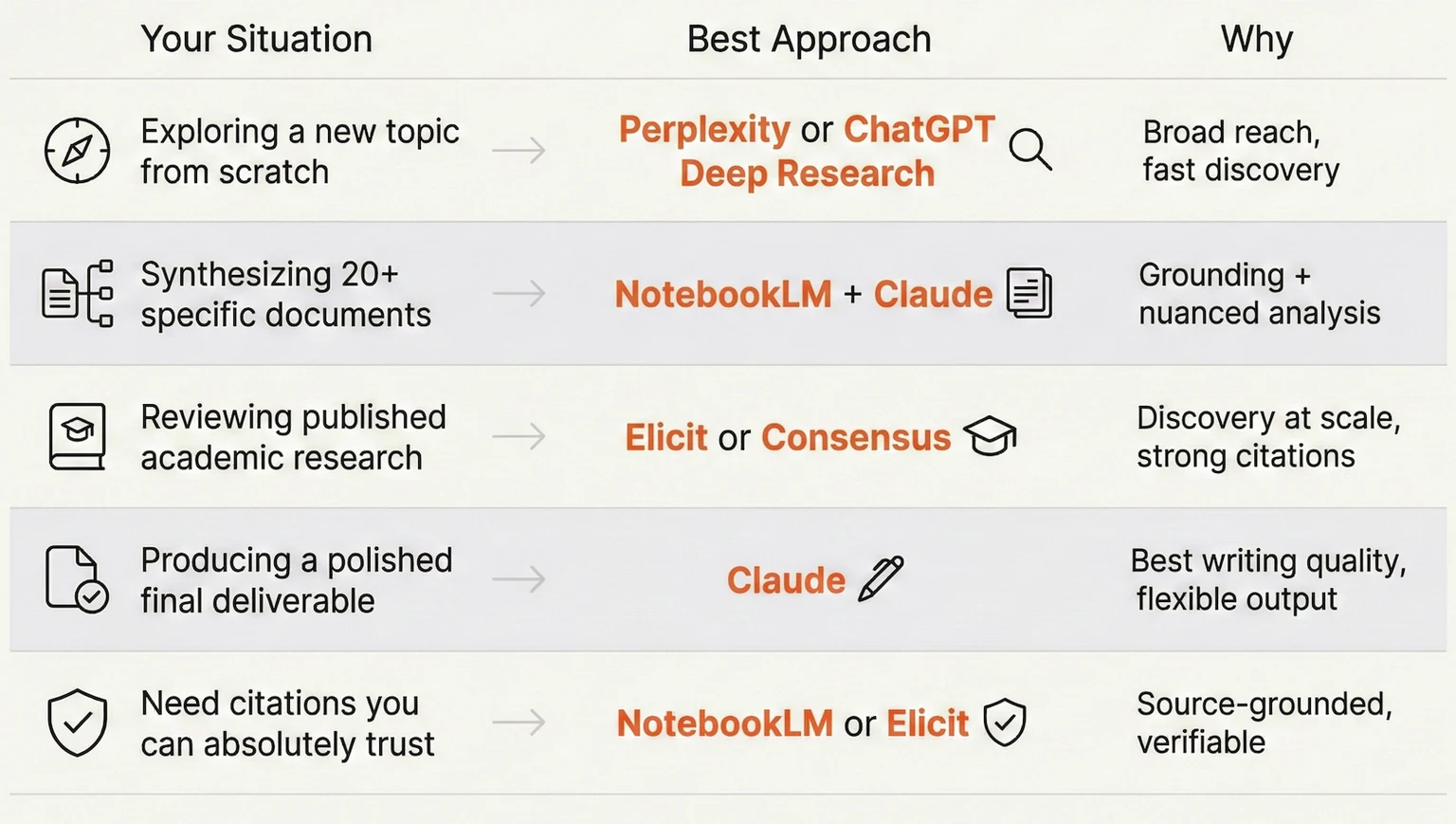
The bigger picture: the AI research tool space is still immature. No single tool handles the full research-to-deliverable pipeline well. Research timelines are reportedly compressing 40-60% with AI assistance, but that number only holds if you match the right tool to each phase of the work.
The tools that win this market won't be the ones with the longest feature list. They'll be the ones that integrate source grounding, cross-document synthesis, reliable citations, and polished output into a single workflow. Nobody's there yet.
The bottom line
Stop looking for the best AI research tool. There isn't one.
Match tools to phases of your workflow instead. Discovery phase? Use something with broad reach. Synthesis phase? Use something grounded in your actual sources. Output phase? Use whatever produces the best writing for your context.
For a repeatable process once the sources are gathered, use the 5-step workflow for synthesising research from multiple sources. If citation reliability is the risk, pair it with the AI verification triage.
The fact that I ended up using three different tools on a single project tells you everything about where the space is right now. Pick the phase of research you struggle with most, try the recommended approach, and build your own stack from there.
Continue Reading
AI Strategy10 min read
We Looked Into the Markdown-for-AI Theory. The Data Wasn't Kind.
Publishing Markdown mirrors of your web pages for AI search visibility is a waste of time. Here's why AI crawlers stick to HTML, and what you should focus on instead.
Rosh Jayawardena
AI Strategy12 min read
The 3% Problem: The AI Literacy Gap Hiding Behind Your Adoption Dashboard
Your AI adoption dashboard says 73%. Your team's output says otherwise. The enterprise AI problem has shifted from access to proficiency, and the gap is wider than most leaders think.
Rosh Jayawardena
AI Strategy9 min read
I Gave the Same 15 Sources to Three Different AI Models. They Found Completely Different Things
Different AI models find different things in the same documents. Here's what the research actually shows, and why model choice is a research methodology decision, not a feature checkbox.
Rosh Jayawardena
Deep dives, delivered weekly
AI patterns, workflow tips, and lessons from the field. No spam, just signal.