Back to Blogs
The 5-Step Workflow for Synthesising Research From Dozens of Sources
9 min readFeb 6, 2026
How To

Rosh JayawardenaData & AI Executive
Most synthesis guides are built for academics writing literature reviews. Here's a workflow for knowledge workers who need to turn 20+ sources into a deliverable with a deadline.
You know that moment. You've gathered 30 sources for a research project. Your browser has 47 tabs open. You've got PDFs scattered across three folders, highlights in four different colours, and a growing sense of dread that you have no idea how to turn any of this into a coherent story.
I've been there more times than I'd like to admit. And here's what I've found: more sources doesn't mean better insight. Without a system, more sources usually means more confusion. You end up reading everything twice, forgetting what you already read, and eventually just picking the three sources you remember best and hoping nobody notices.
There's a better way. Over the past few years, I've put together a 5-step workflow that's worked for me whether I have 20 sources or 100. It works with AI tools or without them. And it tends to produce actual synthesis, not just organised summaries.
Here's the workflow.
Step 1: Triage Before You Read
I used to start reading immediately. Took me a while to realise this was a mistake.
When you dive straight into your first source, you have no idea whether it's central to your argument or barely relevant. You end up giving equal attention to everything, which means you give deep attention to nothing.
Before you read a single document, sort your sources into three buckets:
Core (5-7 sources): These are the sources you need to read properly. They're either foundational to the topic, directly address your research question, or come from the most credible authorities. This is your foundation.
Supporting (10-15 sources): These sources add evidence, examples, or alternative perspectives. You'll skim them for specific points, not read cover to cover. You're looking for data, quotes, and counterarguments.
Reference (everything else): Keep these for citations and fact-checking, but don't read them now. They exist to support claims you'll make later, not to shape your thinking.
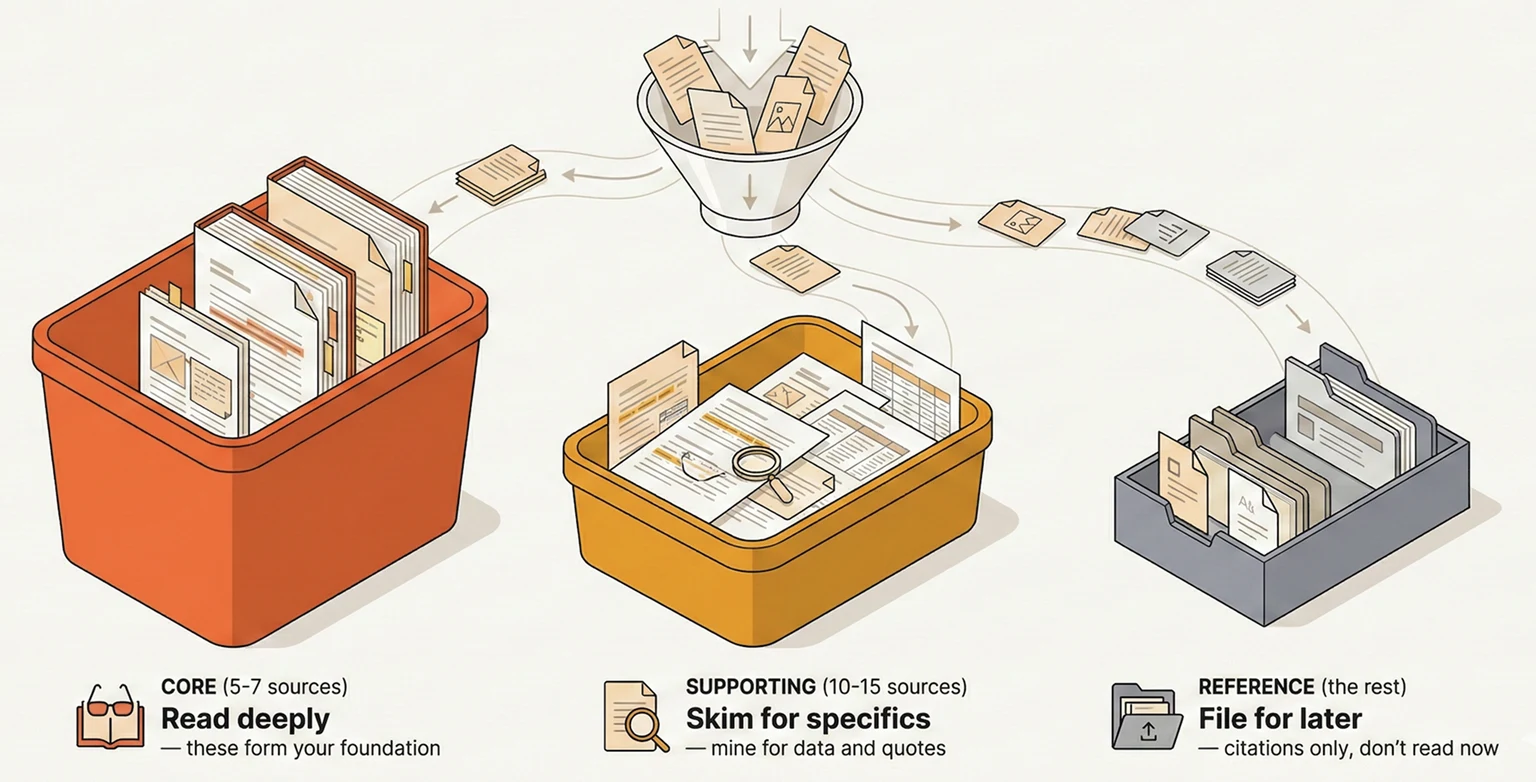
How do you know which bucket a source belongs in? Spend 60 seconds on each: read the abstract or executive summary, skim the headings, check the conclusion. That's usually enough to categorise.
This triage made a real difference for me. Instead of drowning in 30 documents, you're deeply engaging with 5-7 while strategically mining the rest. You've given yourself permission to not read everything, which, paradoxically, means you'll probably understand more.
Step 2: Extract, Don't Summarise
Here's a trap I fell into for years: I'd read a source and write a summary. Then I'd read the next source and write another summary. After 20 sources, I had 20 summaries and still couldn't see how they connected.
Summaries capture what each source says. But synthesis requires seeing relationships between sources. For that, you need extractions, not summaries.
For each source in your Core bucket, capture three things:
-
What does it claim? State the main argument in one sentence. Not what the source is about, what it argues.
-
What evidence supports it? Pull the specific data points, examples, or logic that back up the claim.
-
What's its unique contribution? What does this source say that others don't? This is where synthesis starts - you're already thinking comparatively.
For Supporting sources, you can be faster. You're looking for specific ammunition: a statistic here, a counterexample there. You don't need the full argument, just the pieces you might use.
One technique that's worked well for me: progressive extraction. On your first pass, bold the key passages. On your second pass, highlight the best of what you bolded. Then extract your claims from only the highlighted text. This is adapted from Tiago Forte's Progressive Summarization, but focused on project output rather than permanent notes.
Where does AI fit here? AI tools are useful for extracting claims from long documents. They can summarise a 50-page report in seconds. But here's the catch: AI can't tell you what matters for your specific argument. It doesn't know your research question, your audience, or what you're trying to prove. Use AI for extraction. Keep the judgment for yourself.
Step 3: Map Themes and Contradictions
Now you have raw material: claims, evidence, and unique contributions from your sources. The next step is seeing patterns.
The mistake I kept making here was organising by source. Creating a folder for each document, or a section of notes for each author. This keeps sources separate, which is exactly the opposite of what synthesis requires.
Instead, organise by theme. Take all your extractions and group them by what they're about, not where they came from.
As you cluster, look for three things:
Convergence: Multiple sources making the same point. When three independent researchers reach the same conclusion, that's a stronger argument than any single source. Note these agreements - they're the backbone of your synthesis.
Contradictions: Sources that disagree. This isn't a problem to solve. This is a finding. If credible sources contradict each other, that tension is interesting. Your synthesis might explain why they disagree, or acknowledge legitimate debate, or take a side with reasons. Don't paper over real disagreement.
Gaps: What no source addresses. Sometimes the most interesting insight is what nobody is saying. If you're researching AI productivity tools and nobody discusses the learning curve, that gap is worth noting. It might become your contribution.
One warning: don't force themes that aren't there. If sources genuinely don't connect, that's useful information. Not everything synthesises neatly, and pretending it does makes your work less credible, not more.
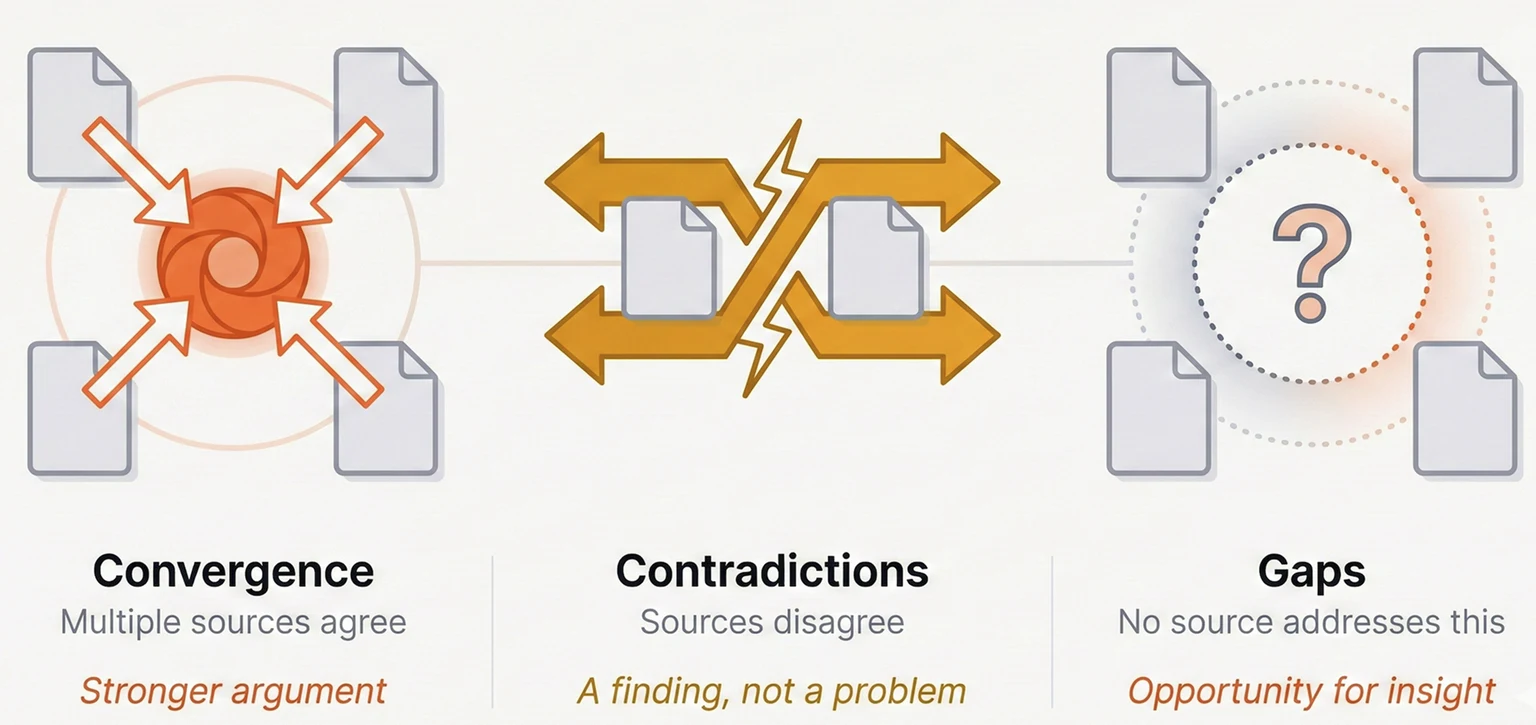
By the end of this step, you should have a theme map: clusters of related claims with notes on where sources agree, disagree, and stay silent.
Step 4: Build Your Argument Skeleton
You've triaged your sources, extracted claims, and mapped themes. Now comes the actual synthesis: deciding what story these sources tell together.
Don't write prose yet. Build the skeleton first.
For each section of your deliverable, write one sentence that captures the argument. Not the topic - the argument. "This section covers AI productivity" is a topic. "AI productivity tools help most with routine tasks but struggle with novel problems" is an argument.
Here's a quick test: if you can't state your section's argument in one sentence, you probably haven't synthesised yet. You're still in summary mode, organising information rather than making meaning from it.
Once you have your one-sentence arguments, list 2-3 sources that support each. This is where your theme map pays off. You're not just citing sources - you're showing how multiple voices converge on your point.
A practical format that works:
Section: AI tools have uneven capabilities
Argument: AI performs well on structured extraction but poorly on judgment-heavy synthesis
Sources: Harvard/BCG "Jagged Frontier" study, CHI 2025 cognitive effort research, [your third source]
This skeleton is your synthesis. The writing that follows is just articulation. If your skeleton is strong, the prose almost writes itself. If you're struggling to write, your skeleton probably isn't clear enough.
Step 5: Write Iteratively, Not Perfectly
Your first draft will be wrong. Plan for it.
The goal of draft one is getting your argument structure on paper, not perfection. Write fast. Follow your skeleton. Don't stop to wordsmith.
Once you have a draft, run what I call the synthesis check. Go back to your theme map and ask:
- Did I miss anything important? Sometimes a theme that felt minor during mapping turns out to be central once you're writing.
- Did I overweight one source? If 40% of your citations come from one document, you might be summarising that source rather than synthesising across sources.
- Does my argument actually hold? Now that you've written it out, do the pieces fit together? Are there logical gaps?
Iterate based on what you find. Synthesis isn't a one-pass activity.
One more thing: be careful with AI here. AI can help you structure prose, smooth transitions, and catch errors. But the synthesis - the new meaning you create by combining sources - needs to be yours. If you let AI write your conclusions, you've outsourced the thinking. What you produce isn't synthesis. It's a fancy summary with your name on it.
What to Avoid
A few patterns that look like synthesis but aren't:
Book report mode. Summarising each source in turn, then calling it a "literature review." Real synthesis weaves sources together. Each paragraph should draw from multiple sources, not dedicate itself to one.
Research as procrastination. Collecting more sources instead of synthesising the ones you have. If you've been "researching" for two weeks and haven't started writing, you're probably avoiding the hard part. Synthesis is cognitively demanding. Reading more is easier.
Forced agreement. Pretending sources agree when they don't. Contradictions make your synthesis more credible, not less. Acknowledge them.
AI ghostwriting. Having AI draft your synthesis sections. This defeats the purpose. Synthesis is human judgment: deciding what matters, what connects, what it means. That's the work. Don't outsource it.
The Bottom Line
Synthesis isn't about reading more. It's about seeing connections that matter and making arguments that couldn't exist without your thinking.
The 5-step workflow again:
- Triage your sources into Core, Supporting, and Reference
- Extract claims and evidence, not summaries
- Map themes, contradictions, and gaps
- Build your argument skeleton with one-sentence arguments
- Write iteratively and check against your theme map
Give this a go on your next research project. Start with triage. I know it feels like extra work before the "real" work, but it made a real difference for me.
The goal isn't to process all the information. It's to create new meaning from it. That's what synthesis is. And now you have a system for doing it.
When the output depends on citations or factual claims, add a verification pass with the AI verification triage.
Continue Reading
How To13 min read
How to Get Your Brand Mentioned in Google AI Overviews
Getting a brand mentioned in Google AI Overviews requires indexed, useful pages, credible supporting evidence, carefully chosen queries, and repeated testing that separates mentions, citations, recommendations, and owned-source appearances.
Rosh Jayawardena
How To15 min read
How to Get Your Brand Mentioned in Google Gemini
Google Gemini brand mentions are variable, context-dependent outputs, not permanent rankings. Brands improve accurate discoverability by clarifying identity, maintaining accessible facts, publishing useful evidence, earning legitimate corroboration, and testing defined prompts across named Gemini surfaces.
Rosh Jayawardena
How To16 min read
Get Your Brand Mentioned in ChatGPT: An Evidence-Led Process
Getting a brand mentioned in ChatGPT requires crawlable, clear information, relevant independent evidence, and repeated testing across realistic prompts; these actions can improve discoverability and accuracy but cannot guarantee a mention, citation, or recommendation.
Rosh Jayawardena
Deep dives, delivered weekly
AI patterns, workflow tips, and lessons from the field. No spam, just signal.