9 min readDec 25, 2025
How To

Rosh JayawardenaData & AI Executive
RAG and fine-tuning solve different problems. Here's how to decide which one your project actually needs.
You're building an AI system. You know you need to customize it somehow — either ground it in your data or adapt it to your domain. Two options keep coming up: RAG and fine-tuning.
The internet is full of opinions. "RAG is always better." "Fine-tuning is outdated." "Use both." None of these are helpful when you're staring at a real project with real constraints.
Here's the truth: RAG and fine-tuning solve fundamentally different problems. One controls what the model knows at runtime. The other changes how the model behaves by default. Choosing wrong wastes months and budget. Choosing right accelerates everything.
This article gives you a practical framework for deciding — based on your actual constraints, not ideology.
What Each Actually Does
Before comparing, let's be precise about what these approaches do.
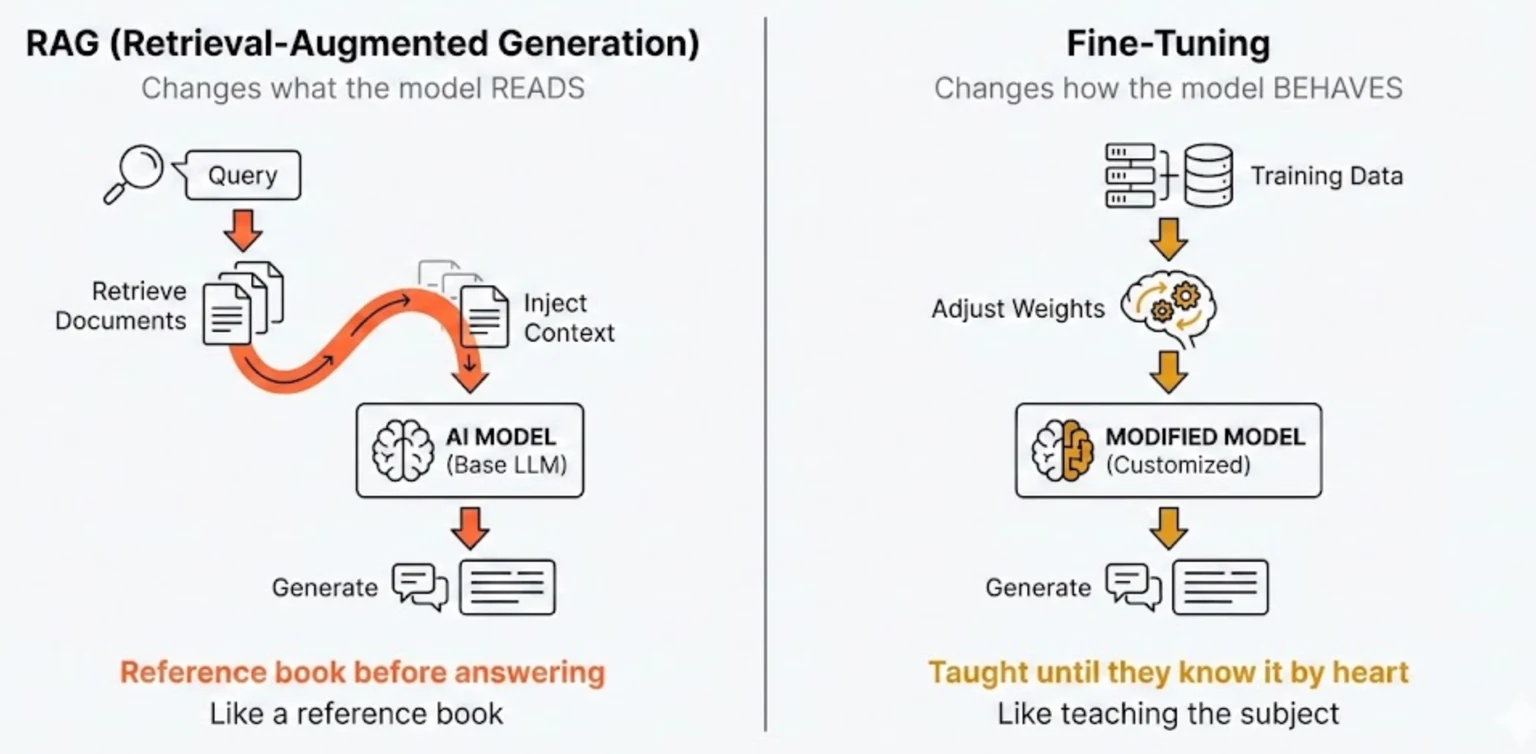
RAG (Retrieval-Augmented Generation) works at query time. When a user asks a question, the system retrieves relevant documents from your knowledge base and injects them into the prompt as context. The model generates a response based on that context. The key insight: you're not changing the model — you're changing what it reads before answering.
Fine-tuning works at training time. You take a pre-trained model and train it further on your data. This adjusts the model's weights to embed domain knowledge permanently. The key insight: you're changing the model itself — the knowledge becomes part of its parameters.
Think of it this way: RAG is like giving someone a reference book before they answer your question. Fine-tuning is like teaching them the subject until they know it by heart. Both can answer questions. They work differently under the hood.
The Decision Framework
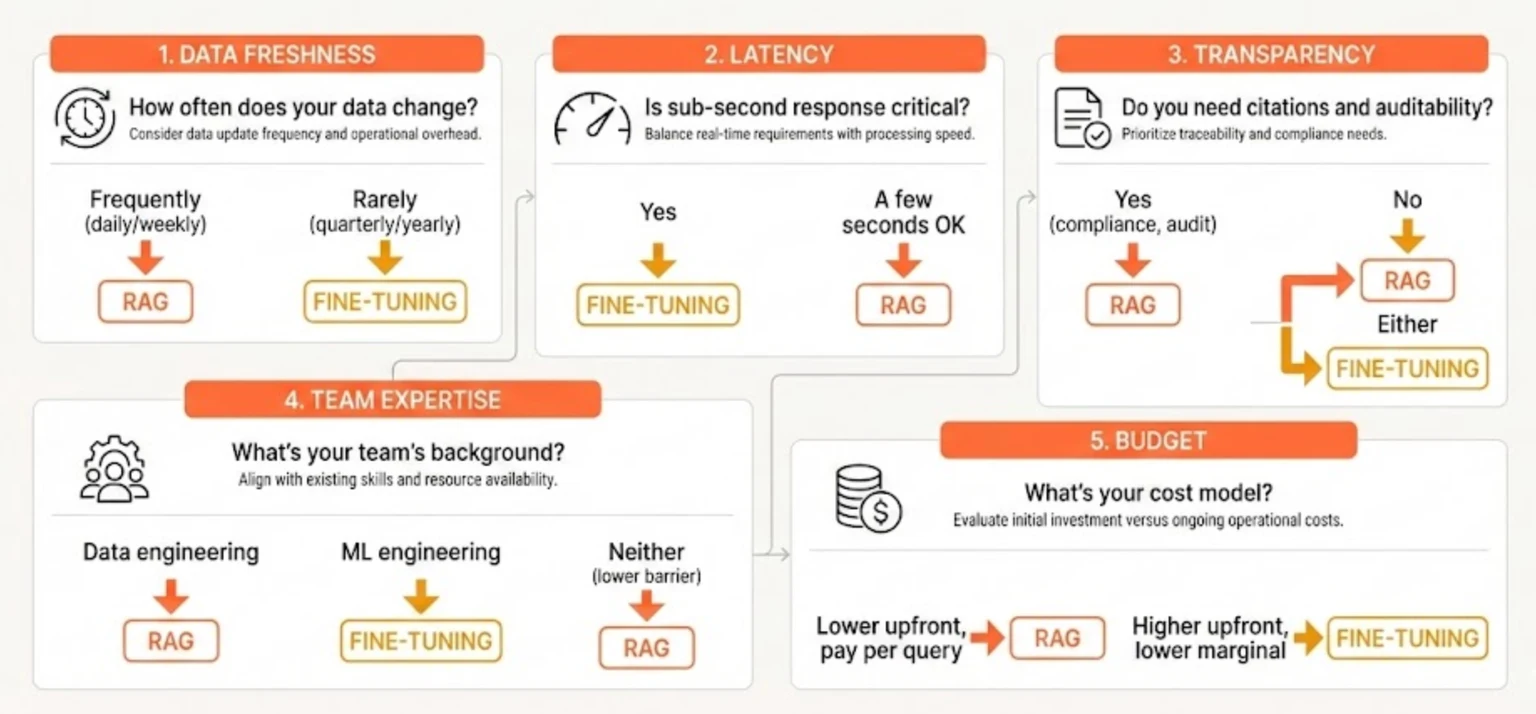
Five questions will get you to the right answer for most projects.
Question 1: How often does your data change?
If frequently (daily or weekly): RAG wins. Product catalogs, pricing, policies, support documentation — anything that updates regularly. RAG handles this seamlessly because you just update the documents. Fine-tuning would require retraining the model every time something changes.
If rarely (quarterly or yearly): Fine-tuning becomes viable. Legal definitions, scientific terminology, internal classifications, core domain knowledge — if the information is stable, embedding it in the model can make sense.
Question 2: Is latency critical?
If sub-second responses are required: Fine-tuning has an edge. No retrieval step means faster inference. For real-time applications like high-volume customer chatbots, this matters.
If a few seconds is acceptable: RAG works fine. The retrieval step adds latency — typically 30-50% overhead — but optimizations like semantic caching and reranking can bring response times under a second.
Question 3: Do you need transparency and citations?
If yes (compliance, audit, trust): RAG is purpose-built for this. You can trace every claim back to a source document. Banks, healthcare providers, legal teams — anywhere auditability matters, RAG delivers the citation trail that compliance requires.
If no (internal tools, creative tasks): Either approach works. When citations don't matter, you have more flexibility in your choice.
Question 4: What's your team's expertise?
Data engineering, search, pipelines: RAG fits naturally. Building retrieval systems uses skills your team already has.
ML engineering, training infrastructure: Fine-tuning is accessible. You have the MLOps capability to train and version models properly.
Neither: RAG has a lower barrier to entry. You can start with managed vector databases and embedding APIs without deep ML expertise.
Question 5: What's your budget model?
Lower upfront, pay per query: RAG. You pay for embeddings and retrieval at runtime but avoid expensive GPU training cycles.
Higher upfront, lower marginal cost: Fine-tuning. Training is expensive, but once done, inference can be cheaper at scale — especially for narrow, stable domains with high query volume.
When to Use Each
Abstract frameworks are useful. Concrete examples are better.
Use RAG When:
Customer support with current information. A SaaS company needs their chatbot to answer questions about the latest features and pricing. RAG pulls from current documentation. When you ship updates, just update the docs — no retraining required.
HR policy and benefits FAQs. Employees ask about benefits, policies, onboarding procedures. Information changes at least yearly. RAG ensures answers reflect the latest policy documents without touching the model.
Compliance and audit requirements. A bank needs to show exactly which document each response came from. RAG provides the citation trail. Every answer can be traced to a specific source, which is exactly what auditors want.
Rapidly evolving domains. News, market data, regulatory updates — anything where "current" matters more than "comprehensive."
Use Fine-Tuning When:
Consistent brand voice. A company has thousands of past customer interactions in a specific tone and style. Fine-tuning on those interactions embeds that voice into the model permanently. Every response sounds on-brand.
Domain-specific reasoning patterns. Medical diagnosis, legal analysis, financial modeling — when the model needs to reason in domain-specific ways, not just retrieve domain facts. Fine-tuning teaches reasoning patterns that prompting alone can't achieve.
Structured output requirements. When responses must follow specific formats — medical forms, legal summaries, structured technical reports — fine-tuning teaches the model those patterns reliably.
Specialized terminology. When your domain has vocabulary the base model doesn't understand well, fine-tuning can embed that understanding directly.
Use Both When:
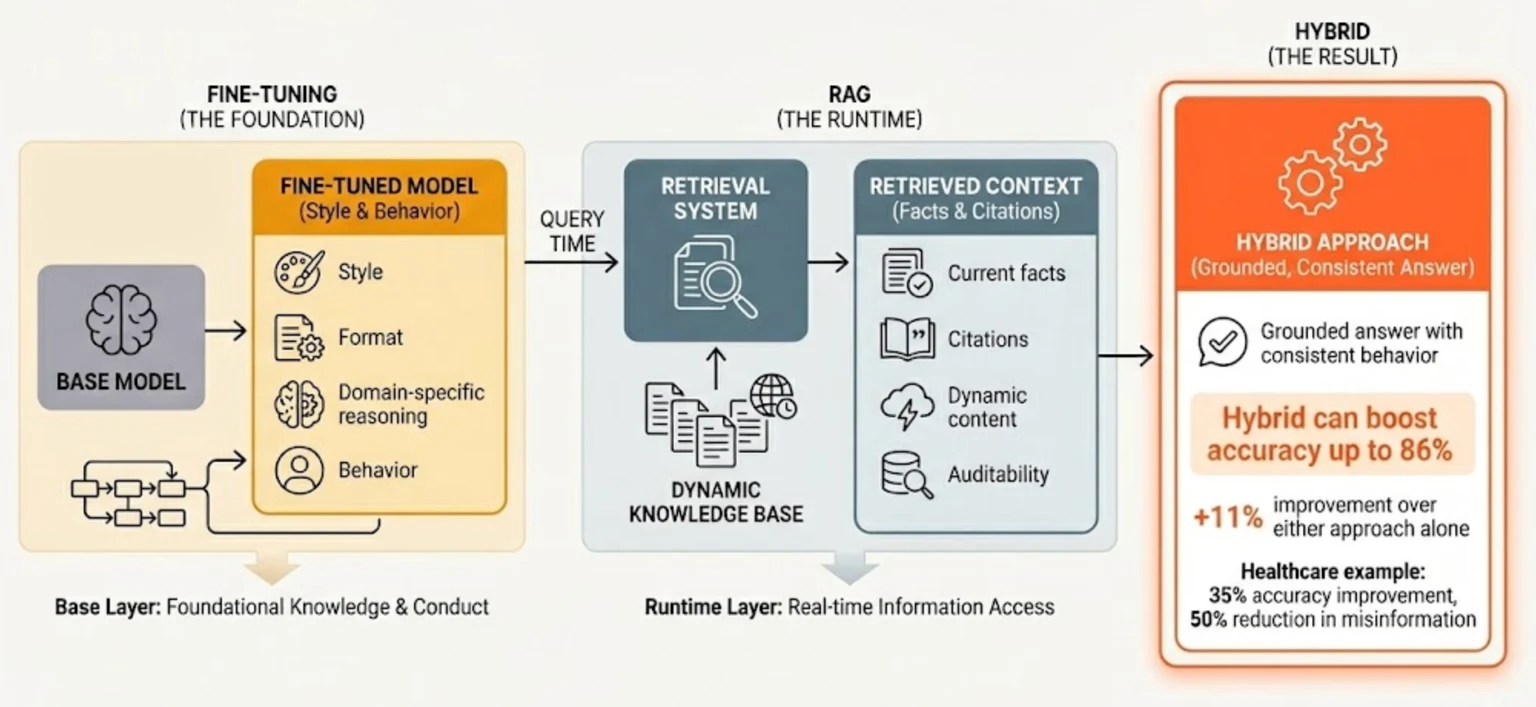
Medical systems. Fine-tune on terminology and diagnostic reasoning patterns. Layer RAG for the latest research findings and rare case studies. The fine-tuning handles clinical reasoning; RAG handles current evidence. Studies show hybrid approaches in healthcare can improve accuracy by 35% while reducing misinformation by 50%.
Legal research. Fine-tune for legal language understanding and argumentation patterns. Use RAG to access up-to-date case law and statutes. The model reasons like a lawyer but cites current precedent.
Enterprise customer support. Fine-tune for brand voice and core product expertise. Use RAG for current documentation, account-specific information, and recent updates. Customers get consistent, on-brand responses grounded in accurate, current information.
The Hybrid Reality
The 2025 consensus isn't "RAG vs fine-tuning." It's knowing when to use which — and when to combine them.
The pattern that works:
- Start with RAG for knowledge retrieval, compliance documentation, and factual Q&A
- Add fine-tuning only when you need behavior changes — style, format, or domain-specific reasoning
- Measure before adding complexity
Why hybrid can outperform either alone:
Fine-tuning alone hallucinates on anything not in the training data. The model is confident about what it learned but makes things up when asked about anything new.
RAG alone can't enforce consistent style or teach specialized reasoning patterns. It provides facts but doesn't shape how the model uses them.
Hybrid gives you grounded facts with learned behavior. Research suggests hybrid approaches can boost accuracy up to 86% — an 11% improvement over either approach alone.
The tradeoff: Hybrid means inheriting the complexity of both systems. You need retrieval infrastructure AND training pipelines. Your team needs both skill sets. Only go hybrid if your use case genuinely requires both capabilities — and your team can support both systems long-term.
Making the Call
Here's the quick decision path:
Start with RAG if:
- Your data changes frequently
- You need citations and auditability
- You want faster time to deployment
- Your team has data engineering skills
Consider fine-tuning if:
- Consistent style or format is critical
- You need domain-specific reasoning
- Latency requirements are strict
- Your data is stable and well-curated
Go hybrid if:
- You need both current facts AND specialized behavior
- Your use case genuinely requires both capabilities
- Your team can support both systems
The honest advice for most projects: Start with RAG. It's lower risk, faster to deploy, easier to update, and handles the most common requirement — grounding AI in your actual data.
Add fine-tuning when you have clear evidence that you need behavior changes the base model can't achieve through prompting or RAG alone. Not because it seems more sophisticated. Because your metrics show you need it.
Go hybrid only when your use case genuinely demands both — and accept the operational complexity that comes with it.
The Complete Picture
Over this series, we've covered the full journey:
- Why AI hallucinates — and how RAG grounds it in real sources
- How RAG works — chunk, embed, retrieve, generate
- How to build a working system — practical implementation choices
- How to optimize — chunking, hybrid search, and reranking
- When to choose RAG — versus fine-tuning, and when to combine them
RAG controls what the model reads. Fine-tuning controls how the model behaves. They solve different problems. Knowing which problem you actually have — that's the real skill.
Build accordingly.
Continue Reading
How To13 min read
How to Get Your Brand Mentioned in Google AI Overviews
Getting a brand mentioned in Google AI Overviews requires indexed, useful pages, credible supporting evidence, carefully chosen queries, and repeated testing that separates mentions, citations, recommendations, and owned-source appearances.
Rosh Jayawardena
How To15 min read
How to Get Your Brand Mentioned in Google Gemini
Google Gemini brand mentions are variable, context-dependent outputs, not permanent rankings. Brands improve accurate discoverability by clarifying identity, maintaining accessible facts, publishing useful evidence, earning legitimate corroboration, and testing defined prompts across named Gemini surfaces.
Rosh Jayawardena
How To16 min read
Get Your Brand Mentioned in ChatGPT: An Evidence-Led Process
Getting a brand mentioned in ChatGPT requires crawlable, clear information, relevant independent evidence, and repeated testing across realistic prompts; these actions can improve discoverability and accuracy but cannot guarantee a mention, citation, or recommendation.
Rosh Jayawardena
Deep dives, delivered weekly
AI patterns, workflow tips, and lessons from the field. No spam, just signal.