
Back to Blogs
The 3% Problem: The AI Literacy Gap Hiding Behind Your Adoption Dashboard
12 min readMar 9, 2026
AI Strategy

Rosh JayawardenaData & AI Executive
Your AI adoption dashboard says 73%. Your team's output says otherwise. The enterprise AI problem has shifted from access to proficiency, and the gap is wider than most leaders think.
I spent a morning recently sitting with a group of business users, showing them how to use a developer-focused AI tool for knowledge work. These were smart, experienced people. They'd had access to AI tools for months.
Every single one of them was using AI as a chatbot. Copy text in, copy the response out, paste it into a document. That was the workflow.
When I showed them how to set up custom skills, work directly with files on their machines, analyse real data sets, generate visualisations, and surface insights automatically, the room went quiet. Then the questions started. Not "how does this work" questions. "Why didn't anyone show us this a while ago" questions.
That was an aha moment for me too. Being buried in AI tools all day, I'd become a bit blind to how wide the AI literacy gap in the enterprise workforce actually is. The distance between what these tools can do and what most people use them for surprised me. And the data backs it up: fewer than 3% of knowledge workers qualify as AI proficient, according to the Section AI Proficiency Report. The gap between "has access" and "gets value" is wider than most of us realise.
Your adoption dashboard says 73%. Your team's output tells a different story. This article looks at the four structural mechanisms causing that disconnect, and why the usual response of more training and more tools isn't fixing it.
The numbers are worse than you'd expect
The Section AI Proficiency Report surveyed 5,013 knowledge workers across the US, UK, and Canada. The headline finding: roughly 10% score as truly AI-proficient. About 3% qualify as practitioners or experts. The other 90% are sceptics, novices, and experimenters with inconsistent prompting skills and no reliable use cases.
That's not a bell curve. It's a cliff.
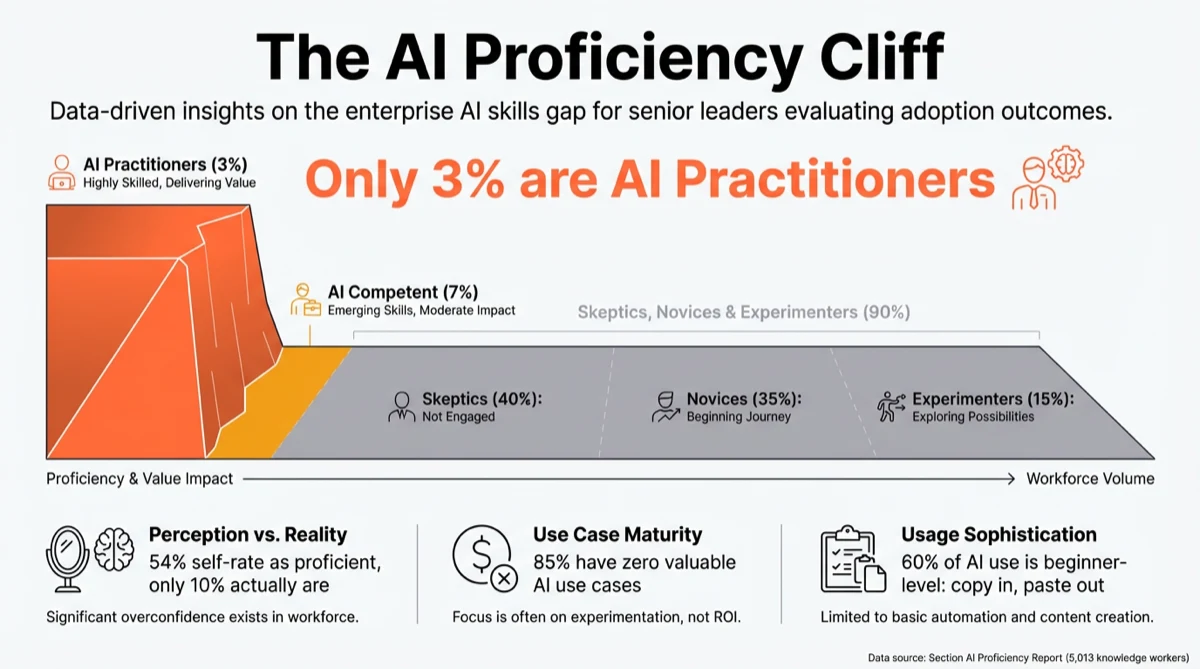
A small group of power users (the 3%) are getting serious value from AI. A thin middle layer of about 7% is getting moderate value. And the vast majority are getting almost nothing. This bimodal distribution is the real story hiding behind your adoption metrics.
It gets worse. 85% of enterprise employees don't have a single AI use case that delivers business value, according to a January 2026 BusinessWire report. Three in four workers regularly abandon AI tools mid-task because the output quality isn't good enough (Udacity, 2025).
The perception gap compounds the problem. When Section AI asked workers to self-rate their AI proficiency, 54% called themselves proficient. The actual assessed score? 10%. People think they're using AI well. They're not. And most organisations have no mechanism to reveal the gap.
60% of enterprise AI use cases are beginner-level: copying text in, pasting answers out, asking basic questions. It looks like adoption on a dashboard. It isn't AI proficiency in any meaningful sense.
So why does the AI skills gap among knowledge workers persist? It's not because people are lazy or resistant. From what I've seen, it's structural.
Why the AI literacy gap persists: four structural mechanisms
The AI proficiency gap isn't a people problem. It's a design problem in how organisations deploy AI. Four mechanisms keep it locked in place.
The half-life problem
AI skills decay. Fast.
McKinsey's 2026 research on AI upskilling estimates the half-life of AI skills at roughly 3-4 months. The prompting techniques that worked in January are partially obsolete by April. Interfaces change. New capabilities appear. Old workflows break.
This isn't like learning Excel, where your skills compound over decades. The target moves constantly. In surveys across 2025 and 2026, roughly 78% of executives reported that AI is advancing faster than their organisations can train for it.
You can't train your way out of a moving target with annual programmes.
The bandwidth trap
The binding constraint on AI proficiency isn't skill or willingness. It's time.
Knowledge workers are already at capacity. Full calendars, back-to-back meetings, existing deliverables. Expecting them to learn new tools, redesign their workflows, and experiment with AI in the margins of packed days isn't a strategy. It's wishful thinking.
Harvard Business Review put it directly in February 2026: AI doesn't reduce work, it intensifies it. Before AI makes you faster, it adds cognitive load. You're learning a new tool while doing your existing job. That's a net burden until proficiency kicks in.
The paradox is hard to ignore: the people who would benefit most from AI proficiency are the ones with the least time to develop it.
The theory-application gap
Most AI training teaches what AI is. Not how to use it in your specific work.
Only 31% of workers say their employer provides AI training at all. Of those who get it, the typical programme is a one-hour webinar covering concepts: what is a prompt, what is an LLM, here's how to write a query. Theory, not application.
The gap between "I understand what AI is" and "I can use this tool to do the research task I do every Tuesday" is pretty big. And most training programmes never bridge it.
The OECD found that trained employees achieve 2.7x higher proficiency than self-taught users, but that's when training is hands-on and role-specific. A generic webinar on prompt engineering doesn't move the needle. This is why employees can't use AI effectively despite months of access: they were taught concepts, not workflows.
The fix isn't more training. It's different training: embedded in actual work, tied to real tasks, with ongoing reinforcement rather than a one-off session.
The opacity problem
Most AI tools are black boxes. You type something in, you get something out. If you can't see why the AI gave you that answer, you can't evaluate it, improve your approach, or build genuine proficiency.
This is where tool design matters. Tools that make their reasoning transparent (showing which sources informed an answer, visualising how knowledge connects) lower the proficiency barrier. When you can see the AI's working, the feedback loop is immediate. You learn what makes a good question because you can see what the AI did with it.
When reasoning is invisible, users stay stuck at beginner level. They can't tell good output from bad, so they can't improve. We explored a version of this in our piece on how different AI models find completely different things in the same sources. Transparency isn't just about trust. It's about learning.
These four mechanisms explain why throwing more training budget at the problem won't work on its own. So what will?
What actually moves the needle
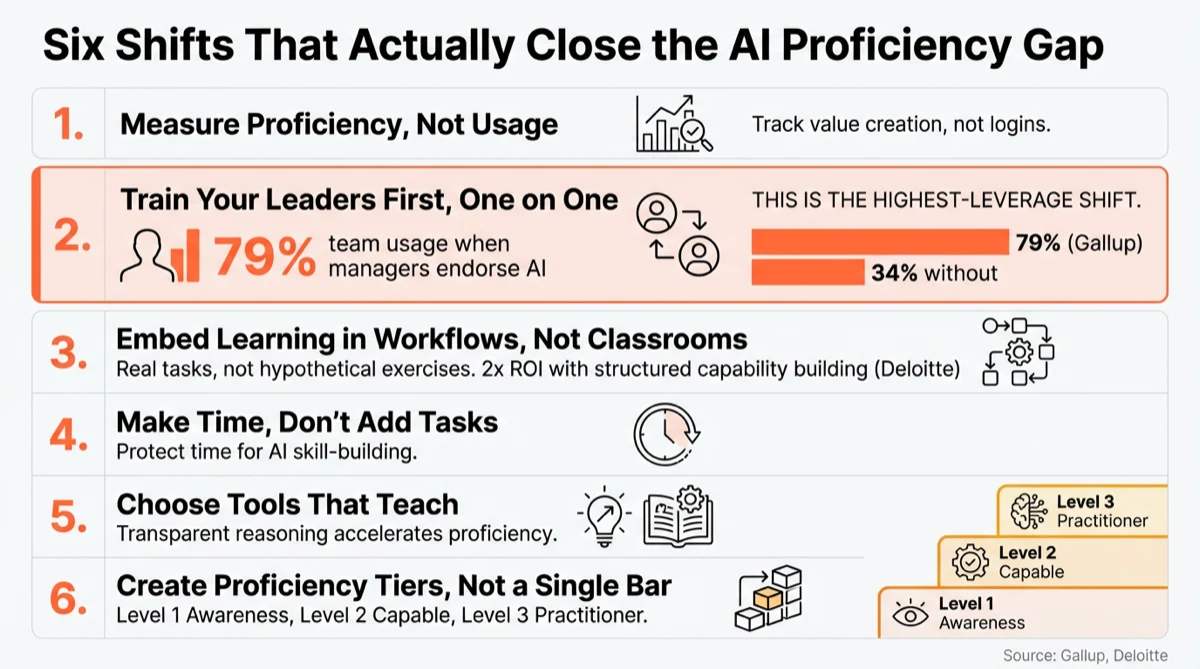
Closing the AI adoption proficiency gap requires structural changes, not just training programmes. Six shifts that have worked.
Measure proficiency, not usage
It's worth rethinking what you measure. Track workflow integration depth, output quality improvement, and use case diversity. Not logins.
Remember the bimodal distribution: the goal is moving people from the 90% to the 10%. A dashboard showing 73% adoption that can't distinguish someone pasting text into ChatGPT from someone building automated research workflows is measuring the wrong thing.
Train your leaders first, one on one
This is probably the highest-leverage move, and most organisations skip it.
Before rolling out training programmes for the workforce, get your leaders actually using AI to do their own jobs. Not a one-hour demo. Sit with them one on one and work through their actual tasks. Their reports, their analysis, their decision-making workflows.
Leaders who personally use AI are credible when they ask their teams to adopt it. They stop asking "is anyone using the AI tools?" and start asking "have you tried using it for this specific task?" Because they've done it themselves.
The data backs this up. Gallup found employees are 2.5x more likely to use AI when their leaders actively support it. Even stronger: employees who strongly agree their manager supports AI use are 9x more likely to say AI helps them do their best work. When a manager endorses AI, team usage reaches 79%. Without that support, it drops to 34%.
The bottleneck isn't training. It's leadership modelling.
Start with your direct reports. Block 90 minutes per leader. Work through one real task with an AI tool. The goal isn't to make them experts. It's to give them enough hands-on experience to lead their teams with credibility.
Embed learning in workflows, not classrooms
Training that happens outside the workflow doesn't transfer. The most effective AI skill-building is embedded in the actual work: prompt libraries for specific tasks, AI champions within teams, real projects instead of hypothetical exercises.
Organisations pairing AI investment with structured capability building are nearly twice as likely to see strong ROI, according to Deloitte's analysis. The difference isn't spending more on training. It's training in context.
Even something as straightforward as structuring your documents so AI tools can actually work with them is the kind of embedded, workflow-specific skill that generic training programmes miss entirely. Building AI capability in a workforce means meeting people in the tools and tasks they already use.
Make time, don't add tasks
Address the bandwidth trap directly. If you're serious about building AI proficiency across your enterprise, protect time for it.
If you can't give people two hours a week to experiment with AI tools in the context of their real work, your adoption initiative is a mandate, not a strategy. The 3% didn't get proficient by watching webinars. They got proficient by having space to experiment and fail.
Choose tools that teach
Tools with transparent reasoning (source grounding, visualised knowledge connections) accelerate proficiency because they show users what the AI is doing, not just what it outputs.
The feedback loop matters. When users can see which sources informed an answer and how pieces of knowledge connect, they learn to ask better questions faster. Opacity keeps people stuck at beginner level. Transparency builds practitioners.
Create proficiency tiers, not a single bar
Not everyone needs to be an AI practitioner. Use a tiered model:
- Level 1, Awareness: Understands what AI can do, uses it occasionally for simple tasks
- Level 2, Capable: Uses AI regularly for specific workflows, can evaluate output quality
- Level 3, Practitioner: Integrates AI deeply into work, builds custom workflows, trains others
Set realistic targets. Moving 30% of your workforce from Level 1 to Level 2 is more valuable (and more achievable) than trying to push everyone to Level 3. Match the ambition to the mechanism: address the bandwidth trap, embed learning in context, and give people tools that teach as they go.
The gap that matters
The AI literacy gap is the enterprise AI problem of 2026. The tools are here. The budgets are allocated. The missing piece is genuine human capability. Not access, not willingness, but depth of understanding.
The 3% aren't special. They just had the right conditions: time to experiment, tools that showed their reasoning, training that connected to real work, and measurement that valued proficiency over logins. Those conditions are buildable. They're just not what most organisations are building.
What's the biggest barrier to AI proficiency in your organisation: time, training, tools, or something else?
The companies that sort this out won't just have AI tools. They'll have AI-capable teams. That's the gap that actually matters.
Continue Reading
AI Strategy10 min read
We Looked Into the Markdown-for-AI Theory. The Data Wasn't Kind.
Publishing Markdown mirrors of your web pages for AI search visibility is a waste of time. Here's why AI crawlers stick to HTML, and what you should focus on instead.
Rosh Jayawardena
AI Strategy9 min read
I Gave the Same 15 Sources to Three Different AI Models. They Found Completely Different Things
Different AI models find different things in the same documents. Here's what the research actually shows, and why model choice is a research methodology decision, not a feature checkbox.
Rosh Jayawardena
AI Strategy8 min read
The AI Verification Triage: What to Always Check, What to Spot-Check, and What to Trust
92% of users don't verify AI outputs. Here's a framework for knowing when that's fine and when it'll burn you
Rosh Jayawardena
Deep dives, delivered weekly
AI patterns, workflow tips, and lessons from the field. No spam, just signal.