Back to Blogs
AI Search Visibility for a New Brand
9 min readApr 28, 2026
AEO

Rosh JayawardenaData & AI Executive
AI search visibility for a new brand: what a 14-day GEO case study really shows, and what smaller businesses can actually copy.
AI Search Visibility for a New Brand: What a 14-Day GEO Case Study Actually Tells Us
If you run a newer brand, traditional SEO can feel a bit slow. You publish the pages, clean up the metadata, wait for Google to care, and mostly stare at analytics that do not move. AI search visibility has changed that rhythm slightly, because brands can now appear in ChatGPT, Perplexity, Gemini, Copilot, or Google AI experiences before they have built much classic authority.
That does not mean the rules have disappeared. It just means the rules are different.
A competitor piece from Otterly claims a zero-authority brand earned AI search mentions in 14 days and reached rank #7 in its test set. Fair enough, that is interesting. What matters more is what the experiment actually tells us, what it does not, and what a smaller business could reasonably copy without getting carried away.
What is ai search visibility, and why does it matter for a new brand?
AI search visibility is a measure of whether answer engines mention your brand, cite your pages, and describe you accurately when users ask buying or research questions. HubSpot frames it around four signals: mentions, citations, sentiment, and share of voice.
For the broader foundation behind those signals, see our practical guide to answer engine optimization.
That is a useful distinction, because SEO still cares about pages while AI systems often care about entities, relationships, and which sources they trust enough to quote. In practice, that means a small brand can be absent from page one in Google and still show up in an AI-generated answer, if the right evidence exists across the web.
The commercial bit is fairly obvious. If Google’s AI Overviews appeared in 18% of U.S. desktop searches in March 2025, as cited by HubSpot from Pew Research, and if a decent share of searches now end without a click, then the answer itself has become part of the buying journey. Being missing from that answer is not ideal.
We touched a related issue in our piece on Markdown vs HTML for AI crawlers, where the practical question was not just whether AI bots can access your content, but whether they can interpret it cleanly enough to reuse it. That same idea applies here. If your brand facts are unclear, scattered, or inconsistent, your visibility problem starts before the prompt is even asked.
Why this matters more for low-authority sites
A newer website usually has three problems at once. It has weak backlinks, little brand recognition, and not much evidence sitting outside its own domain.
That third part matters more in AI search than many teams expect. A language model does not need to believe your homepage alone. It looks for corroboration.
Can a new brand get ai search visibility in 14 days?
Yes, a new brand can get ai search visibility in 14 days, but usually only for a narrow set of prompts where the category, wording, location, and supporting citations line up unusually well.
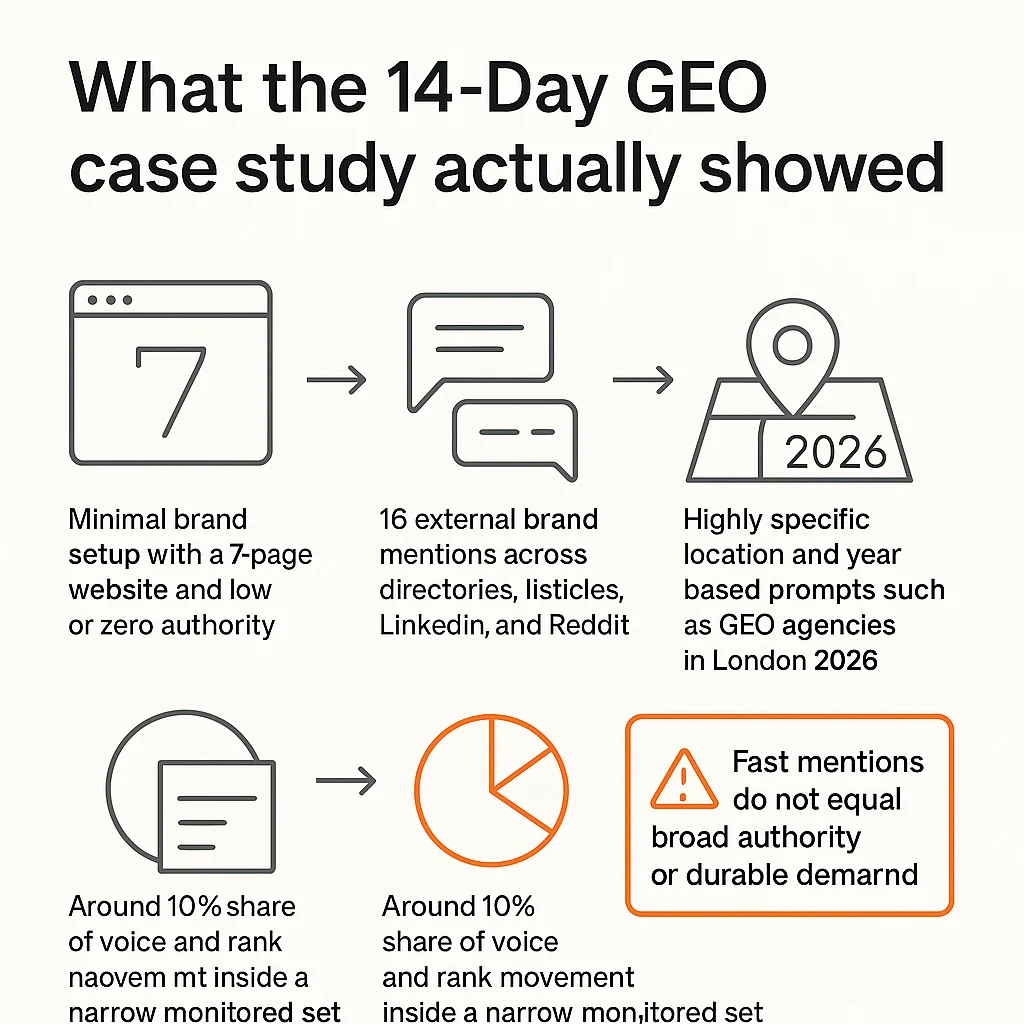
That is the most useful reading of the Otterly case study. They created a minimal seven-page brand, built external mentions, and tracked nine prompts around a very specific query class: GEO agencies in London, with year-based and location-based phrasing. The reported outcome was 16 external mentions, about 10% share of voice, and a rank position inside their monitored set within 14 days.
I would not dismiss that. I would not over-romanticise it either.
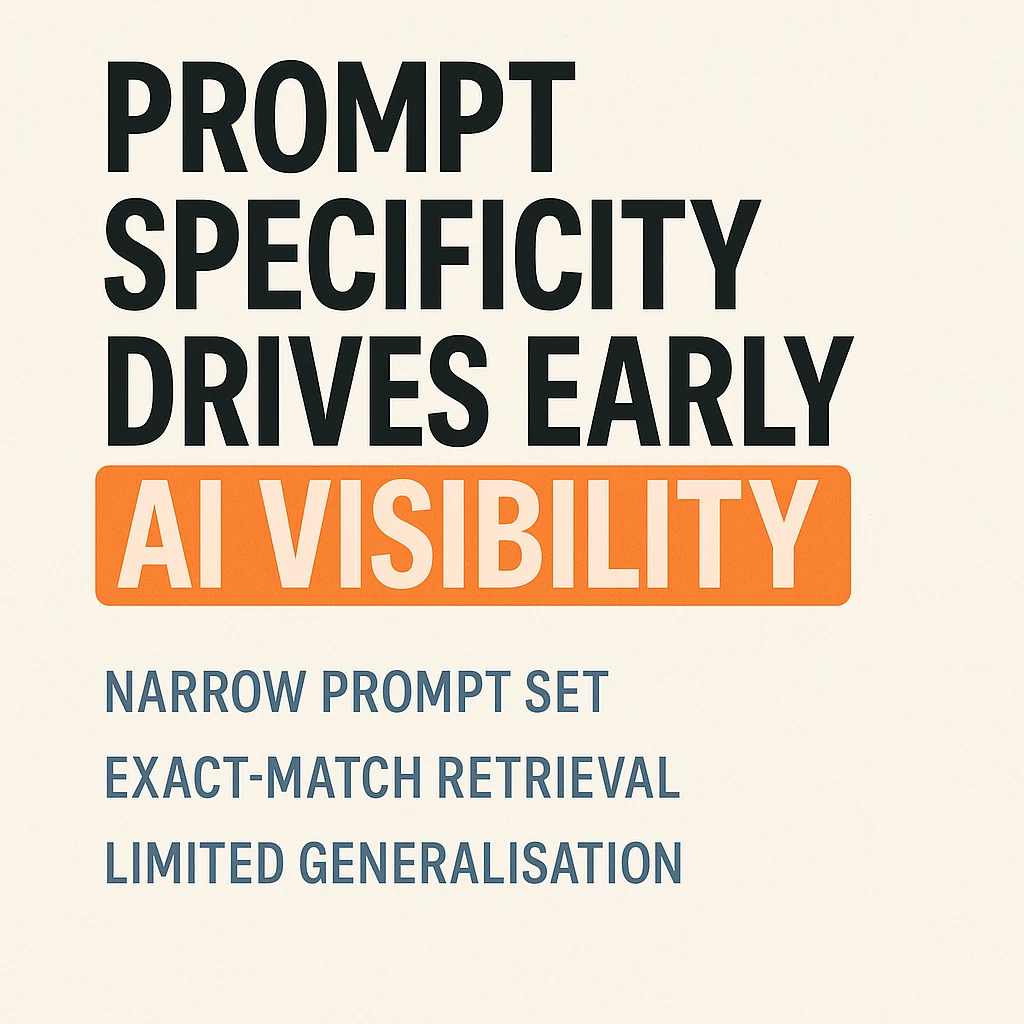
What the test appears to show is that AI citation systems can respond quickly when a brand is mentioned repeatedly on sources they already trust. It does not show that a brand with no authority can suddenly compete everywhere. The strongest movement came from exact or near-exact prompt matches, especially location-specific and year-tagged prompts.
That pattern matters. It suggests early new brand ai search gains are often retrieval wins, not broad reputation wins.
This is where teams can get a bit too excited. I have seen people treat a handful of mentions as proof they have cracked GEO. Usually they have only proved that a model can retrieve them for one corner of the market. Useful, yes. Comprehensive, not really.
What matters more for early ai search visibility, your website or third-party mentions?
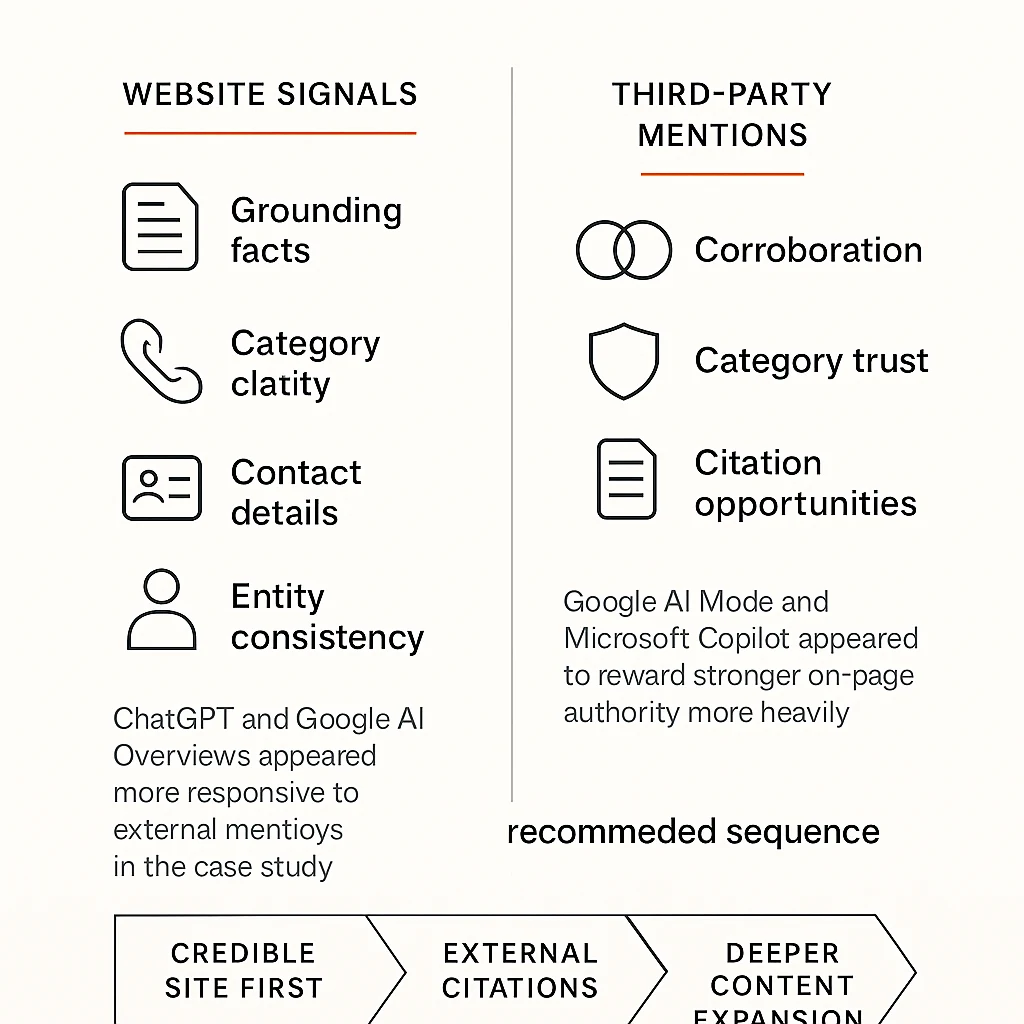
For early ai search visibility, third-party mentions often matter more than your website alone, but your own site still needs to provide the grounding facts that make those mentions believable.
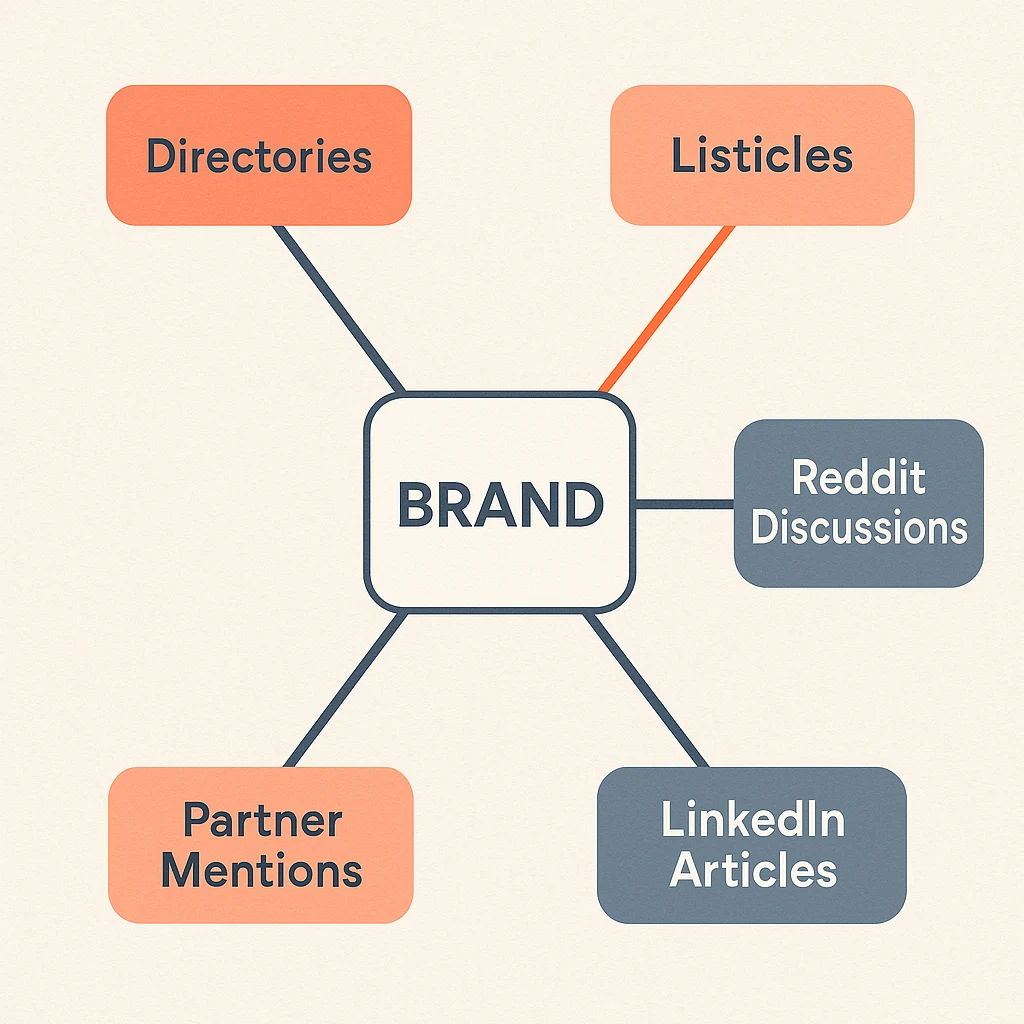
That balance is easy to miss. Otterly’s experiment leaned heavily on off-page signals, and the off-page part seems to have done most of the lifting. Directory listings, listicle mentions, LinkedIn Pulse content, and Reddit participation were the main distribution surfaces. Their own site was intentionally thin.
Even so, a thin site is not the same as an irrelevant site. The homepage, services page, about page, contact page, and supporting pages gave the AI systems a base entity to understand. Without that, external mentions can become noisy or contradictory.
HubSpot’s explanation is useful here. Mentions tell a model your brand exists in a category. Citations tell it where the supporting evidence sits. If you only have mentions and no coherent owned pages, you risk being vaguely present but poorly understood.
Platform behaviour also looks uneven. Otterly reported stronger results in ChatGPT and Google AI Overviews, weaker results in Google AI Mode and Microsoft Copilot, and mixed behaviour in Perplexity and Gemini. Superlines makes a similar point in a broader way: different AI systems rely on different layers, from training data to search indexes to live retrieval.
So if you are starting from scratch, I would not frame this as website versus mentions. I would frame it as sequence.
- Build a credible minimum site.
- Make the brand facts consistent.
- Get cited on external surfaces AI already trusts.
- Then expand your owned content.
That is less exciting than “authority is dead.” It is also more likely to hold up.
Which channels help a low-authority brand earn AI mentions fastest?
The channels most likely to help a low-authority brand earn AI mentions quickly are directories, already-cited listicles, Reddit discussions, LinkedIn articles, and other third-party pages that answer engines already pull from.
The useful part of the Otterly case study is not the headline. It is the channel mix.
Here is the short version.
1. Directories
Otterly called out platforms such as Clutch, GoodFirms, DesignRush, and Sortlist. These are structured, category-based, and reasonably easy for AI systems to interpret.
If your business is not listed, or the listing is incomplete, I would fix that before commissioning another thought-leadership article. It is not glamorous work. It is often effective.
2. Existing listicles on trusted sites
A mention inside a page that AI systems already cite can matter more than publishing your own listicle on a site nobody reads or retrieves.
This is the bit many teams get wrong. They create more content on their own domain when what they actually need is corroboration elsewhere.
3. Reddit
Superlines notes that social and community surfaces matter because AI systems pull from them differently across platforms. Reddit in particular keeps appearing in citation discussions for product, service, and recommendation queries.
There is an obvious catch. Low-effort self-promotion on Reddit tends to be embarrassing and easy to spot. Genuine participation works better. Which is annoying, because it takes actual effort.
4. LinkedIn
LinkedIn is useful when the topic is professional, B2B, or service-led. Short practitioner articles and consistent brand context can help reinforce category associations.
I would keep expectations sensible though. A LinkedIn post alone is rarely the whole story. It works better as supporting evidence.
Where this 14-day GEO case study is useful, and where I’d be careful
The case study is useful because it isolates one important idea: off-page signals can move earlier than classic SEO for a new brand.
It is less useful as a promise.
The market was narrow. The prompts were narrow. The wording bias looked strong. The time window was short. There was also no serious proof that these mentions translated into durable pipeline, recurring traffic, or broader category authority.
That is not a criticism of running the experiment. It is a criticism of how quickly this industry turns directional tests into universal claims.
Go Fish Digital makes a different, and in some ways more mature, point in its own GEO case study. Their gains came from prompt mapping, fact-dense content, and broader query fan-out over a longer period. That is harder to package into a flashy headline, but it is probably closer to how durable ai citations for new websites are built.
If I were advising a client, I would treat the 14-day result as evidence that AI citation networks can move quickly. I would not sell it as a guarantee that any new brand can be visible everywhere by next Friday.
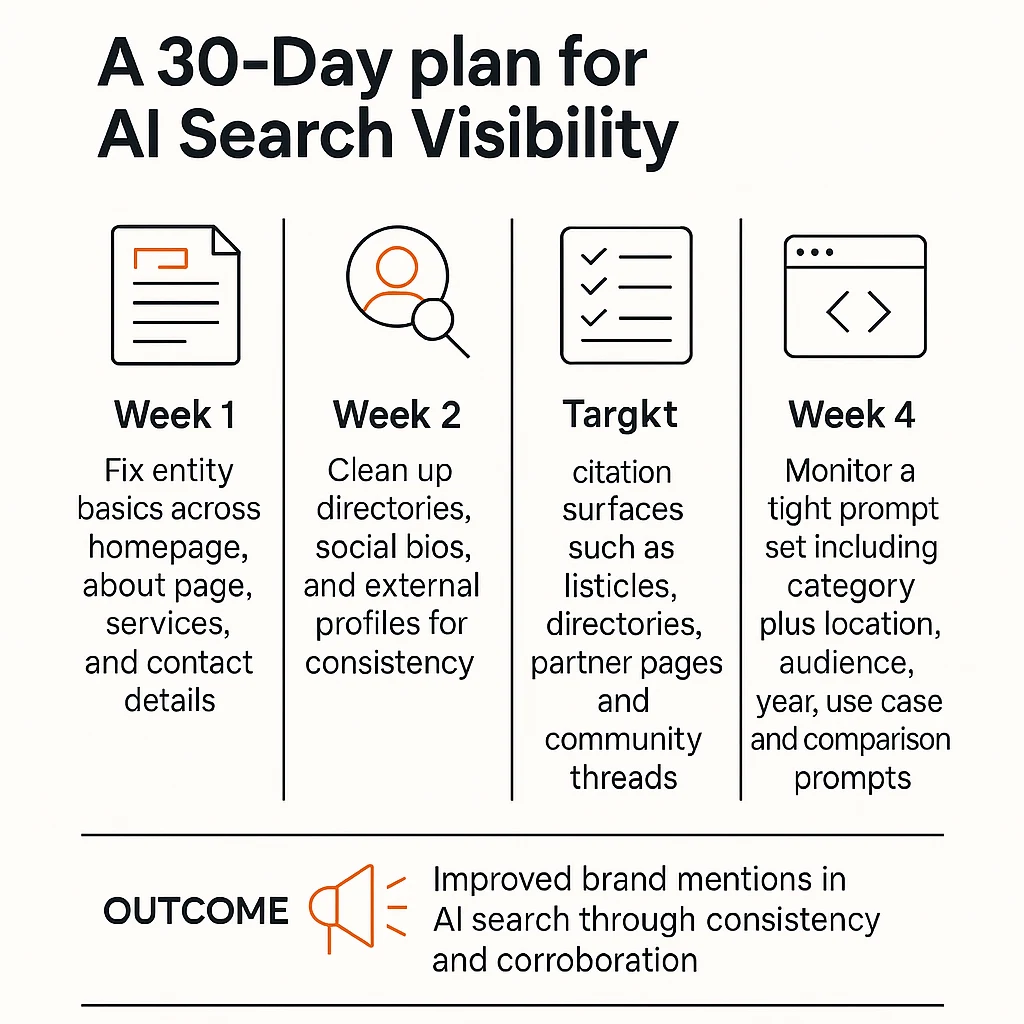
A practical 30-day plan for improving ai search visibility from a cold start
If you want ai search visibility from a cold start, I would keep the first month fairly simple.
The citation basics are the same whether the brand is new or established; our guide to getting cited by ChatGPT for your business covers that groundwork.
Week 1: fix your entity basics
Make sure your homepage, about page, service pages, contact details, and category language all agree. Pick one core description of what the brand is, who it helps, and where it operates.
Week 2: clean up external profiles
Update directories, social bios, author profiles, and partner mentions so the business name, service category, and location are consistent.
We covered the owned-content side of this in our earlier piece on AI search visibility brands winning in AI search. The short version is that consistency beats volume early on.
Week 3: target citation surfaces
Look for listicles, association pages, directories, partner pages, and community discussions that already rank or get cited for the prompts you care about. Aim for accurate mentions, not random backlinks.
Week 4: monitor prompt coverage
Track a small set of prompts each week. Keep them specific.
- Category + location
- Category + audience
- Category + year
- Best providers for a use case
- Alternatives and comparison prompts
This matters because brand mentions in ai search can be highly prompt-sensitive. If you measure only broad terms, you may miss the first signs of movement.
Frequently Asked Questions
Can a new website appear in ChatGPT or Perplexity answers?
Yes, a new website can appear in ChatGPT or Perplexity answers if the brand is described clearly on-site and mentioned on third-party sources those systems trust. A new site with no corroboration is less likely to be retrieved consistently.
Do brand mentions matter more than backlinks for AI search?
For early AI visibility, brand mentions often matter more than traditional backlinks because answer engines look for corroborated entity signals across multiple sources. Over time, the stronger result usually comes from mentions, citations, and a credible owned site working together.
How long does GEO take to work?
Prompt-specific gains can show up within days or weeks, especially for narrow queries. Broader and more durable visibility usually takes longer because authority, consistency, and retrieval coverage compound over time.
Is ai search visibility the same as SEO?
No. AI search visibility overlaps with SEO, but it measures mentions, citations, and framing inside generated answers rather than only rankings and clicks from search results pages.
Conclusion
The short version is this: a new brand can earn AI mentions quickly, and the Otterly case study gives a decent example of how that can happen. The better lesson is not that websites no longer matter. It is that external validation often moves faster than on-page authority when a brand is new.
If you want results here, start with the boring bits. Tighten your brand facts, clean up your directory presence, target the sources AI systems already cite, and measure a small prompt set properly. That will usually do more for AI visibility than another vague blog post about the future of search.
Deep dives, delivered weekly
AI patterns, workflow tips, and lessons from the field. No spam, just signal.