
Back to Blogs
GPTBot vs OAI-SearchBot vs ChatGPT-User Explained
11 min readAug 5, 2026
Comparison

Rosh JayawardenaData & AI Executive
GPTBot may support training-related use, OAI-SearchBot supports ChatGPT search, and ChatGPT-User retrieves pages after user requests. Robots.txt controls are documented for the first two, while ChatGPT-User policy remains unresolved.
The names make these agents look like variants of one OpenAI web crawler. That is the first thing to unlearn.
GPTBot, OAI-SearchBot, and ChatGPT-User have different documented jobs. One concerns content that may be used for training, one supports ChatGPT search, and one is associated with a page visit triggered by a user interaction. Once you separate those jobs, the controls make more sense—and so do their limits.
The three agents are not three names for the same crawler
OpenAI’s crawler documentation says it uses web crawlers and user agents either automatically or when a user request triggers an action. Within that broad system, it identifies GPTBot with content that may be used to train its generative AI foundation models. The word may matters: access creates the possibility of that use; it does not prove that any given page was or will be used for training.
OAI-SearchBot has a different role. OpenAI associates it with search results, and its publisher guidance says sites should not block OAI-SearchBot if they want their content to be eligible for summaries and snippets in ChatGPT. This is the search-oriented agent: discovery, surfacing, summaries, snippets, citations, and links are the relevant product context.
ChatGPT-User is different again. Secondary technical descriptions consistently associate it with user-triggered retrieval: when someone asks ChatGPT or a Custom GPT a question, ChatGPT may visit a page to help form an answer and may include a source link. That is a page fetch tied to an interaction, not the same function as crawling for possible training or supporting search discovery.
So the useful shorthand is:
- GPTBot: potential training use.
- OAI-SearchBot: ChatGPT search.
- ChatGPT-User: retrieval triggered by a user interaction.
These are documented agent names and robots.txt identifiers, not necessarily the complete HTTP User-Agent headers that will appear in every request. The supplied official material does not establish complete current header strings, IP ranges, or a single verification procedure for all three agents. OpenAI is the documented operator, but a request merely claiming one of these names is not thereby proven to be from OpenAI.
The comparison therefore begins with purpose. If you collapse all three into “OpenAI traffic,” you lose the distinction that determines what a request may be doing and what a control can reasonably affect.
How their operating roles differ
The easiest mistake is to reason from access directly to outcome. GPTBot fetched a page, therefore the page trained a model. OAI-SearchBot fetched it, therefore it will appear in ChatGPT search. ChatGPT-User fetched it, therefore it was cited. None of those conclusions follows from the supplied evidence.
GPTBot is associated with crawling material that may be used in training OpenAI’s generative AI foundation models. But OpenAI’s documentation does not give us GPTBot’s detailed discovery algorithm, crawl schedule, frequency, or page-processing pipeline. We know the purpose attached to the agent; we do not know the whole machinery behind it.
OAI-SearchBot supports search-related use. OpenAI says allowing it can enable a site to appear in search results, and its publisher FAQ connects access with summaries and snippets. But the evidence does not establish whether OAI-SearchBot maintains a conventional persistent index, how pages are selected, how often they are revisited, or how retrieval and presentation are put together.
ChatGPT-User is tied to a user action. A user asks something; ChatGPT may then visit a page to help answer. This is the clearest contrast between automatic crawler functions and user-triggered retrieval. Even here, though, the boundary of our knowledge is narrow: the supplied sources do not show that every ChatGPT web request uses ChatGPT-User.
There is also a wrinkle that prevents the three labels from mapping neatly to three wholly separate fetch pipelines. OpenAI says that if a site allows both GPTBot and OAI-SearchBot, it may use the result of one crawl for both use cases to avoid duplicate crawling. The controls and purposes are separate; the underlying fetch work may sometimes be shared.
This is the reveal: separate agents do not necessarily mean every byte is fetched separately. They mean the site owner is being given separate purpose-based choices.
OpenAI explicitly says the GPTBot and OAI-SearchBot settings are independent. You can allow OAI-SearchBot for search-related access while disallowing GPTBot to indicate that crawled content should not be used for training. A search-related robots.txt change may take about 24 hours to affect OpenAI’s systems, but OpenAI states that timing for search results—not as a universal propagation time for every agent, cache, or control layer.
ChatGPT-User does not fit as cleanly into this robots.txt model. Some secondary sources say robots.txt may not apply to its user-triggered requests; another says it does respect robots.txt. A report about an OpenAI wording change also inferred that ChatGPT-User would no longer comply. The supplied official passage explicitly names GPTBot and OAI-SearchBot as robots.txt controls but does not settle ChatGPT-User’s policy.
That question remains unresolved.
What robots.txt can control—and what remains unresolved
For GPTBot and OAI-SearchBot, the documented control is straightforward in concept. OpenAI names GPTBot and OAI-SearchBot as independent robots.txt tags. A site can express different policies for the two purposes.
For example, the purpose of an agent-specific configuration like this is to permit search-related crawling while declining GPTBot access:
Txt
User-agent: OAI-SearchBot
Disallow:

User-agent: GPTBot
Disallow: /
In common robots.txt syntax, an empty Disallow: imposes no restriction, while Disallow: / blocks the whole site for the named agent. These syntax details come from secondary technical guidance; the supplied OpenAI passage confirms the agent names and their independence but does not provide a complete syntax or precedence specification.
The same caution applies to wildcard and path-specific rules. Secondary guidance describes User-agent: * as applying to all crawlers, and robots.txt can express rules for parts of a site rather than only a whole-site choice. But the evidence here does not establish OpenAI-specific precedence when wildcard, agent-specific, and path-specific groups overlap. If a real configuration depends on such an overlap, this evidence cannot tell you which OpenAI rule wins.
What does each confirmed setting mean? Allowing GPTBot leaves content accessible for possible training-related use. Disallowing it signals that crawled content should not be used for that purpose. Neither statement tells us that allowed material will actually be selected for training, nor does the supplied evidence show that a later block removes material obtained earlier or guarantees exclusion from every future model-improvement process.
Allowing OAI-SearchBot preserves the documented possibility that content can work with ChatGPT search. Blocking it removes that path of access. But permission is not a ticket into a result: it does not guarantee discovery, inclusion, a given position, a summary, a snippet, a citation, a link, or traffic.
After a robots.txt update, OpenAI says its search systems may take about 24 hours to adjust. That statement should not be stretched. It does not establish what happens to cached or previously fetched content, and it does not promise that GPTBot, ChatGPT-User, a WAF, or any other layer changes on the same schedule.
Then there is ChatGPT-User. Secondary sources show User-agent: ChatGPT-User as a possible group label, but they disagree about whether its requests are governed by robots.txt. Since the supplied official crawler overview documents controls for GPTBot and OAI-SearchBot without giving a definitive ChatGPT-User policy, it would be too strong to say either that ChatGPT-User always obeys robots.txt or that it always ignores it.
Nor is robots.txt the only thing that affects access. OpenAI’s crawler access guidance notes that web-protection services, bot-mitigation systems, CAPTCHAs, JavaScript challenges, behavioral checks, session validation, and other application-level controls can stop automated access. Authentication and rate limits can do the same. A robots.txt file may say “come in” while the CDN or application still says “no.”
The reverse is conceptually important too. Robots.txt is a policy signal, not a lock. Cloudflare describes compliance as voluntary and distinguishes such passive signals from enforcement through tools such as web application firewalls. So there are really three separate questions: what policy did the site publish, who sent the request, and what will the infrastructure permit?
Access controls are not the same as bot verification
A User-Agent header is text supplied by the client. Any client can claim to be GPTBot, OAI-SearchBot, or ChatGPT-User. The string is useful for classification, but it is not proof of identity.
This makes log interpretation less certain than it first appears. A line containing GPTBot tells you what the requester claimed to be. Before attributing the request to OpenAI, an operator would need other signals.
General bot-verification practice uses layers. Where an operator publishes current authoritative IP ranges, the request’s source address can be checked against them. Where the operator documents DNS verification, forward-confirmed reverse DNS can add another check: resolve the source IP to a hostname, confirm that the hostname belongs to the expected operator domain, and then resolve the hostname back to the original IP.
Those are general methods, not a complete OpenAI procedure established by the supplied evidence. Secondary sources claim that OpenAI-related ranges or machine-readable feeds exist, and one makes specific claims about OAI-SearchBot ranges and reverse DNS. But the official OpenAI crawler passage supplied here does not document the current ranges, a universal reverse-DNS requirement, or identical signals for all three agents. Any such check should therefore use current, validated operator data rather than a copied list or an old observation from logs.
Identity proof and access policy remain separate even when verification is strong. A request might be verified as coming from an operator yet be disallowed by the site’s robots.txt policy. Or robots.txt might allow the named agent while a CDN, WAF, anti-bot system, login requirement, application check, or rate limiter blocks the request. Verification answers “who is this?”; robots.txt answers “what policy have we stated?”; infrastructure answers “will this request get through?”
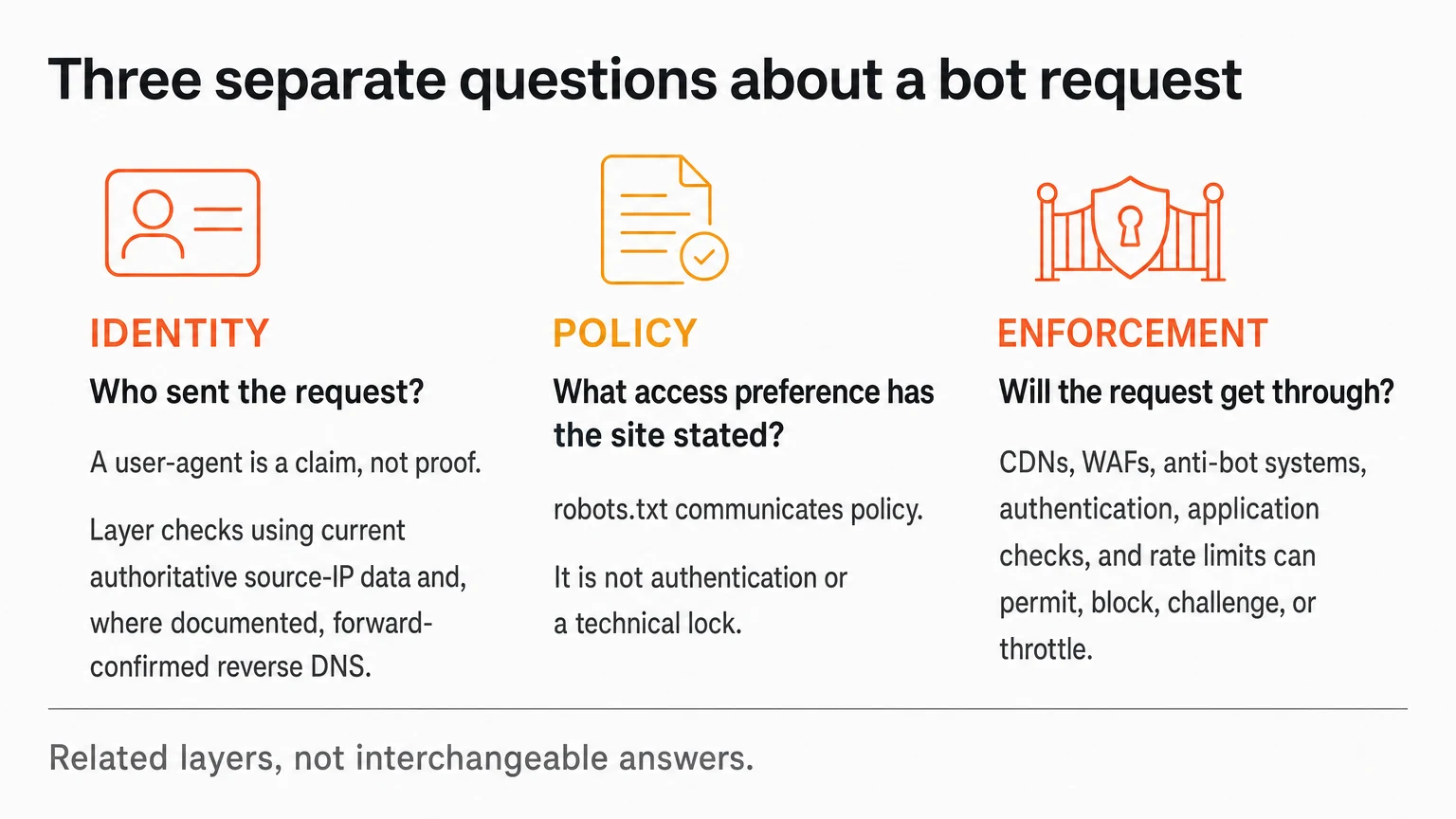
No concrete OpenAI-specific rate limits are established here, and neither are universal enforcement settings. The defensible point is narrower: do not trust the user-agent alone, and do not mistake robots.txt for authentication or hard access enforcement.
Practical implications without guaranteed outcomes
What, then, can a site operator actually decide?
Start with GPTBot. If you allow it, your content remains eligible for possible training-related use. If you disallow it, you are using OpenAI’s documented signal that crawled content should not be used for training its generative AI foundation models. This says nothing certain about whether allowed pages are selected, what happened to previously obtained material, or whether every model-development pathway is covered.
Next consider OAI-SearchBot. If you want to preserve eligibility for ChatGPT search discovery and surfacing, do not block it. Then make sure the pages are actually reachable: an open robots.txt policy will not overcome a CDN block, WAF rule, anti-bot challenge, login wall, application check, or rate limit. Even when access works, there is no guaranteed ranking, traffic, citation, attribution, source link, or inclusion.
Treat ChatGPT-User as a third question: do you want to permit page retrieval associated with a user’s request? The documented role points to live, user-triggered access, but the evidence does not tell us how often it occurs, whether every web request uses this agent, or whether a fetched page will appear as a source. More importantly, the supplied sources do not settle whether robots.txt reliably governs these requests, so a robots.txt rule alone cannot support a confident operational conclusion here.
Freshness, retrieval context, and product behavior may affect what users ultimately see, but the supplied research does not give a complete causal model for them. Nor does it explain all effects on cached or previously obtained content. Access is one dependency among several; it is not the outcome itself.
There are practical uncertainties even for the confirmed controls. Cloudflare notes that robots.txt compliance is voluntary in general, while one community report alleges that GPTBot ignored valid disallow rules and repeatedly requested a URL. A single report does not establish a systematic OpenAI policy of ignoring robots.txt. It does show why published policy, observed behavior, and enforceable infrastructure controls should not be treated as the same thing.
The sound decision is therefore not “allow OpenAI” or “block OpenAI.” It is three decisions:
- Do you want to permit GPTBot access associated with possible training use?
- Do you want to preserve OAI-SearchBot access associated with ChatGPT search?
- How do you want to handle user-triggered retrieval associated with ChatGPT-User, given that its robots.txt behavior is unresolved here?
Then make a fourth, separate decision about enforcement: which requests can you verify, and what should your CDN, WAF, application, authentication, anti-bot logic, and rate limits actually allow?
That is the real difference in GPTBot vs OAI-SearchBot vs ChatGPT-User. The names do not merely label traffic; they divide three purposes that should not be granted, blocked, verified, or interpreted as if they were one.
Continue Reading
Comparison11 min read
ClaudeBot vs Claude-SearchBot: How to Control Anthropic Crawlers
ClaudeBot collects public-web content that may contribute to model training, Claude-SearchBot supports search indexing, and Claude-User retrieves pages for user questions. Each identity requires separate robots.txt and Crawl-delay decisions.
Rosh Jayawardena
Comparison14 min read
Googlebot vs Google-Extended: Search and Gemini Controls
Googlebot is Google Search’s documented crawler, while Google-Extended is a robots.txt control for specified AI training and grounding uses of crawled content, including documented Gemini-related applications.
Rosh Jayawardena
Comparison9 min read
RAG vs Long-Context LLMs: The Decision Framework That Actually Helps You Choose
Every RAG vs long-context article ends with "it depends." This one gives you the specific thresholds to make the decision yourself.
Rosh Jayawardena
Deep dives, delivered weekly
AI patterns, workflow tips, and lessons from the field. No spam, just signal.