Back to Blogs
Your CEO Is Using Personal ChatGPT Too — The $8.1B Shadow AI Economy Nobody Talks About
8 min readDec 25, 2025
AI Strategy

Rosh JayawardenaData & AI Executive
Enterprise AI has a 5% success rate. Consumer tools hit 40%. No wonder employees are going rogue.
Here's an uncomfortable truth: 68% of C-suite executives have used unapproved AI tools at work in the past three months. Not their employees. Not the interns. The people signing off on million-dollar enterprise AI budgets are sneaking off to personal ChatGPT accounts to get actual work done.
According to a Nitro study reported by CIO Dive, more than a third of those executives did it at least five times in a single quarter. These are the same leaders approving 590to1,400 per employee annually on "official" AI tools. The same ones sitting in board meetings discussing AI governance.
This isn't hypocrisy. It's a rational response to a broken system. And it's created an $8.1 billion shadow economy that most companies pretend doesn't exist.
The Numbers That Should Terrify Every CIO
Let's talk about why your executives are going rogue.
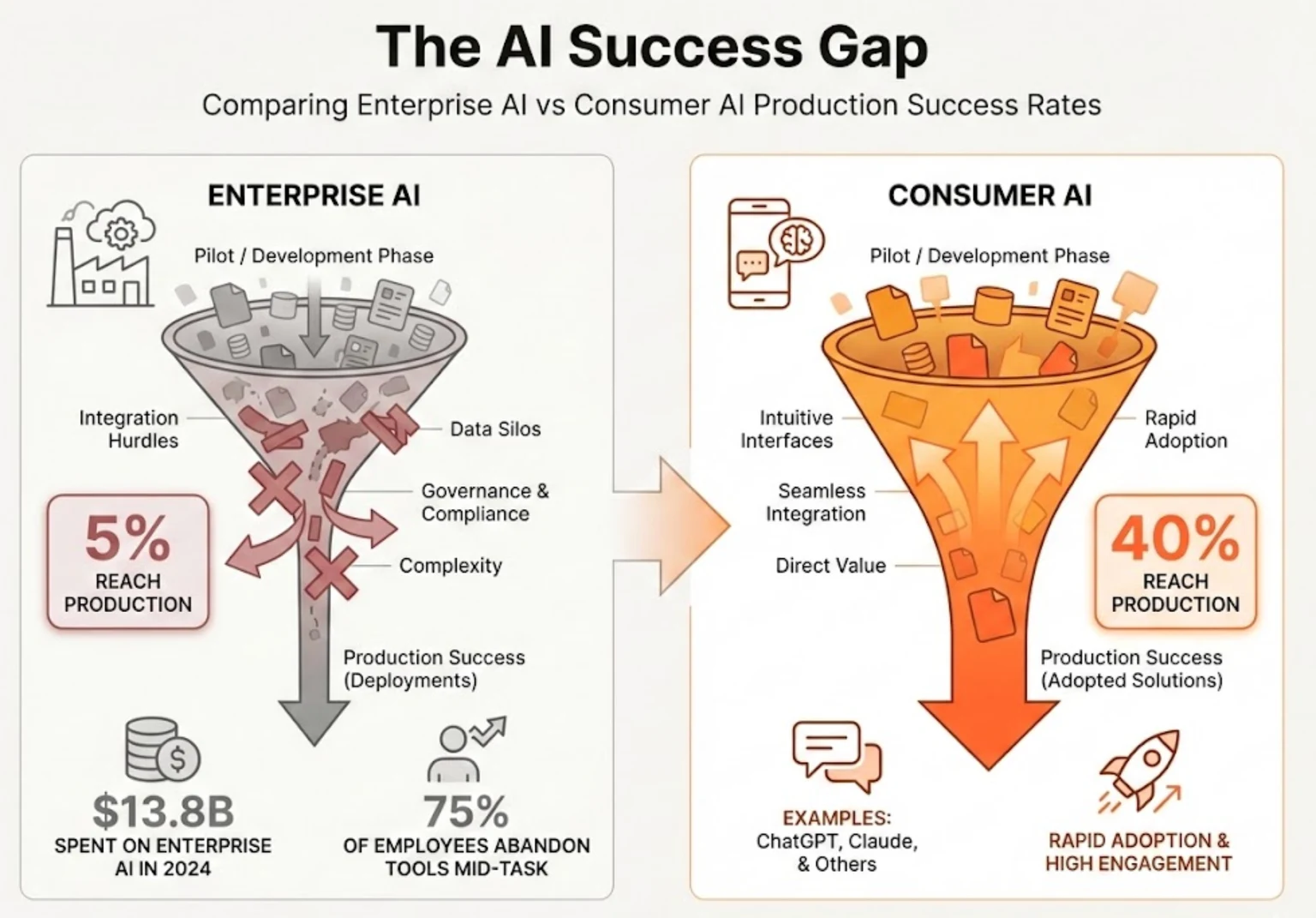
Enterprise AI initiatives reach production just 5% of the time. Consumer tools like ChatGPT and Claude? They hit 40%. That's not a gap — it's a chasm. According to Fortune's analysis of the MIT study on generative AI adoption, despite 30to40 billion invested in enterprise AI, only 5% of organizations are seeing transformative returns.
The Menlo Ventures 2024 State of Generative AI report shows enterprise AI spending surged 6x to $13.8 billion last year. Companies are spending more than ever. And 95% of it goes nowhere.
Meanwhile, 75% of employees abandon enterprise AI tools mid-task, usually because the output isn't accurate enough to be useful. The tools exist. They're just not good enough.
So employees do what any rational person would do: they find something that works.
What Shadow AI Actually Looks Like
Shadow AI sounds sinister. It conjures images of rogue employees exfiltrating data to sketchy servers. The reality is far more mundane — and far more widespread.
It's the financial analyst under deadline pressure, using personal ChatGPT Plus to analyze confidential revenue projections because the approved tool can't handle the complexity. Fortune documented this exact scenario at a technology company preparing for an IPO — the security dashboard showed "ChatGPT – Approved" while analysts were using personal accounts for sensitive work.
It's the emergency physician entering patient symptoms into an embedded AI to accelerate diagnoses, not realizing the tool isn't covered under HIPAA business associate agreements.
It's the consultant at 3am, racing to finish a client deck, who knows the enterprise Copilot will give generic output while Claude will actually understand the nuance.
These aren't security breaches by careless employees. They're productivity solutions by desperate ones. According to IBM's research, 98% of organizations now report unsanctioned AI use. When nearly everyone is breaking the rules, maybe the rules are the problem.
Why Enterprise AI Fails Where Consumer AI Succeeds
The technology isn't the issue. OpenAI's models power both ChatGPT and many enterprise solutions. The difference is everything wrapped around them.
That gap is closely related to the enterprise AI proficiency problem: access is not the same thing as capability.
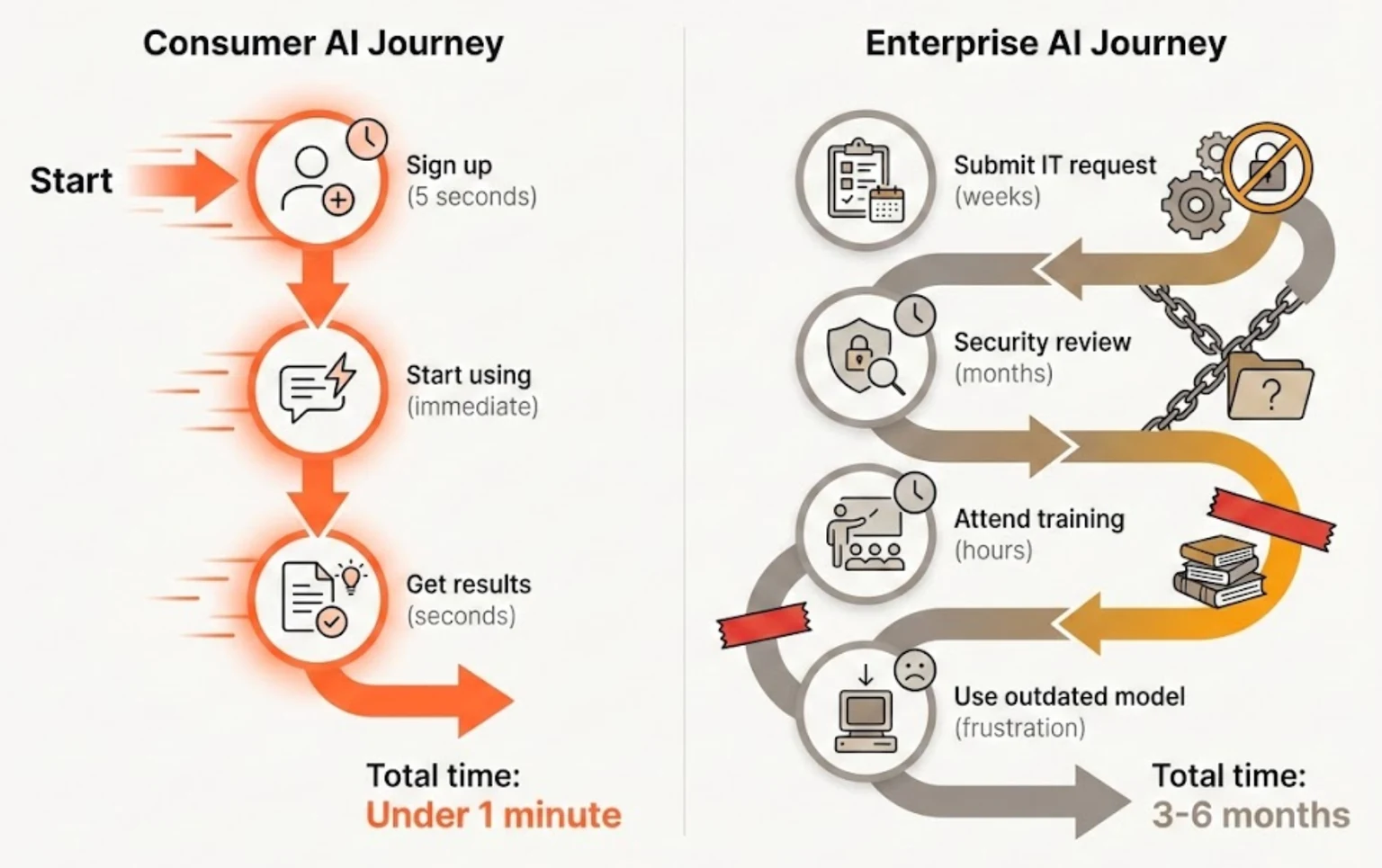
Consumer AI: Sign up, start using it immediately, get results in seconds.
Enterprise AI: Submit a request to IT, wait for security review, attend training sessions, use a version frozen to a model from six months ago, work within guardrails designed for the lowest-common-denominator use case.
As Cormac Whelan, CEO at Nitro, told CIO Dive: "If your competitors are using AI to accelerate content production right now, waiting for the approved stack means losing ground every day."
Executives understand this. They've done the math. And they've concluded that asking for forgiveness beats explaining why they sat on the sidelines waiting for compliance.
The Dialpad C-Suite Report found that only 19% of executives report revenue increases greater than 5% from enterprise AI investments. Another 36% see zero change. When your official tools produce nothing, using unofficial ones isn't rebellion — it's survival.
The Security Paradox
Here's where it gets uncomfortable.
Shadow AI is genuinely risky. Cyberhaven's research shows that 27.4% of data employees enter into AI tools is now sensitive — up from 10.7% just a year ago. That's a 3x increase in exposure. IBM's 2025 Cost of Data Breach report found that AI-associated breaches cost organizations $670,000 more on average than standard incidents.
And yet, 63% of organizations lack AI governance policies entirely, according to ISACA. They can't even measure the risk they're supposedly managing.
This creates a paradox. Blocking AI entirely means losing competitive ground daily. Allowing it without governance means accepting unknown exposure. And pretending it isn't happening — which is what most companies do — means getting the worst of both worlds.
The uncomfortable truth: your employees will use AI. The only question is whether IT knows about it.
What Forward-Thinking Companies Are Doing
The solution isn't stricter enforcement. It's enablement.
Some organizations are implementing BYOAI (Bring Your Own AI) policies that bring shadow usage into the light. Instead of pretending employees don't have personal subscriptions, they create frameworks for using them safely — with data classification guidelines, approved use cases, and clear boundaries.
Others are building AI governance boards that actually move at business speed. Not six-month approval cycles, but rapid evaluation processes that can greenlight new tools in weeks, not quarters.
The smartest companies are measuring what matters: actual productivity gains, not compliance checkboxes. They're asking whether the approved stack actually helps people do their jobs, not just whether it satisfies the security questionnaire.
Because here's the thing: "approved" means nothing if nobody uses it. A perfectly governed AI tool that sits unused while employees sneak off to ChatGPT is worse than no tool at all. At least with no tool, you don't have a false sense of security.
The $8.1 Billion Wake-Up Call
The shadow AI economy isn't rebellion. It's a market signal.
When Fortune reports that workers at 90% of companies use personal AI accounts while only 40% of companies have official subscriptions, that's not a compliance failure. It's a product failure. Your employees are telling you, with their wallets and their browser history, that the official tools don't work.
When 68% of your executives break their own rules, the rules are wrong. When 75% of employees abandon your approved tools mid-task, the tools are wrong. When you're spending $13.8 billion industry-wide on solutions with a 5% success rate, something is deeply, structurally broken.
The companies that win won't be the ones with the tightest AI policies. They'll be the ones who treat shadow AI as a feature request, not a security incident. Who ask "why are people going around our tools?" instead of "how do we stop them?"
Your employees have already made their choice. The question is whether you'll help them do it safely — or keep pretending it isn't happening while $8.1 billion flows through the shadows.
Continue Reading
AI Strategy10 min read
We Looked Into the Markdown-for-AI Theory. The Data Wasn't Kind.
Publishing Markdown mirrors of your web pages for AI search visibility is a waste of time. Here's why AI crawlers stick to HTML, and what you should focus on instead.
Rosh Jayawardena
AI Strategy12 min read
The 3% Problem: The AI Literacy Gap Hiding Behind Your Adoption Dashboard
Your AI adoption dashboard says 73%. Your team's output says otherwise. The enterprise AI problem has shifted from access to proficiency, and the gap is wider than most leaders think.
Rosh Jayawardena
AI Strategy9 min read
I Gave the Same 15 Sources to Three Different AI Models. They Found Completely Different Things
Different AI models find different things in the same documents. Here's what the research actually shows, and why model choice is a research methodology decision, not a feature checkbox.
Rosh Jayawardena
Deep dives, delivered weekly
AI patterns, workflow tips, and lessons from the field. No spam, just signal.