
Back to Blogs
RAG vs. Long Context Windows: A Decision Framework for Research Workflows
9 min readDec 28, 2025
Engineering

Rosh JayawardenaData & AI Executive
Long context windows are getting massive—but that doesn't mean RAG is dead. Here's when each approach actually works, with real numbers.
Every time a model announces a bigger context window, someone on Twitter declares RAG dead.
Gemini hits 2 million tokens. "RAG is obsolete." Claude extends to 1 million. "Why would anyone chunk documents anymore?" GPT-4o reaches 128k. "Just stuff it all in."
I get the appeal. Context windows have grown from 4k to 2 million tokens in two years. The fantasy of dumping your entire knowledge base into a single prompt and asking questions is seductive. No chunking strategy. No embedding pipeline. No retrieval tuning. Just... paste and ask.
But the people actually building production systems know it's more nuanced. There's a reason enterprises are still investing heavily in RAG infrastructure even as context windows balloon. And it's not because they haven't heard the good news about long context.
Here's what the benchmarks actually show, what it costs, and a practical framework for choosing the right approach.
The Seductive Promise of Long Context
Let's be fair to long context first. It's genuinely powerful for certain use cases.
The numbers are impressive: Gemini 2.0 offers 2 million tokens. Claude recently jumped from 200k to 1 million. GPT-4o sits at 128k. That's enough to fit entire codebases, legal contracts, or research paper collections into a single conversation.
And for certain tasks, long context actually outperforms RAG. Research from SuperAnnotate shows that long-context models slightly edge out RAG on multi-hop reasoning—questions that require connecting information scattered across multiple documents. When you need to cross-reference, synthesize, or trace relationships through a large corpus, having everything in context helps.
The architecture is simpler too. No retrieval pipeline to maintain. No embedding infrastructure. No debates about chunk size or overlap. For static, pre-curated document sets that rarely change, you can preload critical knowledge and get low-latency responses.
So why isn't everyone just using long context?
Because there's a catch. Several, actually.
Where Long Context Breaks Down
The "Lost in the Middle" Problem
A Stanford and UC Berkeley study published in Transactions of the Association for Computational Linguistics documented something uncomfortable: language models perform best when relevant information sits at the beginning or end of the context window. Accuracy significantly degrades when the answer is buried in the middle.
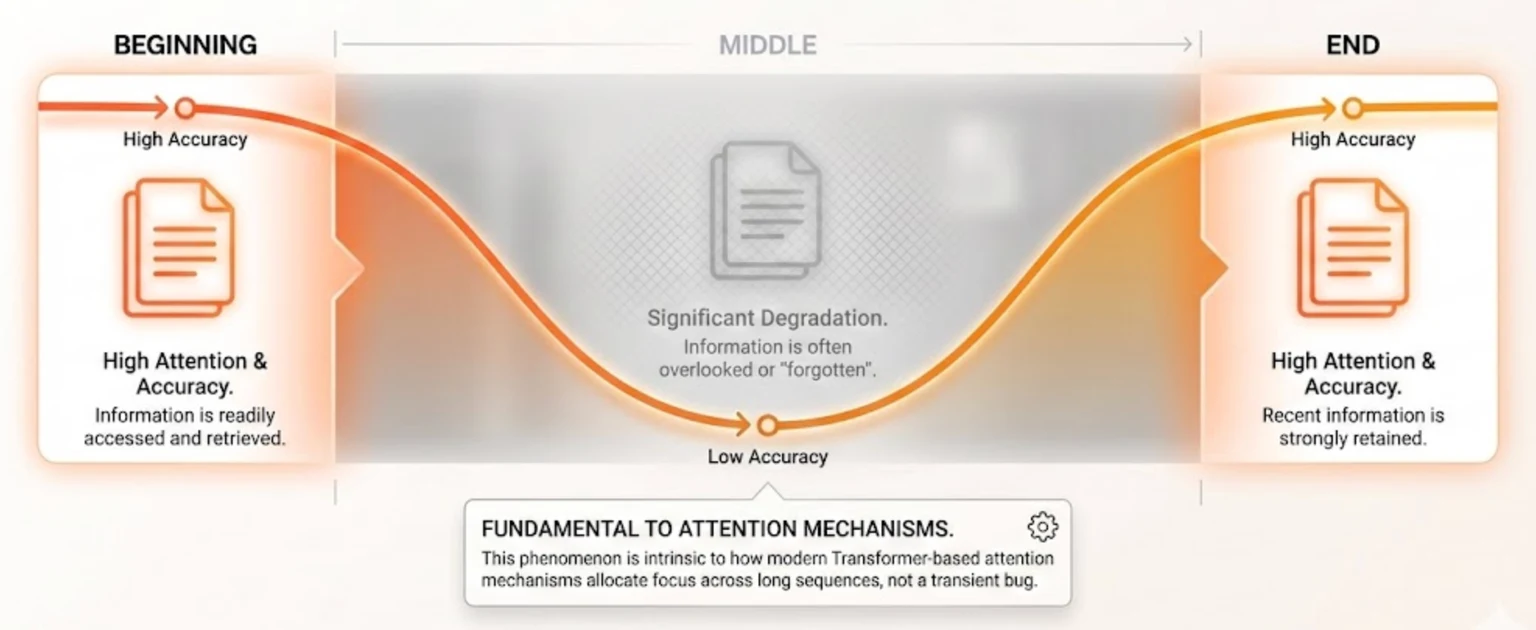
This isn't a bug being patched. It's fundamental to how attention mechanisms work with rotary positional encoding. Models disproportionately favor initial and recent tokens. The further information is from these positions, the less reliably the model can use it.
The implication: stuffing 2 million tokens into context doesn't mean the model can reason over 2 million tokens effectively.
Models Break Earlier Than Advertised
Research from AIMultiple found that most models break "much earlier than advertised." A model claiming 200k tokens typically becomes unreliable around 130k, with sudden performance drops rather than gradual degradation.
Even with perfect retrieval—scenarios where the model could theoretically find the right information—sheer context volume degrades problem-solving ability. A 2025 paper demonstrated that even when models can perfectly retrieve evidence, the abundance of distracting context hurts their ability to apply that evidence.
The capability to ingest 10 million tokens does not guarantee the ability to reason over them.
The Cost Problem
Here's where it gets practical.
Using Claude's full context on a book-length document like "A Tale of Two Cities" costs roughly $3. The same query via RAG? About $0.03.
That's a 100x cost difference.
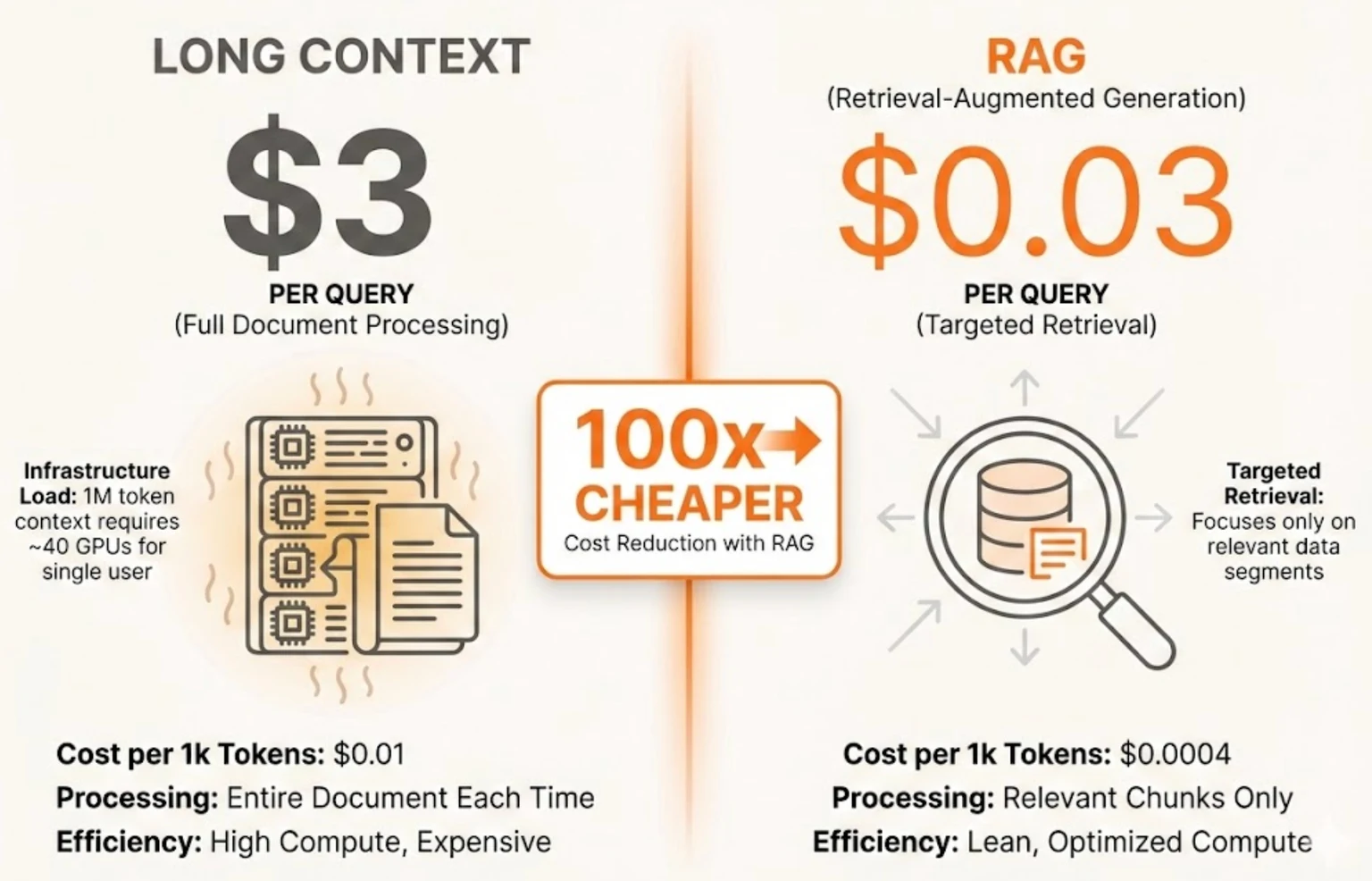
At enterprise scale, this compounds fast. CopilotKit's analysis found RAG costs roughly 0.0004 per 1 k tokens versus GPT−4−Turbo′s 0.01 per 1k tokens. And if you're processing a 1-million token context window? LegionIntel estimates you'd need approximately 40 A10 GPUs for a single user.
For high-frequency queries—think research assistants, customer support, documentation search—relying on massive context windows is economically unviable.
Where RAG Wins
RAG isn't legacy technology. It solves real problems that long context can't.
Cost Efficiency
Pinecone's research showed that RAG preserved 95% of original accuracy while using only 25% of the tokens—a 75% cost reduction with marginal quality drop.
A query requiring 100,000 tokens in full context can often be distilled to 1,000 task-specific tokens. That slashes input size, latency, and cost dramatically.
Dynamic Data
Long context requires re-processing your entire corpus when documents change. RAG updates incrementally. Change one document, update one embedding. The rest of your knowledge base stays indexed and ready.
For documentation, knowledge bases, or any corpus that evolves—which is most real-world use cases—this matters.
Debugging and Transparency
When a RAG query goes wrong, you can see exactly what was retrieved. You can inspect the chunks, check the similarity scores, and trace the reasoning. It's an open book.
Long context is a black box. When the model hallucinates or misses something, good luck debugging which of your 200k tokens caused the problem.
For regulated industries, legal work, or financial analysis where you need to cite sources and explain reasoning, this transparency isn't optional.
Scale
Databricks' benchmarks found that RAG performance stays nearly constant from 2k to 2 million tokens. Long-context models show sharp accuracy drops as context grows.
RAG scales to trillions of tokens via vector databases. That's not a theoretical number—it's production reality for companies indexing massive document collections.
Consider the math: a standard annual financial report is 300-400 pages. With long context, you can fit maybe 10 of those. Great for a demo. Useless for a production financial research product.
Honest caveat: RAG adds complexity. Chunking strategy, embedding choice, retrieval quality, reranking—none of this is free. But for production systems at scale, that complexity pays off.
The Decision Framework
Here's how to actually decide.
| Scenario | Long Context | RAG |
|---|---|---|
| Small, static document set (< 50k tokens) | ✓ | |
| Cross-document reasoning and synthesis | ✓ | |
| Documents change frequently | ✓ | |
| Cost is a constraint | ✓ | |
| Need to cite specific sources | ✓ | |
| Production scale (1000s of users) | ✓ | |
| One-off deep analysis task | ✓ | |
| Building a product | ✓ |
A 2024 study found that 60% of queries produce identical results with both approaches. For that majority, use RAG—it's cheaper. Reserve long context for the 40% where cross-referencing and complex reasoning actually matter.
The Hybrid Future
The real story of 2025 isn't RAG vs. long context. It's both, used strategically.
GraphRAG from Microsoft builds entity-relationship graphs from your documents, enabling theme-level queries like "What are the compliance risks across all our vendor contracts?" with full traceability.
LongRAG processes entire document sections instead of fragmenting into 100-word chunks, reducing context loss by 35% in document analysis.
Self-RAG trains models to decide when to retrieve and when to reason from existing context—boosting factuality and citation accuracy.
Routing architectures are emerging that send simple queries to RAG (cheaper, faster) and complex queries to long-context processing (better synthesis).
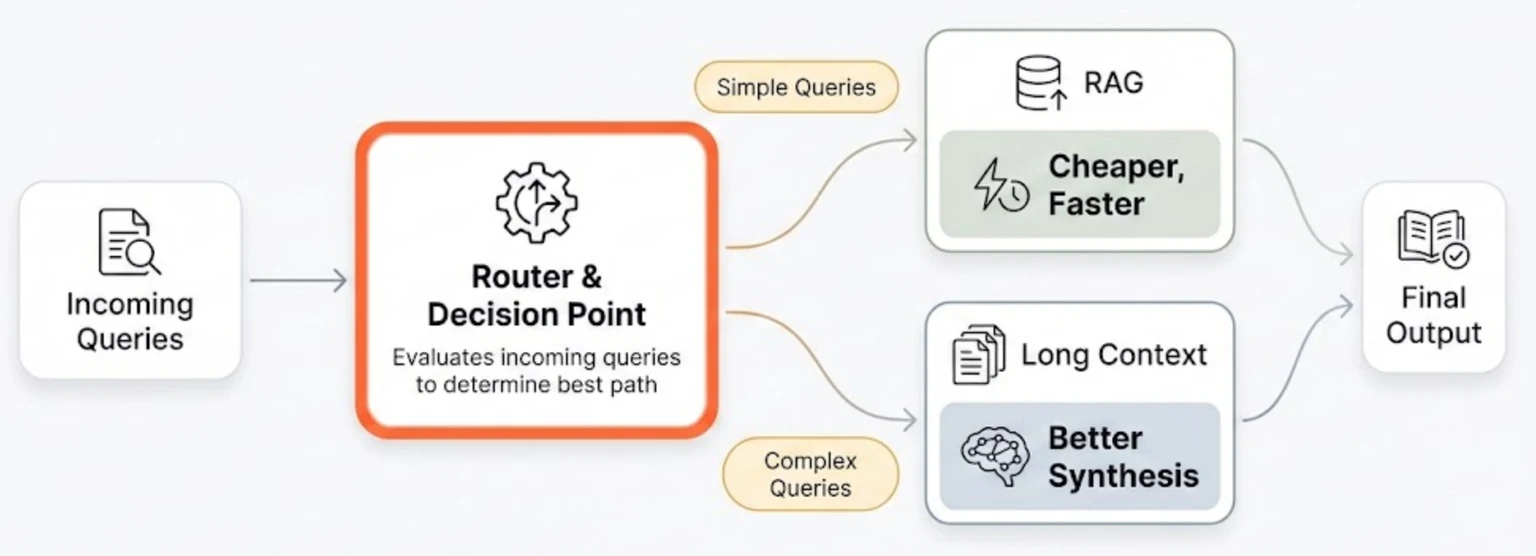
The tools are getting smarter about combining both approaches. Instead of choosing one, build systems that use both: RAG for the heavy lifting, long context for synthesis.
The Bottom Line
Context windows are growing, but that doesn't make RAG obsolete.
The question isn't "which is better?" It's "which is better for this specific task?"
For most research workflows: start with RAG. It's cheaper, more transparent, and scales. Reserve long context for cross-document synthesis and complex reasoning where having everything visible matters. And watch the hybrid approaches—that's where things are heading.
The engineers winning with AI aren't picking sides in the RAG vs. long context debate. They're using both, strategically.
Continue Reading
Engineering8 min read
Gaslighting Your AI Into Better Results: What the Research Actually Shows
A Reddit post about telling Claude you work at a hospital went viral. Turns out there's actual research explaining why this works across all LLMs.
Rosh Jayawardena
Engineering8 min read
Microsoft Is So Worried About Claude Code, They're Testing It Against Copilot
Microsoft just told thousands of engineers to install Claude Code and compare it to Copilot. When you're running internal benchmarks against a competitor, you're not confident you're winning.
Rosh Jayawardena
Engineering12 min read
The Complete Guide to RAG Chunking: 6 Strategies with Code
How you split your documents determines whether RAG finds what you need or returns noise. Here's the complete breakdown with code.
Rosh Jayawardena
Deep dives, delivered weekly
AI patterns, workflow tips, and lessons from the field. No spam, just signal.